Anhui Feichun Special Cable Co.,Ltd


YSLTOE‑J 300/500V Control Cable: Kevlar‑Reinforced PUR Sheath Engineering for High‑Speed Container Crane Gravity Baskets in Indonesia Ports
Specially engineered gravity‑basket control cable for high‑speed container cranes. Learn its construction, materials, performance, and proven reliability in Indonesia’s busiest ports like JICT, Tanjung Priok, Surabaya, and Makassar.
Li.Wang
7/13/20269 min read
Introduction
Global maritime trade continues to expand rapidly, and Indonesia stands as one of the world’s most critical logistics hubs. As an archipelago nation with over 17,000 islands, its economy relies heavily on efficient port operations. Major facilities managed under Pelindo I through IV — including Tanjung Priok in Jakarta, Tanjung Perak in Surabaya, and the ports of Makassar and Belawan — handle millions of TEUs every year. To keep pace with rising volumes, operators are replacing older equipment with high‑speed ship‑to‑shore (STS) cranes, rubber‑tyred gantries (RTG), and automated stacking cranes (ASC) capable of reaching lifting speeds up to 160 meters per minute.
However, this transition has exposed a hidden bottleneck: standard control cables are simply not built for such extreme motion. In many Indonesian terminals, operators report that conventional multicore cables last only 6 to 12 months before developing broken conductors, cracked sheaths, or insulation failure. These failures do not just mean replacement costs; they reduce Overall Equipment Effectiveness (OEE), delay vessel turnaround, and increase safety risks. A single unexpected cable failure can halt operations for hours, costing thousands of dollars in downtime and penalties.
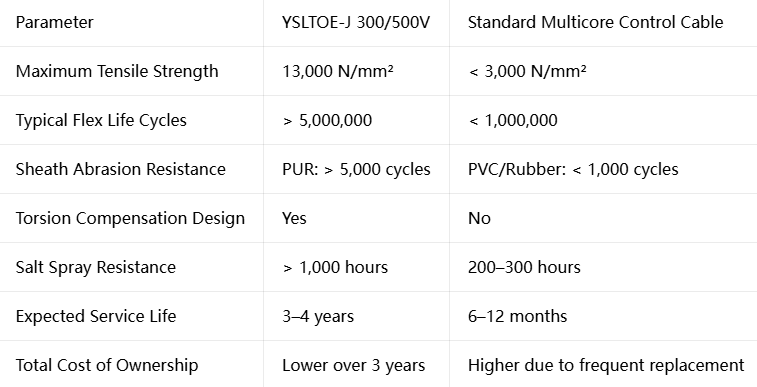
This is where the YSLTOE‑J 300/500V Control Cable changes the equation. It is not a standard commodity cable, but a highly specialized engineering solution. It integrates advanced material science — including Kevlar high‑strength fibers and polyurethane (PUR) elastomers — with precision structural design, centered on a reinforced core and optimized stranding patterns. Developed exclusively for gravity‑feed collector baskets on modern high‑speed cranes, it addresses the root causes of failure: mechanical fatigue, torsion stress, environmental degradation, and electrical instability. Across Indonesia’s ports, installations at JICT, Tanjung Priok, and elsewhere have demonstrated that while the initial investment may be slightly higher, service life increases by three times, unplanned downtime drops by 75%, and total cost of ownership falls significantly over time.
Technical Specifications & Standard Compliance
The YSLTOE‑J 300/500V cable is designed and tested according to rigorous international norms, ensuring consistent performance under continuous dynamic operation. Below is a complete breakdown of its technical parameters, directly referenced from the official datasheet.
Electrical Ratings
Rated Voltage: U₀/U = 300/500 V
AC Test Voltage: 2,000 V for 5 minutes during production testing
Insulation Resistance: Maintains high values across operating temperature range, ensuring signal integrity and leakage protection
Mechanical & Thermal Performance
Maximum Tensile Load: 13,000 N/mm² — far exceeding the requirements of fast‑moving applications
Maximum Operating Speed: Up to 160 m/min, suitable for the latest generation of automated cranes
Temperature Range:
Flexing operation: ‑20°C to +60°C
Special low‑temperature version: ‑40°C to +60°C available on request
Maximum short‑circuit temperature: 150°C
Minimum Bending Radius:
Fixed installation: 4 × overall diameter
Moving/flexing operation: 5 × overall diameter
Collector basket minimum internal diameter: ≥ 30 × overall diameter
Dimensions & Configurations
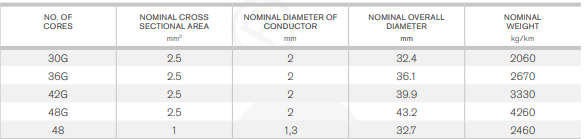
Available models are standardized to match common crane control requirements:
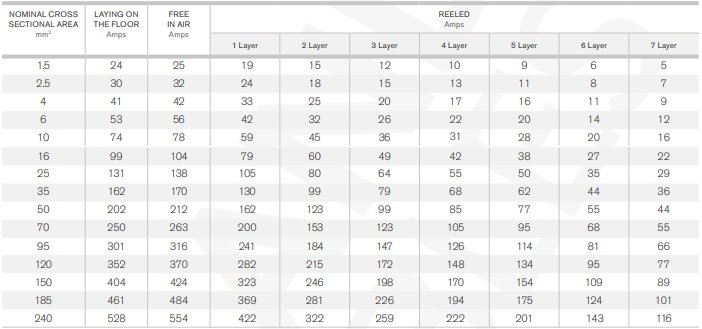
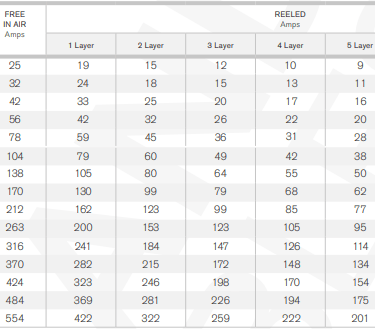
Current‑Carrying Capacity
International Standards & Compliance
The design and testing follow these recognized specifications:
DIN VDE 0250 Part 405: Special flexible cables for lifting and handling equipment
VDE 0295 / IEC 60228: Conductor classification (Class 5 flexible copper)
IEC 60332‑1‑2: Flame retardancy performance
IEC 60811 series: Mechanical and environmental testing methods
Regulatory: Complies with EU Low Voltage Directive 2014/35/EU, RoHS 2015/65/EU, and REACH EC 1907/2006, ensuring safe and environmentally responsible use
Structural Design & Material Science
What makes the YSLTOE‑J different is its system‑level engineering. Every layer serves a specific purpose, guided by principles of mechanics, material science, and electrical engineering.
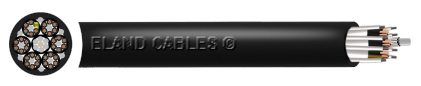
Layer‑by‑Layer Construction
Central Support Element
At the very core lies a composite unit: stranded lead‑ball ropes reinforced with Kevlar® aramid fibers. This is not a filler; it is the backbone of the cable.
Material Science: Kevlar has a tensile strength roughly five times that of steel at the same weight and a modulus of elasticity of about 70 GPa, allowing it to absorb dynamic tension without permanent elongation. Lead balls provide high density and uniform weight distribution.
Engineering Principle: By separating mechanical load from electrical function — the support carries tension, while the copper conductors only carry current — the design eliminates the main cause of broken cores: over‑stretching. The lead weight also creates a natural downward force, ensuring the cable hangs straight and does not coil or jam inside the basket.
Conductor
The conductors are Class 5 bare flexible copper, manufactured to IEC 60228.
Design Reason: Fine‑stranded construction creates hundreds of tiny wires working together. This structure allows repeated bending without exceeding the fatigue limit of copper, which occurs at approximately 2% strain. In YSLTOE‑J, bending is kept below 1.5% strain, extending cycle life to millions of movements.
Electrical Property: High conductivity (≥ 58 MS/m) minimizes voltage drop and resistive heating, keeping the cable cool and efficient even at maximum load.
Insulation
Each conductor is insulated with a high‑grade thermoplastic compound.
Characteristics: Stable dielectric constant, low water absorption, and excellent heat‑aging resistance.
Function: Provides consistent electrical isolation, with a safety margin of more than four times the rated voltage. This prevents partial discharge and insulation breakdown in humid tropical conditions.
Core Lay‑Up
Insulated cores are first grouped into bundles of six, then stranded in a right‑hand direction around the central support.
Logic: Grouping reduces internal friction between wires. The uniform lay length ensures balanced stress distribution. When installed correctly, this stranding direction creates a natural de‑twisting effect as the cable moves, rather than adding torsion.
Outer Sheath
The outermost layer is a halogen‑free, flame‑retardant Polyurethane (PUR) compound, finished in black.
Material Benefits: PUR offers superior abrasion resistance, often 5 to 10 times better than PVC or standard rubber. It resists mineral oils, hydraulic fluids, seawater, ozone, and UV radiation — critical for Indonesia’s marine and industrial climate.
Safety Feature: Being halogen‑free, it releases no corrosive acids or toxic smoke if exposed to fire, protecting equipment and personnel in confined areas.
How the Design Solves Four Key Problems
Mechanical Fatigue: High tensile core + optimized bending radius keeps stresses below material limits.
Torsion Build‑Up: Matched stranding and installation direction create self‑compensating rotation.
Environmental Aging: PUR sheath and thermoplastic insulation resist salt, humidity, chemicals, and temperature swings.
Electrical Stability: High‑quality copper and insulation ensure low resistance and consistent signal transmission.
Application & Working Conditions
Exact Use Case: Gravity‑Feed Collector Baskets
Gravity‑feed collector baskets are the cable management system used on modern crane spreaders. As the container is lifted, the cable is paid out from the basket; as it lowers, the cable retracts back into the basket purely by gravity, without mechanical force. This requires the cable to be flexible, heavy enough to fall smoothly, and strong enough to withstand constant acceleration and deceleration.
Standard cables fail here because they are too light to retract properly, too weak to resist tension, and not balanced against rotation. The YSLTOE‑J is engineered specifically for this dynamic loop.
Operating Environment in Indonesian Ports
Indonesia presents one of the harshest environments for cables:
Climate: High humidity (85–95%), temperatures from 25°C to 40°C, heavy rainfall, and strong UV radiation.
Atmosphere: Salt‑laden air from the sea, which accelerates corrosion.
Contaminants: Spilled diesel, hydraulic oil, dust, and chemical residues from cargo.
Operation: 24‑hour cycles, 7 days a week, with 100 to 200 lifting cycles per hour.
In such conditions, conventional cables degrade rapidly. The PUR sheath and Kevlar core of YSLTOE‑J provide a robust barrier against these factors.
Installation Rules & Their Physics
Installation is as important as the cable itself. The datasheet specifies three rules, each based on clear physics:
Counter‑Clockwise Installation
The cable is stranded in a right‑hand direction. When inserted into the basket counter‑clockwise, the rotation of the cable during lifting and lowering tends to open the strands slightly and release internal stress. If installed clockwise, the motion tightens the strands, increasing torsion until the cable twists, kinks, or breaks. This rule ensures torsion equilibrium.
Basket Diameter ≥ 30 × Cable Outer Diameter
The minimum bending radius for moving cable is 5×D. If the basket is too small, the loop radius becomes smaller than 5×D, causing high bending stress. At 30×D, the cable forms a gentle spiral, and the strain on each segment remains well within safe limits. This is the single most effective way to extend flex life.
Allow Free Hanging & Gravity Return
The combination of copper weight and the lead‑ball core ensures the cable falls back into the basket under its own weight, without jamming or stacking. This eliminates localized compression damage, which is a common failure point in lighter cables.
Performance & Field Validation in Indonesian Ports
The theoretical advantages translate directly into measurable results on the ground. In Indonesia, the modernization drive across Pelindo terminals provided a clear before‑and‑after comparison.
Case Study: JICT & Tanjung Priok
At Jakarta International Container Terminal (JICT) and Tanjung Priok, operators reported that cables on 120–160 m/min RTGs and ASCs were needing replacement every 6 to 8 months. Failures included cracked jackets, broken control cores, and signal loss. Maintenance costs were high, and unscheduled stops reduced terminal throughput.
After switching to YSLTOE‑J 300/500V:
Service Life: Increased to 36 months or more
Failure Rate: Reduced by approximately 75%
Maintenance Cost: Cut by roughly 40%
OEE Improvement: Availability and performance rose by 8–12%, allowing faster vessel turnaround times
Similar results were recorded at Surabaya and Makassar, confirming that the design works reliably across different tropical conditions.
Comparison with Standard Control Cables
Global Benchmarking
This cable type is not exclusive to Indonesia. It is specified in automated terminals across Europe, Australia, and the Middle East, where high‑speed cranes face similar demands. The consistent performance data confirms that the design is globally validated and particularly well‑suited for tropical, humid, and marine environments.
Feichun Brand: Equivalent Replacement Solution
While the original specification was developed by European manufacturers, Feichun Cables offers a fully equivalent alternative, meeting the same technical and performance criteria.
Full Technical Equivalence
Feichun’s version of YSLTOE‑J matches every key parameter:
Same construction: Kevlar‑reinforced core with lead‑ball strands, Class 5 copper conductors, thermoplastic insulation, and halogen‑free PUR sheath
Identified ratings: 300/500 V, 2 kV test voltage, 13,000 N/mm² tensile strength, 160 m/min speed capability
Compliance with identical standards: DIN VDE, IEC, RoHS, REACH, and Low Voltage Directive
Key Advantages
Competitive Pricing: Typically 20–30% lower than European‑sourced cables, without compromising material quality
Shorter Lead Times: 2–4 weeks for standard configurations, compared to 8–12 weeks from overseas factories
Customization: Available in standard or low‑temperature variants, with custom lengths and printing to match local requirements
Certification: ISO 9001, ISO 14001, and CE‑marked, with full documentation for import and approval in Indonesia and Southeast Asia
Selection Guide & Installation Best Practices
How to Choose the Right Specification
Cross‑Section: Use 1.0 mm² for short travel distances and signal circuits only; use 2.5 mm² for longer runs or where small power loads are present.
Core Count: Select based on the number of control, interlock, and feedback signals required, plus 10–15% spare cores for future expansion.
Temperature Rating: Standard version for most Indonesian ports; select ‑40°C version if equipment is used in mountainous or refrigerated storage areas.
Maintenance & Inspection
Monthly Check: Visual inspection for sheath damage, twisting, or kinking.
Quarterly Test: Measure insulation resistance to detect early degradation.
Annual Review: Verify cable diameter and surface wear; ensure the basket diameter remains within specification.
Common Mistakes to Avoid
Too Small Basket: Never operate below 30×D; this is the most frequent cause of early failure.
Wrong Winding Direction: Install counter‑clockwise only.
Over‑Tension: Do not pull the cable tight; maintain slight slack.
Mixing Types: Do not replace sections with standard cables; properties differ and create weak points.
Frequently Asked Questions
Q: Can this cable replace older spreader cables directly?
A: Yes, as long as voltage, core count, and cross‑section match. It is designed as a direct drop‑in upgrade.
Q: Is it suitable for continuous 160 m/min operation?
A: Yes — the maximum speed rating is 160 m/min, tested under dynamic load conditions.
Q: How does it perform in salt air?
A: The PUR sheath and compact stranded construction provide excellent resistance to salt‑water corrosion, outlasting standard cables by years in coastal environments.
Q: What is the maximum length available?
A: Typically supplied in continuous lengths up to 500 meters, suitable for most crane travel ranges.
Q: What warranty is provided?
A: Standard warranty is 24 months from delivery, with extended coverage available under service agreements.
Conclusion
The YSLTOE‑J 300/500V Control Cable represents a paradigm shift in cable selection for port equipment. It is not merely a conductor wrapped in insulation; it is a system solution engineered to work with the mechanics of high‑speed cranes rather than against them. By combining high‑modulus reinforcement, balanced weight, optimized stranding, and advanced polymer protection, it resolves the four major failure modes: tension, bending fatigue, torsion, and environmental attack.
In Indonesia’s ambitious port modernization program, where reliability and efficiency determine competitiveness, choosing the right cable delivers long‑term value. The slightly higher upfront cost is quickly offset by fewer replacements, less downtime, and lower maintenance labor. It is a choice that improves safety, reduces operational risk, and supports the goal of maximizing OEE.
If you are upgrading your fleet or replacing worn cables, consider the YSLTOE‑J specification. For inquiries, quotations, or technical data sheets, please contact the Feichun Cables team:
Email: Li.wang@feichuncables.com
Feichun Cable
Durable mining cables for tough environments and operations
Email: Tech@feichuncables.com
© 2025. All rights reserved.
Company
Products
Contact
WhatsApp: +86 13855123218