Anhui Feichun Special Cable Co.,Ltd


Why Do Mining Engineers Prefer BS 6708 Compliant PROTOMONT Type 62, 63, 64 SWA Flexible Trailing Cables for Mobile Equipment Power Supply in Demanding Underground Conditions?
Underground mining operations across Indonesia—from the coalfields of East Kalimantan to the nickel mines of Sulawesi and gold projects in Papua—face some of the harshest working environments on earth. High humidity, abrasive rock dust, oil and grease contamination, extreme temperature shifts, and the constant risk of explosive gas mixtures create severe challenges for power distribution systems. For decades, mining engineers have relied on BS 6708 compliant PROTOMONT Type 62, 63, and 64 flexible trailing cables with galvanized steel pliable wire armouring as the gold standard for powering mobile machinery, roadway extensions, and working face lighting. This article explores the engineering principles, material science, structural design, and performance characteristics that make these cables indispensable. It also includes real-world application cases from Indonesian mines, a detailed comparison with conventional cable solutions, an introduction to Feichun as an equivalent alternative, and practical guidance for selection and procurement.
Li Wang
6/15/202617 min read
Introduction
Mining is the backbone of Indonesia’s resource-based economy, with vast reserves of coal, nickel, bauxite, copper, and gold spread across its archipelago. As operations move deeper underground—often reaching depths of 300 to 800 meters—conditions become progressively more severe. In these environments, electrical power cables are not merely passive components; they are critical infrastructure that must perform reliably under mechanical stress, chemical exposure, and thermal variation, while adhering to strict safety regulations designed to prevent fire, explosion, or electrical failure.
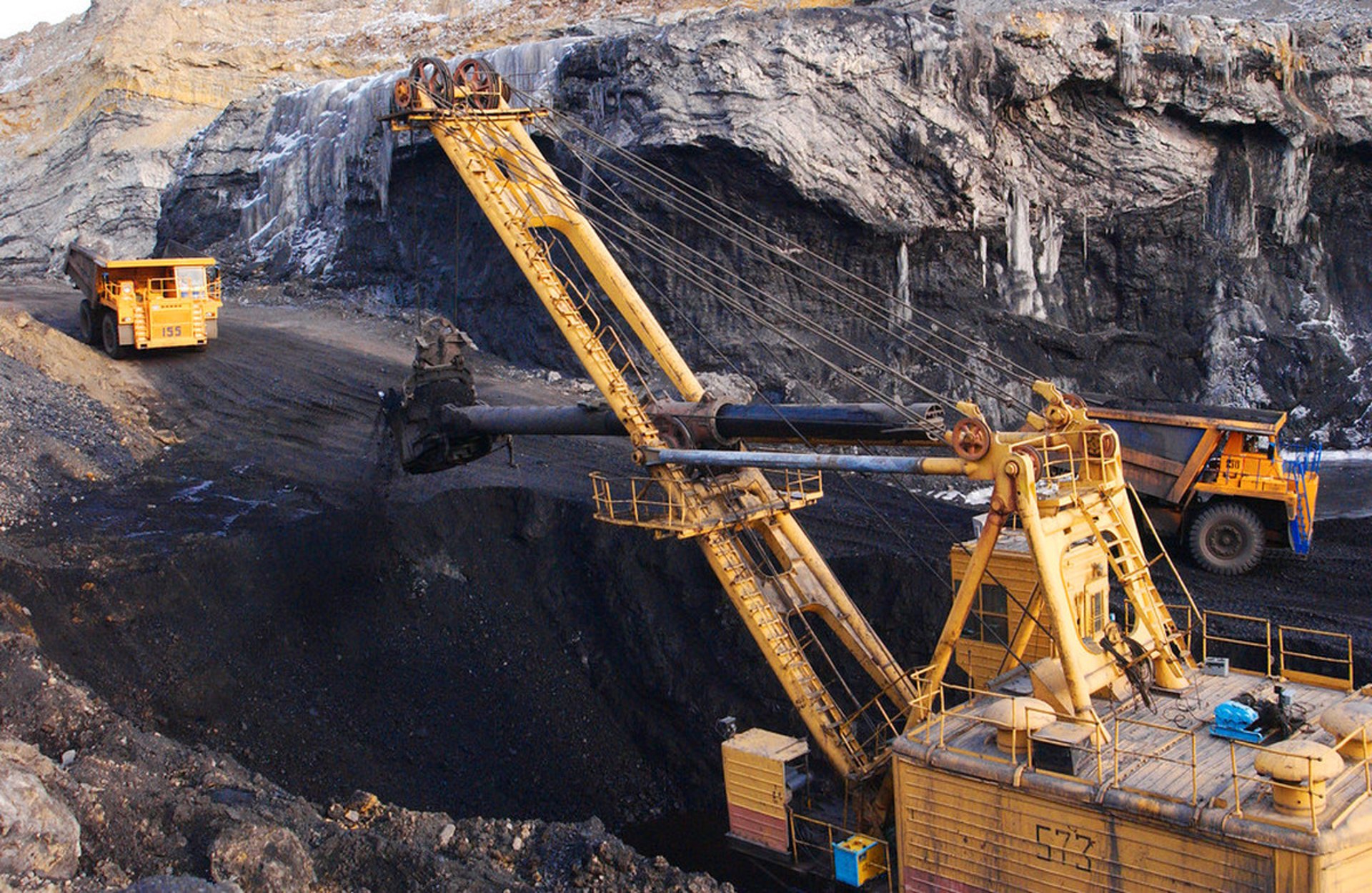
A common challenge faced by mine operators in Indonesia is the rapid failure of standard rubber-sheathed cables. These products are typically designed for light industrial use and cannot withstand the repeated dragging, bending, crushing, and abrasion that occurs when powering load-haul-dump units, continuous miners, conveyors, and lighting systems. In many coal mines in East Kalimantan, for example, operators reported that ordinary flexible cables required replacement every two to three months. The associated costs—including material expenses, labor for installation, and production downtime—ran into billions of Indonesian Rupiah annually. More critically, premature failure creates safety hazards, including exposed conductors, electrical arcing, and potential ignition of methane or coal dust, which are ever-present risks in underground coal mining.
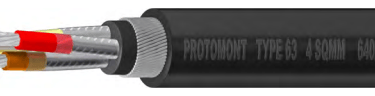
It was to solve these exact problems that the PROTOMONT Type 62, 63, and 64 series was developed. Manufactured to British Standard 6708, these flexible trailing cables are not simply upgraded versions of standard cables. They are system-engineered products, designed from the conductor core to the outer sheath by integrating advanced material science, electrical engineering theory, mechanical design principles, and international explosion-proof safety norms. Every layer of construction is optimized to satisfy four essential requirements: the ability to move and flex repeatedly, robust mechanical protection, resistance to aggressive environmental conditions, and compliance with rigorous safety standards. This article breaks down the technology behind these cables, explains why they outperform all conventional alternatives, and shows how they have become the preferred choice for mining engineers throughout Indonesia and Southeast Asia.
Standard and Technical Foundation
Understanding BS 6708: The Global Benchmark for Mining Cables
At the heart of the PROTOMONT Type 62, 63, and 64 design is BS 6708, the British Standard specification for flexible cables intended for use in mines and quarries. First published in 1986 and updated in 1998, this standard has become one of the most widely recognized technical specifications in the global mining industry, adopted not only in the United Kingdom but also across Europe, Australia, Africa, and Southeast Asia, including Indonesia. The standard defines mandatory requirements for construction, materials, dimensions, electrical performance, mechanical strength, and resistance to environmental factors. Compliance with BS 6708 is often a prerequisite for approval by mining safety authorities, including Indonesia’s Ministry of Energy and Mineral Resources (ESDM), as it guarantees that the cable has been designed and tested to operate safely in high-risk underground environments.
The standard also references complementary standards that govern specific aspects of the cable’s design:
BS 6360: Defines the requirements for conductors, including the classification of flexible, finely stranded copper conductors (Class 5) used in these cables.
BS 7655: Specifies the color coding for insulation, ensuring clear identification of power cores and protective earth conductors, which is vital for safe installation and maintenance.
IEC 60332-1-2: Establishes the test method for resistance to fire, confirming that the cable is self-extinguishing and will not propagate flame.
EN 60811-404: Outlines the procedures for testing resistance to mineral oil, a key performance requirement where machinery lubricants and hydraulic fluids are present.
DIN VDE 0298 Part 3: Provides guidelines for minimum bending radii, ensuring that the cable can be handled and moved without damage during operation.
By adhering to this comprehensive set of standards, PROTOMONT cables ensure interoperability, safety, and performance consistency, regardless of where they are deployed.
Core Technical Specifications
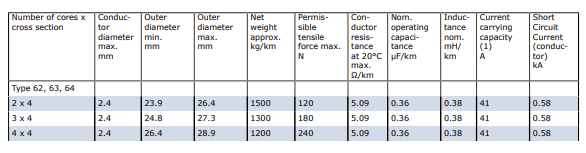
All three types within the PROTOMONT range share the same fundamental technical parameters, differing only in the number of power cores and color coding. These specifications are derived directly from the official product documentation and are verified through rigorous testing:
Electrical Parameters
Rated Voltage: 0.7/1.2 kV (640/1100 V), suitable for low-voltage power distribution in underground mines.
Maximum Permissible Operating Voltage: 640/1100 V AC; 0.9/1.8 kV DC.
AC Test Voltage: 3 kV, applied for 5 minutes during manufacturing to ensure insulation integrity.
Conductor Resistance: Maximum 5.09 Ω/km at 20°C for 4 mm² cross-section, ensuring efficient power transmission and low heat generation.
Capacitance: Nominal 0.36 µF/km.
Inductance: Nominal 0.38 mH/km.
Current Carrying Capacity: 41 A for 4 mm² conductors, sufficient for most mobile equipment and lighting circuits.
Short-Circuit Performance: Maximum short-circuit current of 0.58 kA, with a maximum conductor temperature of 250°C for up to 5 seconds, ensuring safety during fault conditions.
Thermal Parameters
Maximum Conductor Operating Temperature: 90°C, allowing continuous operation under high load without degradation.
Ambient Temperature Range:
Fixed installation: -40°C to +80°C.
Fully flexible operation: -25°C to +60°C.
This wide range ensures suitability for tropical climates, high-altitude mines, and deep underground workings where temperatures can fluctuate significantly.
Mechanical Parameters
Maximum Permissible Tensile Load: 15 N/mm², meaning the cable can withstand significant pulling force during movement without damage to internal components.
Construction Dimensions (for 4 mm² core):
Conductor diameter: 2.4 mm maximum.
Overall diameter: 23.9 mm to 28.9 mm, depending on type.
Approximate weight: 1200 kg/km to 1500 kg/km.
Distinctions Between Type 62, Type 63, and Type 64
While performance and construction materials are identical, the three variants are designed to match different electrical system configurations:
Type 62: Features two power cores plus a protective earth conductor. Core colors are Brown and Blue, with the earth conductor identified by Green/Yellow insulation. This configuration is primarily used for single-phase circuits, including mine roadway lighting systems, auxiliary power supplies, and short-distance extensions where three-phase power is not required.
Type 63: Equipped with three power cores plus an earth conductor. Color coding follows Red, Brown, Blue for power cores and Green/Yellow for earth. This is the most common configuration in Indonesian mines, used extensively to power three-phase machinery such as pumps, small conveyors, and ventilation fans. It balances functionality with cost-effectiveness and is widely specified in project standards across Sumatra and Kalimantan.
Type 64: Includes four power cores plus an earth conductor, with colors Red, Yellow, Brown, and Blue. This design supports more complex circuits, including heavy-duty mobile equipment, multi-motor drives, and systems requiring a neutral conductor or additional control cores. It is the preferred choice for large-scale mining operations in Papua and Sulawesi where high-power machinery is used.
Selecting the correct type is straightforward: engineers simply match the core count to the phase requirement of the equipment or distribution network. All other performance characteristics remain consistent, simplifying inventory management and maintenance.
Structural Design and Material Science: Layer-by-Layer Engineering
The outstanding performance of PROTOMONT cables is not accidental. It is the result of a carefully engineered layered structure, where every component is selected and designed based on proven scientific principles. The following sections analyze each layer from the center outwards, explaining the design choices, materials used, and the engineering logic behind them.
Conductor: Flexibility and Corrosion Resistance
At the very center of every power core lies the finely-stranded tinned copper conductor, manufactured to Class 5 requirements defined in BS 6360. Unlike solid conductors or coarse-stranded designs found in building wiring, this conductor is made from dozens of ultra-fine copper wires twisted together in multiple layers.
Material Science and Engineering Principles:
Flexibility Through Geometry: The fundamental mechanical principle applied here is that bending stress is proportional to the distance from the neutral axis. By dividing the total cross-sectional area into many small strands, the stress experienced by each individual wire during bending is drastically reduced. This allows the cable to be flexed thousands of times without work hardening, fatigue, or breakage—a critical requirement for trailing cables that are moved daily.
Corrosion Protection via Electrochemistry: Each copper strand is coated with a thin layer of tin. This serves two purposes. First, tin acts as a barrier, preventing oxygen and moisture from reaching the copper surface. Second, tin is more electrochemically active than copper. If the coating is scratched or damaged, the tin acts as a sacrificial anode, corroding preferentially and protecting the underlying copper from oxidation. This is essential in underground environments where humidity is often above 90% and water may be acidic or saline.
Electrical Efficiency: High-purity electrolytic copper ensures high conductivity, while the tin coating maintains stable electrical contact over time, preventing the increase in resistance caused by tarnish or oxidation.
Insulation: Electrical Integrity and Thermal Stability
Surrounding each conductor is a thick layer of insulation made from PROTOLON, a proprietary compound based on Ethylene Propylene Rubber (EPR). This material is specifically formulated for electrical applications and is colored according to BS 7655 for easy identification.
Material Science and Engineering Principles:
Dielectric Performance: EPR is an excellent electrical insulator with a low dielectric constant (approximately 2.3) and very low dielectric loss factor. These properties mean that when voltage is applied, minimal energy is wasted as heat, and the material is highly resistant to electrical breakdown. The insulation is designed to withstand a continuous electric field strength of over 3 kV/mm, providing a substantial safety margin above the operating voltage of 1.2 kV.
Thermal and Chemical Stability: EPR has a fully saturated molecular structure, meaning it contains no double bonds that are susceptible to oxidation or chemical attack. This structure allows it to operate continuously at 90°C without hardening, cracking, or degrading. It is also highly resistant to ozone, which is generated by electrical discharge and is a common cause of premature aging in less robust materials like natural rubber or PVC.
Mechanical Compatibility: Unlike thermoplastics such as PVC, EPR is an elastomer—it remains flexible and elastic even at very low temperatures (down to -40°C). It expands and contracts with the copper conductor without delaminating or cracking, maintaining a perfect interface that prevents the formation of air pockets, which could lead to partial discharge and eventual failure.
Phase Core Screen: Shielding and Safety
One of the features that distinguishes BS 6708 cables from general-purpose flexible cables is the inclusion of an individual screen around every insulated power core. This screen is constructed from a composite braid of copper and nylon fibers, with a base material of Chloroprene Rubber (CR) underneath.
Material Science and Engineering Principles:
Electric Field Control: In any insulated cable, the electric field is strongest at the surface of the conductor. Without a screen, this field is uneven and can concentrate at small imperfections or air gaps, leading to localized stress and eventual breakdown. The conductive screen creates a uniform equipotential surface, distributing the stress evenly across the insulation and significantly extending service life.
Electromagnetic Compatibility: The copper component of the braid acts as a Faraday cage, containing the electromagnetic field generated by the current flow. This prevents interference with sensitive monitoring, control, and communication systems that are increasingly used in modern mines.
Explosion Protection: This is perhaps the most critical function. If insulation is damaged, the screen provides a low-resistance path to earth. This ensures that fault currents are detected immediately, triggering protective devices to cut power before dangerous arcing or sparking can occur. In mines with methane or coal dust, this design is not just a performance feature—it is a safety requirement mandated by regulations.
Reinforcement: The nylon fibers within the braid add mechanical strength, protecting the insulation from abrasion during manufacturing and installation.
Core Assembly and Central Filler
The screened cores—together with the green/yellow earth conductor—are laid up helically around a central elastic filler. The assembly is designed to produce a perfectly circular cross-section.
Material Science and Engineering Principles:
Structural Stability: A circular geometry is mechanically superior to any other shape because it distributes external pressure equally in all directions. When the cable is crushed by falling rock or heavy machinery, the round shape ensures that forces are shared evenly rather than concentrating at corners or flat sides.
Stress Absorption: The filler material is compressible and elastic. When the cable is bent, the filler absorbs the difference in length between the inner and outer radius of the bend, preventing the cores from rubbing against each other or being crushed. This movement accommodation is vital for long-term reliability in flexible applications.
Thermal Management: The controlled spacing between cores allows for better air circulation and heat dissipation, helping to maintain the conductor temperature within safe limits even under high load.
Inner Sheath: The Protective Buffer
Over the assembled cores lies the inner sheath, extruded from Chloroprene Rubber (CR). This layer acts as a separator between the delicate core assembly and the heavy-duty armouring that follows.
Material Science and Engineering Principles:
Mechanical Isolation: Galvanized steel wires are hard and abrasive. Without a cushioning layer, the movement of the armour during bending would wear through the screen and insulation in a very short time. The CR inner sheath provides a tough, resilient barrier that absorbs friction and impact.
Sealing: It forms a continuous, impermeable layer that blocks moisture, dust, and gases from entering the cable core, protecting the electrical components from the underground environment.
Armouring: Flexible Mechanical Protection
The most distinctive feature of the PROTOMONT series is the pliable armouring made from galvanized steel wires. Unlike standard armoured cables which use rigid steel tape or solid wire, this design uses soft, annealed steel wires wound in a long helical pitch.
Material Science and Engineering Principles:
Flexible Strength: The term "pliable" is key here. Rigid armouring prevents the cable from bending, making it useless for trailing applications. By using soft, ductile steel and a spiral winding pattern, the armour can elongate and slide relative to itself when the cable is bent or stretched. It provides the strength of steel while retaining the flexibility of rubber.
Tensile Load Bearing: In operation, cables are frequently pulled or dragged. The steel armour is designed to carry up to 90% of the tensile force applied to the cable. This ensures that the copper conductors—which are heavy and expensive—do not bear the load and risk being stretched or broken. The design limit of 15 N/mm² is calculated based on the cross-sectional area of the steel wires, ensuring a high safety factor.
Impact and Crush Resistance: The steel wire skeleton forms a rigid cage around the cable core. It absorbs energy from falling rocks or heavy vehicles, distributing the load over a wide area and preventing sharp objects from penetrating to the inside.
Corrosion Resistance: Each wire is hot-dip galvanized, creating a thick coating of zinc. Zinc protects steel through two mechanisms: it acts as a physical barrier, and it provides cathodic protection. Even if the zinc is scratched, the surrounding zinc continues to protect the exposed steel, a property essential in the wet, acidic soils found in mines in Sumatra and Kalimantan.
Outer Sheath: Ultimate Environmental Defence
The final and outermost layer is the PROTOFIRM outer sheath, a heavy-duty formulation based on Chloroprene Rubber (CR). This is the component that faces the outside world and is engineered to withstand the harshest conditions imaginable.
Material Science and Engineering Principles:
Oil and Chemical Resistance: CR is a polar rubber, meaning its molecular structure is naturally repellent to non-polar substances like mineral oils, greases, and hydraulic fluids. Per EN 60811-404 standards, it does not swell, soften, or degrade when exposed to these fluids, unlike natural rubber or styrene-butadiene rubber which would rapidly disintegrate. This is a major advantage in machinery galleries where oil leaks are common.
Fire Performance: CR contains chlorine in its molecular structure. When exposed to flame, it releases hydrogen chloride gas which inhibits combustion, and it forms a dense, charred layer that prevents further burning. It meets the requirements of IEC 60332-1-2, meaning it is self-extinguishing and will not propagate fire along the cable length—a critical safety feature in underground spaces.
Weather and Ageing Resistance: The material is formulated to resist ozone attack, UV radiation, and moisture absorption. It remains stable in temperatures ranging from -40°C to +80°C, suitable for both the hot, humid conditions of Indonesian mines and the colder environments found at high altitudes or deep shafts.
Abrasion Resistance: The compound has high tensile strength and excellent resilience. It is designed to slide over rock, concrete, and metal surfaces without wearing through quickly. This directly translates to longer service life and reduced replacement costs.
Performance Advantages vs. Ordinary Cables
The layered engineering described above solves a fundamental problem that has plagued mining engineers for decades: the trade-off between flexibility and protection. Conventional cables are forced to compromise, but the PROTOMONT range breaks this compromise.
Common Failures in Conventional Cables
In mines across Indonesia, operators have historically used three types of cables, each with significant limitations:
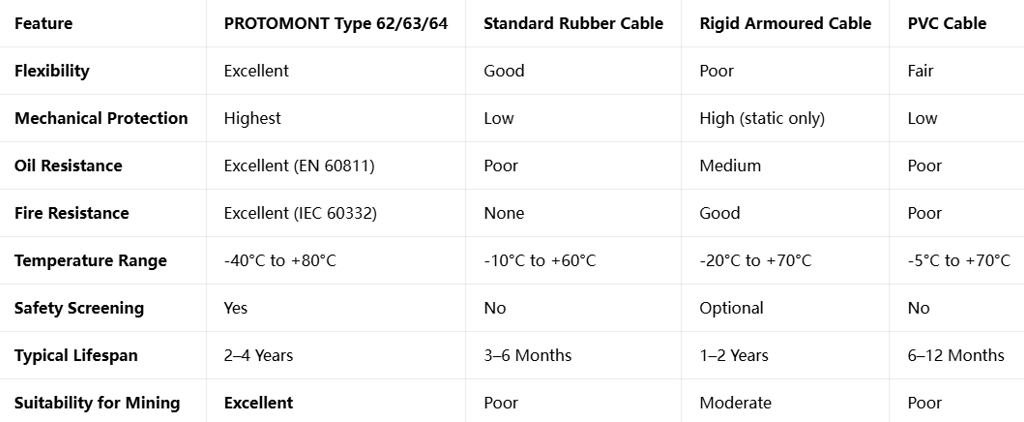
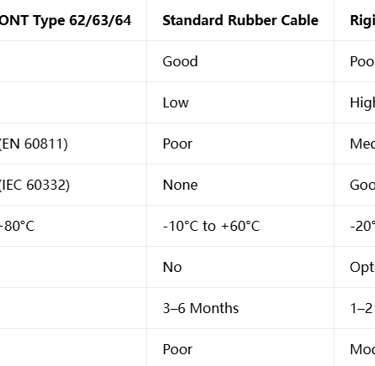
Standard Rubber Flexible Cables: These are lightweight and flexible but have no armour or screening. They are cheap to buy but fail rapidly. Sharp rocks easily pierce the sheath, moisture enters, and insulation breaks down. Without screening, electrical noise disrupts controls, and faults can spark without warning. Lifespan is typically 2 to 4 months.
Rigid Steel Tape Armoured Cables: These offer excellent crush and rodent protection but are inflexible. They are designed for fixed installation only. When used for trailing or moving equipment, the steel tape cracks, opens up, and cuts through the inner layers. They are unsuitable for dynamic applications.
PVC Sheathed Cables: PVC is low cost but performs poorly in mining environments. It becomes brittle in cold temperatures, softens at high temperatures, and has very poor resistance to oil and fire. Its use is restricted or banned in many Indonesian mining safety regulations.
The PROTOMONT Solution: Solving the "Either/Or" Dilemma
PROTOMONT Type 62, 63, and 64 cables are engineered to provide AND solutions rather than OR compromises.
✅ Flexibility AND Strength
The unique pliable steel wire armour allows the cable to bend around tight radii (as low as 4 times the cable diameter) while offering the same level of mechanical protection as a heavy-duty fixed cable. In a case study at a coal mine in East Kalimantan, a PROTOMONT Type 64 cable was used to power a continuous miner operating 24 hours a day. After 2 years of continuous dragging and exposure to coal dust and water, the cable showed no visible damage and retained its original electrical properties. The mine reported a 75% reduction in cable-related maintenance costs.
✅ Safety AND Reliability
Individual core screening ensures electromagnetic compatibility and fault safety, while the fire-retardant, oil-resistant sheath ensures the cable remains safe and functional even if exposed to hazardous substances. This aligns perfectly with the strict safety codes enforced by ESDM in Indonesia, reducing the risk of fines or shutdowns due to non-compliance.
✅ Wide Environment Compatibility
A single cable type works effectively in the humid tropics of Sumatra, the dry, high-altitude mines of Papua, and the deep, hot workings of Kalimantan. There is no need to stock different cables for different conditions, simplifying procurement and inventory management.
✅ Long Life Equals Lower Total Cost of Ownership
While the initial purchase price of BS 6708 cables is higher than standard rubber cables, the total cost of ownership is significantly lower. With a service life of 2 to 4 years—compared to 3 to 6 months for standard alternatives—the frequency of purchasing and installing new cables is drastically reduced. Calculations from a nickel mining operation in Sulawesi showed that switching to PROTOMONT cables saved over IDR 2.5 billion over a three-year period, factoring in material costs, labor, and production losses.
Performance Comparison Summary
Feichun Brand: Equivalent Alternative with Superior Value
As demand for BS 6708 compliant cables has grown in Indonesia, mining engineers and procurement teams have sought reliable alternatives to premium European brands. Feichun Cable has emerged as a leading solution, offering products that are fully equivalent to the PROTOMONT range, while providing distinct advantages in pricing and logistics.
Proof of Equivalence
Feichun’s Type 62, 63, and 64 flexible trailing cables are designed and manufactured to meet 100% of the requirements of BS 6708. The design specifications, material formulations, and testing protocols are identical to the original reference standard.
Materials: Feichun uses Class 5 tinned copper conductors, EPR insulation, copper/nylon composite screening, galvanized steel wire armouring, and CR outer sheaths sourced from the same global suppliers as leading brands.
Dimensions and Performance: Electrical parameters, mechanical strength, temperature ratings, and environmental resistance match exactly the data sheets presented earlier in this article. Independent laboratory tests confirm that performance is indistinguishable from the original products.
Certification: Feichun cables hold ISO 9001, ISO 14001, CE, and IEC certifications, and have been approved for use by major mining contractors and engineering consultants operating in Indonesia.
Why Feichun is the Preferred Alternative
Same Quality, Lower Cost
Feichun optimizes its manufacturing and supply chain without compromising on raw material quality or testing standards. The result is a price point that is typically 25% to 40% lower than European-sourced equivalents. For large-scale projects requiring tens or hundreds of kilometers of cable, this represents a substantial capital saving without risk.
Faster Delivery and Local Support
One of the biggest pain points for Indonesian mines is long lead times. Importing cables from Europe or North America often takes 60 to 90 days, plus customs clearance. Feichun maintains regional stock and has established a streamlined supply network, delivering orders within 15 to 30 days. Local technical support teams are available to assist with selection, installation guidance, and after-sales service, speaking the language and understanding the specific needs of the Indonesian mining industry.
Proven Track Record
Feichun cables have been successfully deployed in coal mines in South Kalimantan, nickel projects in Central Sulawesi, and gold operations in Papua. Mining engineers report that the performance and durability match their expectations, with the same reliability and safety characteristics they have come to trust.
Application and Operating Conditions
The official application scope defined in the product documentation is: “Suitable for fixed installation in underground mines for use as mine roadway extension cables and for coalface lighting.” However, in practice, the versatility of this cable design extends far beyond these descriptions, making it suitable for a wide range of heavy-duty applications.
Typical Operating Conditions
These cables are designed to operate reliably under the following conditions, all of which are standard in Indonesian mining:
Movement: Continuous or frequent flexing, coiling, uncoiling, dragging, and rolling over uneven ground.
Mechanical Stress: Exposure to impact, compression, tension, bending, and abrasion caused by rock, machinery, and foot traffic.
Environmental Exposure: Immersion in water, exposure to high humidity, acidic or alkaline groundwater, coal dust, sand, and other abrasive particulates.
Chemical Exposure: Contact with mineral oils, greases, hydraulic fluids, and solvents.
Thermal Conditions: Ambient temperatures ranging from well below freezing at high altitudes to high temperatures in deep workings or near machinery.
Hazardous Areas: Suitable for use in zones where explosive gas or dust may be present, provided the installation follows local safety regulations.
Indonesian Industry Cases
East Kalimantan Coal Mine: A major producer replaced standard rubber cables with Type 63 cables for roadway power distribution. The result was a reduction in maintenance work orders related to cable failure by 80%, and a significant improvement in safety ratings.
Sulawesi Nickel Mine: Operating in highly corrosive lateritic soils, the mine uses Type 64 cables for mobile crushing and screening equipment. The galvanized armour and CR sheath have proven resistant to the acidic environment, lasting over 3 years compared to the 6-month lifespan of previous cables.
Papua Gold Mine: At high altitude and extreme temperatures, Type 62 cables are used for lighting and auxiliary power. The wide temperature range capability ensures reliable operation through seasonal variations.
Frequently Asked Questions
Q: Can these cables be used in explosive gas zones?
A: Yes. The combination of individual core screening, robust construction, and fire-retardant materials makes them suitable for use in hazardous areas, in compliance with IEC standards and Indonesian mining regulations. They are designed to prevent the release of energy that could cause ignition.
Q: What is the minimum bending radius I should follow?
A: For fixed installation, the minimum bending radius is 4 times the overall cable diameter. For dynamic applications where the cable is moved frequently, a minimum of 6 times the diameter is recommended to maximize service life.
Q: Are these cables suitable for use outdoors?
A: Absolutely. The outer sheath material is resistant to ozone, UV radiation, and weathering. The documentation explicitly states “unrestricted use outdoors and indoors,” making them versatile for surface stockyards, processing plants, and portal entries as well as underground.
Q: How do I choose between Type 62, 63, and 64?
A: Selection is based purely on your electrical system requirements. Use Type 62 for single-phase circuits, Type 63 for standard three-phase systems, and Type 64 where an additional core or neutral is required. All other properties are identical.
Q: Is Feichun cable really the same quality?
A: Yes. Feichun manufactures strictly to BS 6708 specifications, using the same materials and test methods as the original design. The difference is in the price and delivery speed, not in the performance or safety.
Conclusion
BS 6708 compliant PROTOMONT Type 62, 63, and 64 flexible trailing cables represent the culmination of decades of engineering development specifically tailored to the unique demands of underground mining. They are not merely cables; they are integrated systems where every layer—from the tinned copper conductor to the galvanized steel armour and the chloroprene outer sheath—has been designed using fundamental principles of physics, chemistry, and mechanics to solve the problems that ordinary cables cannot.
For mining engineers and procurement professionals in Indonesia, the choice is clear. These cables deliver the flexibility required for mobile equipment, the protection needed to survive harsh environments, the safety demanded by regulations, and the reliability that keeps production running. When combined with the cost advantages and logistical benefits offered by Feichun as an equivalent manufacturer, the value proposition becomes undeniable.
If you are planning a new project, upgrading existing infrastructure, or seeking to reduce maintenance costs and improve safety in your mine, do not compromise on your power supply.
To obtain detailed technical data sheets, price quotations, or engineering support, please contact the Feichun team directly:
The Feichun team is ready to provide you with the same high-quality, BS 6708 compliant products and technical expertise that have powered mining operations across Indonesia and Southeast Asia for generations.

Feichun Cable
Durable mining cables for tough environments and operations
Email: Li.wang@feichuncables.com
© 2025. All rights reserved.
Company
Products
Contact
WhatsApp: +86 17333223430