Anhui Feichun Special Cable Co.,Ltd


TENAX-LUMEN (N)TSCGH3S 6/10kV LED Mining Trailing Cable: Solving Low-Light Visibility Hazards in Indonesia’s Nickel and Coal Mines
Discover how the Feichun TENAX-LUMEN (N)TSCGH3S 6/10kV self-illuminating LED mining trailing cable eliminates low-light visibility hazards in Indonesia’s nickel and coal mines. Detailed technical specifications, electroluminescent (EL) technology, transparent polyurethane sheath innovations, real-world Indonesian case studies from Morowali and Weda Bay, and clear advantages over traditional cables for procurement professionals and mining operators.
Li Wang
4/13/20267 min read
Introduction
Indonesia stands as the world’s largest nickel producer and a major coal exporter, with vast open-pit operations running 24/7 across Sulawesi, North Maluku, and Kalimantan. In these environments—characterized by tropical downpours, thick red laterite mud, airborne dust clouds, and extensive night-shift operations—standard trailing cables for large mobile equipment become virtually invisible. The result is a persistent safety and productivity crisis: crushed cables, unplanned downtime, electrocution risks, and preventable fatalities.
Procurement decision-makers and cable distributors serving the Indonesian mining sector face a clear imperative: adopt solutions that address visibility without compromising mechanical integrity or electrical performance. The Feichun TENAX-LUMEN (N)TSCGH3S 6/10kV self-illuminating mining trailing LED cable, developed by Anhui Feichun Special Cable Co., Ltd., represents a targeted engineering response. By integrating independent electroluminescent (EL) strings beneath a high-transparency polyurethane (PUR) outer sheath, this cable delivers continuous 360° visibility—even when de-energized—directly mitigating the low-light hazards that plague conventional designs.
This in-depth technical guide examines the specific risks in Indonesian mining, dissects the cable’s construction and operating principles, details its applications with localized case studies, quantifies advantages over legacy solutions, and highlights the material innovations in the transparent sheath. Designed for B2B professionals, the analysis provides actionable data for specification, ROI modeling, and supplier evaluation.
The Harsh Realities of Indonesian Mining and Risks of Standard Cables
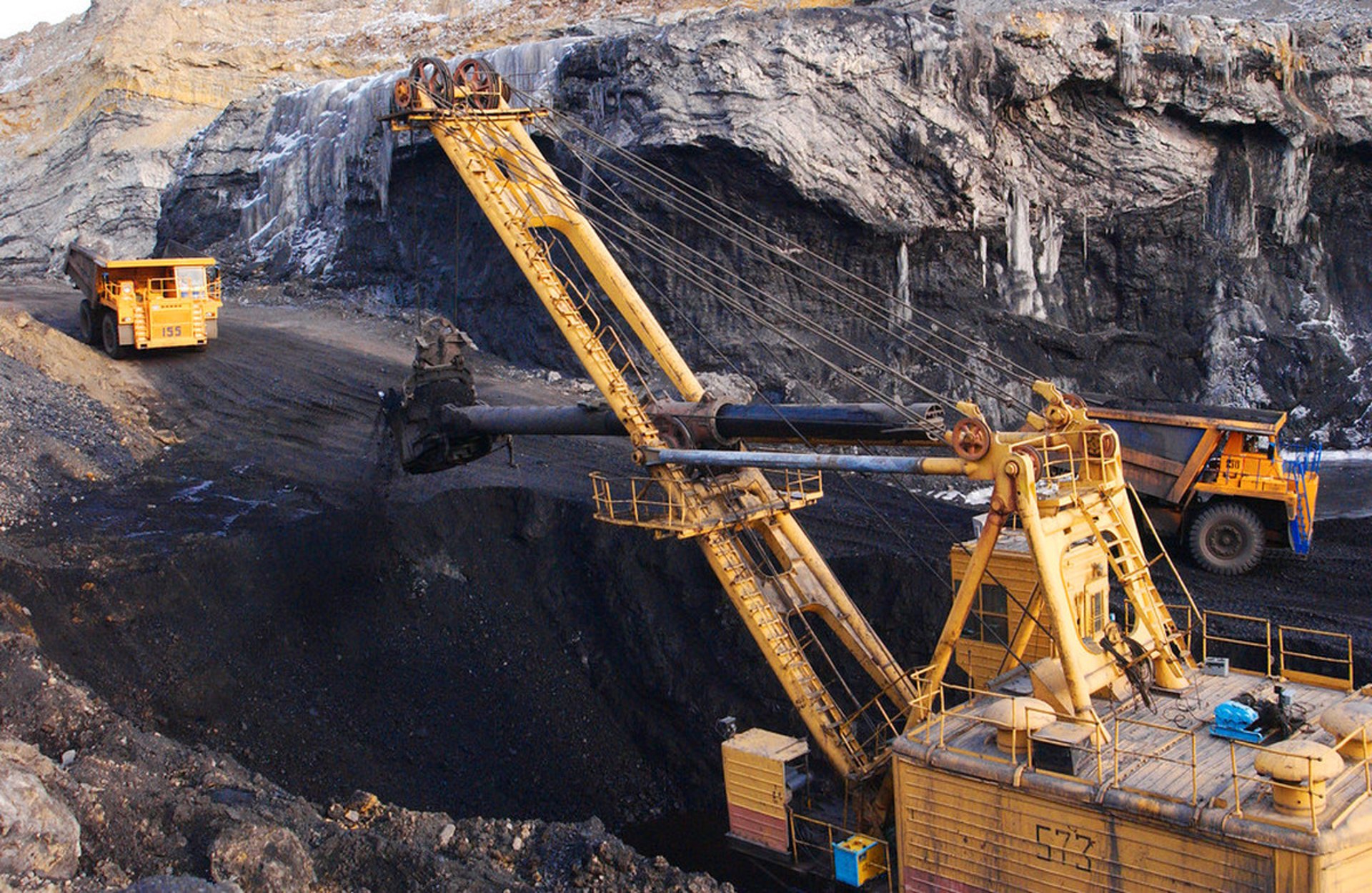
Indonesian nickel operations at Morowali Industrial Park (IMIP) and Weda Bay Industrial Park (IWIP) exemplify extreme conditions. These 24-hour sites feature electric shovels, draglines, and bucket-wheel excavators operating over hundreds of meters of trailing cable in environments where visibility drops to near zero: heavy rain turns laterite soil into slippery red slurry, dust coats every surface, and night shifts account for a significant portion of output.
Standard medium-voltage trailing cables—typically black or single-color rubber or chloroprene sheaths with optional reflective tape—fail critically in these scenarios. Once covered by mud or dust, or operating beyond the reach of fixed lighting, they blend into the terrain. Operators of heavy machinery cannot reliably detect cable paths, leading to four primary hazard categories:
Personnel Injury and Fatality Risks: Workers navigating around moving equipment frequently trip over or step onto obscured cables. Night-shift fatigue, documented in Indonesian coal and nickel operations, compounds reaction-time delays.
Equipment Damage and Electrical Faults: Mobile assets routinely crush or shear cables, breaching insulation and causing short circuits, arc flashes, or ground faults. In high-voltage 6–10 kV systems, such incidents trigger immediate shutdowns and risk fire or explosion in coal seams or dusty nickel processing zones.
Production Downtime and Economic Impact: Each cable failure halts operations for hours or days. Repair or replacement of a 10 kV trailing cable segment, plus diagnostic testing and re-energization, can exceed tens of thousands of USD per event. Multiplied across fleets operating 24/7, annual losses reach millions.
Secondary Disaster Potential: Damaged cables in confined or dust-laden areas elevate explosion and electrocution risks. Recent tailings incidents at Morowali and Weda Bay underscore how environmental stressors (rain, soft soils) already strain infrastructure; invisible cable damage adds an avoidable layer of vulnerability.
Industry data consistently link night operations and poor visibility to elevated incident rates. Traditional mitigation—reflective tape, colored sheaths, or auxiliary lighting—proves inadequate: tape requires external illumination, colors fade or become obscured, and added lamps increase weight and failure points. These limitations drive the demand for an intrinsically visible solution engineered for Indonesian conditions.
What Is the Feichun TENAX-LUMEN (N)TSCGH3S 6/10kV Mining Trailing LED Cable? Technical Breakdown
The Feichun TENAX-LUMEN (N)TSCGH3S 6/10kV is a purpose-built self-illuminating medium-voltage trailing cable optimized for high-power mobile mining equipment. Manufactured to DIN VDE 0250-813 and aligned with IEC standards, it merges robust power transmission with active illumination independent of the main conductors.
Key Electrical and Mechanical Specifications
Rated voltage: 6/10 kV (U₀/U), Um = 12 kV
Test voltage: 17 kV
Conductor: Tinned copper, class 5 finely stranded (35–240 mm² options) for flexibility and corrosion resistance
Insulation: Special cross-linked EPR with inner/outer semi-conductive layers for uniform electrical field control
Core arrangement: Three main cores + split earth + pilot cores, laid up around a semiconductive central filler reinforced with aramid yarns for tensile strength (25 N/mm²)
Illuminating element: Special electroluminescent (EL) strings positioned in the interstices
Outer sheath: Proprietary transparent polyurethane (PUR) compound
Bending radius: 10 × D (flexible operation)
Torsional resistance: ±100°/m
Operating temperature: –50 °C to +60 °C (mobile), up to +80 °C (fixed)
Short-circuit temperature: 250 °C (max 5 s)
Fire performance: Halogen-free, flame-retardant per EN/IEC 60332-1-2
Weight and diameter examples (approximate for common sizes):
3×50 + 2×16 + 1×16: ~3,950 kg/km, Ø 49–53 mm
3×120 + 2×35 + 1×16: ~6,990 kg/km, Ø 65–70 mm
The EL system operates via a dedicated low-voltage AC supply (max 125 V, 800–2,000 Hz, ~15 A/km consumption) from an external inverter. Power draw is negligible, heat generation is virtually zero, and light homogeneity exceeds 95 % across 360°. Critically, illumination persists when the main 10 kV conductors are de-energized—essential during maintenance or power interruptions.
This construction delivers the mechanical toughness required for reeling and trailing duty while embedding visibility as a core function rather than an afterthought.
How Feichun TENAX-LUMEN Solves Visibility Challenges in Dark or Low-Light Environments
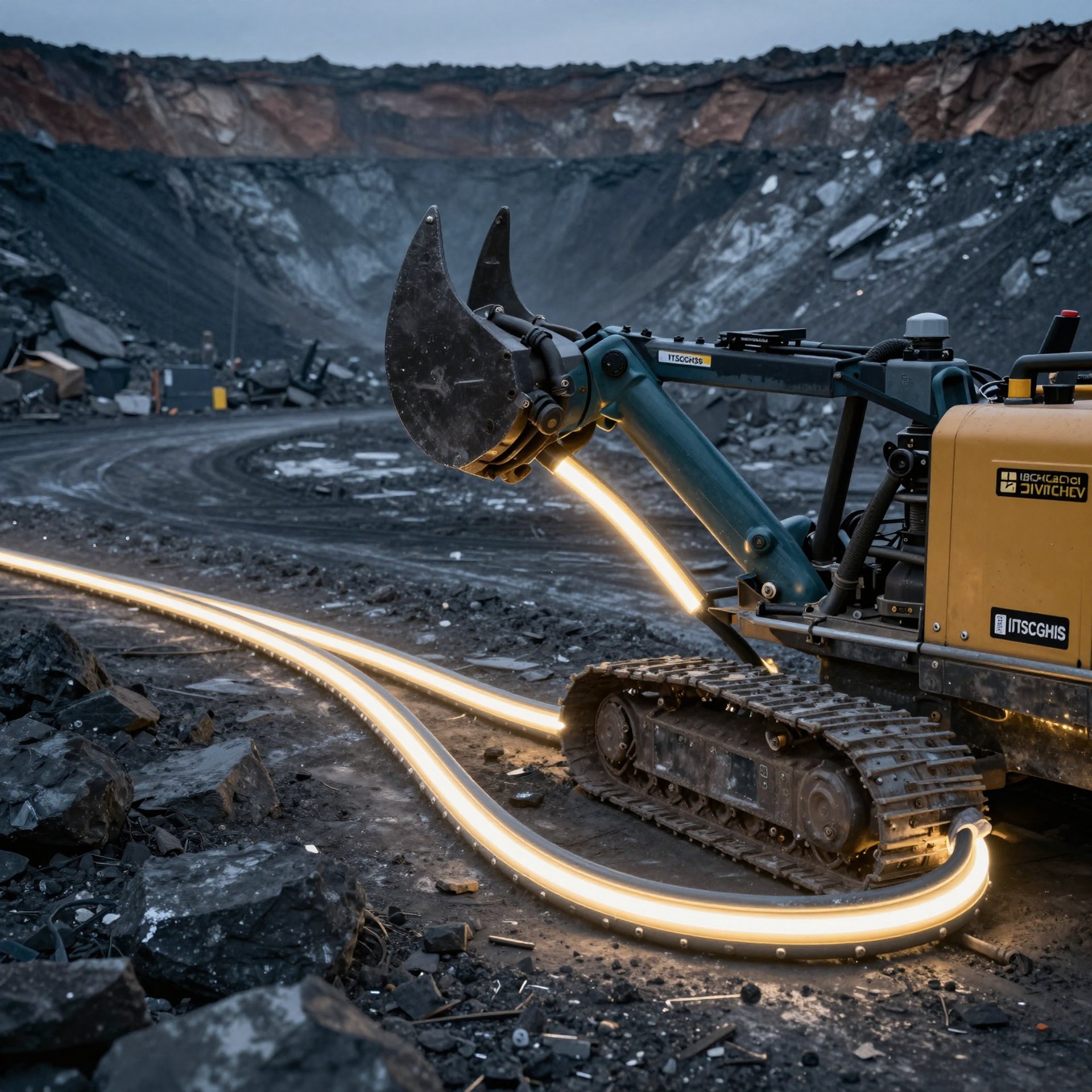
The cable’s visibility solution rests on two synergistic innovations: embedded EL strings and the transparent PUR sheath. Unlike passive reflective systems that depend on external light sources, the EL strings generate their own uniform cold light through electroluminescence. Positioned in the cable interstices, they emit through the clear sheath, creating a continuous glowing line visible from dozens of meters away—even when buried under thin layers of dust or mud.
In complete darkness or after heavy rain at Morowali or Weda Bay, operators and ground crews can instantly identify cable routes without relying on headlamps or vehicle lights. The independent power circuit ensures the glow continues during outages, eliminating the “invisible hazard” window that traditional cables create. Light output remains consistent over the cable’s service life, with no degradation from abrasion or UV exposure thanks to the sheath’s optical stability.
Practical impact: reduced operator hesitation, fewer emergency stops, and proactive avoidance of cable contact. For procurement teams, this translates to measurable risk reduction without additional infrastructure.
Innovations in the Transparent Polyurethane Outer Sheath
The transparent PUR sheath is the enabling technology for sustained visibility. Conventional transparent polymers often sacrifice mechanical properties; Feichun’s proprietary formulation achieves an optimal balance:
Optical Performance: High initial transparency retained over years of service. No yellowing or haze from UV, ozone, or chemical exposure common in mining.
Mechanical Excellence: Exceptional resistance to abrasion, tearing, impact, and crushing—critical for dragline and shovel duty cycles.
Environmental Resilience: Oil, hydraulic fluid, ozone, moisture, and UV resistant. Fully flexible at –50 °C, preventing cracking in high-altitude or nighttime temperature drops.
Safety Compliance: Halogen-free, low-smoke, flame-retardant, meeting stringent international mining codes.
This sheath protects the EL strings and power cores while allowing 360° light transmission. The result is a cable that remains both highly visible and structurally superior in Indonesia’s abrasive, corrosive, and thermally variable conditions—solving the historical trade-off between visibility and durability.
Applications, Uses, and Case Studies in Indonesian Mining Operations
Primary applications include trailing and reeling supply to:
Electric shovels and draglines in nickel laterite extraction
Bucket-wheel excavators in coal and nickel stripping
Tunnel boring machines in underground extensions
Morowali Industrial Park (IMIP) Case Analysis
At IMIP, high-intensity nickel processing involves fleets of 10 kV draglines operating across soft-soil tailings zones. Night shifts and frequent rain create mud-covered cable hazards. Deployment of TENAX-LUMEN 6/10kV (e.g., 3×120 mm² configuration) has enabled operators to maintain visual awareness of cable paths during repositioning, reducing documented run-over incidents. Visible glow persists post-rain, preventing the costly downtime seen in prior non-illuminated cable failures. Estimated ROI: payback within 12–18 months through avoided repairs and lost production.
Weda Bay Industrial Park (IWIP) Case Analysis
IWIP’s remote Halmahera location features dense rainforest, extreme rainfall, and 24/7 operations. Standard cables become invisible in red mud within hours. TENAX-LUMEN’s –50 °C to +60 °C rating and independent EL supply suit the variable climate. Ground crews report safer navigation around energized lines; equipment operators avoid accidental contact during low-visibility maneuvers. Safety compliance improves, aligning with tightening Indonesian regulatory scrutiny on mining incidents.
These deployments demonstrate practical gains: lower injury rates, extended cable life, and uninterrupted output in environments where visibility was previously a critical weak link.
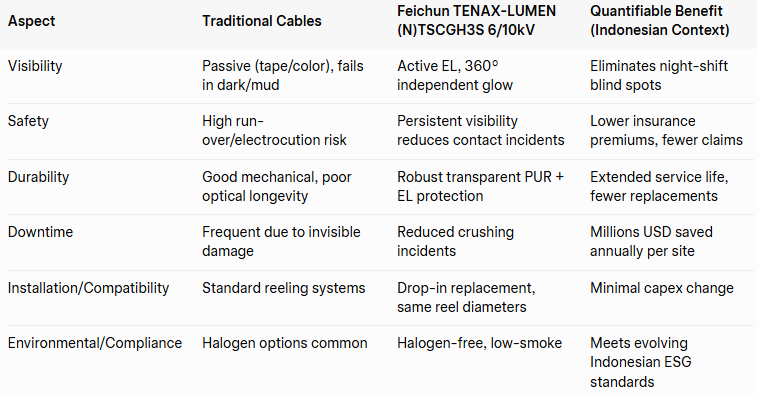
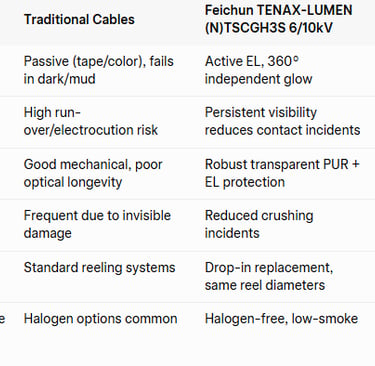
Advantages Over Traditional Mining Cable Solutions
Additional advantages include negligible extra power consumption, zero heat from illumination, and simplified inventory (one cable replaces multiple legacy variants). Long-term TCO analysis for Indonesian operators shows 25–40 % reduction in cable-related costs within three years.
Selection and Implementation Guide for Indonesian Mines
Specifiers should match conductor size to load (35–240 mm²), confirm reel compatibility with 10×D bending, and verify inverter integration. Installation notes: protect EL supply connections from moisture; schedule periodic glow-intensity checks. Maintenance is minimal—standard cleaning preserves transparency. For Morowali/Weda Bay, prioritize 6/10 kV ratings and PUR’s chemical resistance against laterite contaminants.
Frequently Asked Questions (FAQ)
What is the Feichun TENAX-LUMEN (N)TSCGH3S 6/10kV cable?
A self-illuminating 10 kV trailing cable with integrated EL strings and transparent PUR sheath for mining visibility and power delivery.
How does illumination work when main power is off?
The EL strings use a separate low-voltage AC inverter circuit, independent of the main conductors.
Is the transparent PUR sheath durable in tropical mining conditions?
Yes—engineered for abrasion, oil, UV, and –50 °C flexibility while retaining optical clarity.
What are the cost benefits for Indonesian nickel mines?
Reduced downtime, lower repair frequency, and improved safety yield payback typically within 12–24 months.
Can it integrate with existing reeling systems?
Yes—designed as a direct replacement with compatible diameters and flexibility.
How does it compare to reflective tape or external lights?
Superior: always visible, no external dependency, maintenance-free illumination.
What standards does it meet?
DIN VDE 0250-813, IEC equivalents, halogen-free flame retardant.
Where can Indonesian buyers obtain support?
Contact Feichun’s authorized regional distributors or [email protected] for local technical assistance and stock.
Conclusion
The Feichun TENAX-LUMEN (N)TSCGH3S 6/10kV LED mining trailing cable directly addresses a long-standing vulnerability in Indonesian mining operations. By combining proven 6/10 kV power delivery with reliable self-illumination, it enhances safety, uptime, and regulatory compliance in the world’s most demanding nickel and coal environments.
For cable distributors and mine procurement teams, specifying this technology represents a proactive investment in operational resilience. As Indonesia’s mining sector scales and safety expectations rise, solutions like TENAX-LUMEN set the new benchmark for visibility-integrated cabling. Forward-looking operators adopting it today will gain measurable competitive advantage in safety performance and cost efficiency.
If your project requires TENAX-LUMEN (N)TSCGH3S 6/10kV LED mining trailing cable, please contact the FeiChun team for specific technical specifications. Li.wang@feichuncables.com
Feichun Cable
Durable mining cables for tough environments and operations
Email: Tech@feichuncables.com
© 2025. All rights reserved.
Company
Products
Contact
WhatsApp: +86 13855123218