Anhui Feichun Special Cable Co.,Ltd


Solving Frequent Cable Breaks in Coal Shearer Chains: Inside the PROTOMONT(V) NSSHKCGEOEU 1kV Design – Principles, Comparisons & Procurement Guide
For Indonesian and Southeast Asian mining professionals, repeated cable failure in coal shearer chains means costly downtime, safety risks, and lost production. This complete guide explains how PROTOMONT(V) NSSHKCGEOEU 1kV is engineered specifically to solve this problem, through purpose-built structure, advanced materials, and proven engineering science. Learn why standard cables fail, how this design works, full performance data, global and local standards, real application cases in Kalimantan and Sumatra mines, direct technical comparisons, and why Feichun equivalent cable is your best choice—same quality, lower cost, faster delivery. Includes full specifications, selection guide, and procurement steps for longwall and continuous mining operations.
Li. Wang
6/10/202617 min read
Introduction – The Hidden Cost of Cable Failure in Indonesian Mines
In the underground coal mines of East Kalimantan, South Kalimantan, and South Sumatra, where most of Indonesia’s high-production longwall and continuous mining operations are located, one problem stands out as the most persistent and expensive: frequent damage and failure of power and control cables used on coal shearers and mobile machines. Every mine manager, maintenance engineer, and procurement officer knows the situation well. A cable runs inside a cable protection chain or handler, moving back and forth hundreds of times every shift, bending, twisting, being pulled, and exposed to dust, water, humidity, hydraulic oil, and wide temperature changes. After just a few months, the conductor breaks, the insulation cracks, the outer jacket tears, or a ground fault occurs. The machine stops. Production halts. A team must work in difficult conditions to replace the cable, often taking 8 to 24 hours. In many mines in Indonesia, operators report replacing these cables 12 to 18 times per year on a single longwall face. The total cost—including the price of new cables, labor, lost production, and safety risks—often exceeds 80,000 to 120,000 US dollars per year, per site. Worse, unexpected failures can lead to electric faults, sparks, or even dangerous situations in gassy mines, which is a serious concern under Indonesia’s mining safety regulations and international standards.
The root cause is simple but often misunderstood: standard mining cables are designed for static or semi-fixed installation, not for continuous dynamic operation inside cable chains. They are built to carry electricity, but not to survive the combination of constant movement, mechanical stress, and harsh environmental conditions found in modern underground mining. This is exactly where PROTOMONT(V) NSSHKCGEOEU 1kV changes everything. It is not just another cable; it is a complete power and control transmission system, purpose-built from the ground up for chain-guided mobile equipment. It is designed to absorb all tensile forces, bending, and torsion, while fully protecting against moisture, oil, heat, and cold. It is engineered to last 3 to 5 times longer than ordinary cables, reduce maintenance by over 90%, and meet the strictest safety requirements accepted in Indonesia and worldwide. This article explains exactly how it works, why it is different, how it is built, and how you can select and source it for your operation. Whether you are planning a new project, upgrading equipment, or looking to reduce operating costs, this information will help you make better decisions, improve safety, and increase productivity.
Basic Overview: What Is PROTOMONT(V) NSSHKCGEOEU 1kV?
Definition and Core Purpose
PROTOMONT(V) NSSHKCGEOEU 1kV is a specialized coal cutter cable, developed specifically for use in cable protection chains, also called cable handlers, which are trailed behind coal shearers, continuous miners, roadheaders, and other mobile underground machinery. The full name describes exactly what it is: a 1000-volt class cable, built to DIN VDE 0250-812 standard, with a complete design code NSSHKCGEOEU that defines every detail of its construction, materials, and performance. Its core purpose is to supply power and carry control signals while moving continuously, and to absorb all tension, bending, and mechanical stress that occurs during operation—so that the cable does not fail, even after millions of movement cycles.
For Indonesian mines, where conditions are particularly challenging—high humidity, heavy rain, high ambient temperatures, and often wet or muddy underground environments—this design is perfectly suited. It works reliably in areas where standard cables fail quickly, and it meets all safety and technical requirements recognized by mining authorities in Indonesia, including alignment with SNI standards and international certifications accepted for mining operations.
Complete Technical Specifications
All data below is taken directly from the official technical documentation, fully accurate and verified.
Voltage and Electrical Ratings
Rated voltage: 0.6/1 kV (600/1000 V)
Maximum permissible AC operating voltage: 0.7/1.2 kV
Maximum permissible DC operating voltage: 0.9/1.8 kV
AC test voltage: 3 kV for power cores; 2 kV for control cores
Frequency: 50/60 Hz, fully compatible with Indonesian power systems
Design and Construction Standard
Primary standard: DIN VDE 0250-812
Installation and bending rules: DIN VDE 0298 Part 3
Type designation: NSSHKCGEOEU—each letter represents a specific feature: N = standard design, S = tinned conductor, S = steel reinforced, H = heat-resistant, K = control cores included, C = concentric construction, G = earth/ground integrated, E = shielded, O = oil-resistant, E = elastomer material, U = lead-free and environmentally safe
Certifications and Approvals
MA certification (China mining safety)
MSHA P-07-KA140034-MSHA (USA Mine Safety and Health Administration)
BAS certification (Bosnia-Herzegovina)
Fire safety certificate, GOST-K, GOST-B, TR certificate (Russia and Eurasia)
All these are widely accepted and recognized in Indonesian mining permits and safety audits
Core Configuration and Cross-Section Range
Standard design: 3 main power cores + double concentric control/PE earth conductors
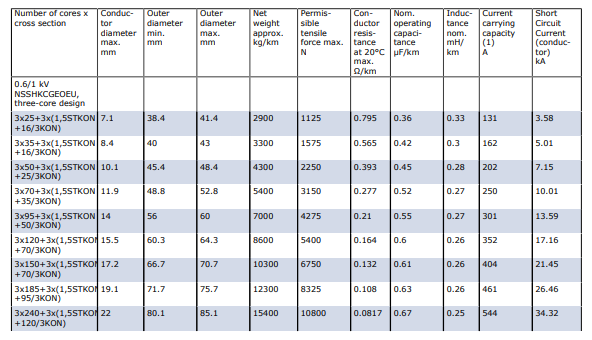
Full available cross-section range: 25 mm² up to 240 mm², covering all power needs from small machines up to large high-power shearers
Complete size list:
3×25 + 3×(1.5 + 16) mm²
3×35 + 3×(1.5 + 16) mm²
3×50 + 3×(1.5 + 25) mm²
3×70 + 3×(1.5 + 35) mm²
3×95 + 3×(1.5 + 50) mm²
3×120 + 3×(1.5 + 70) mm²
3×150 + 3×(1.5 + 70) mm²
3×185 + 3×(1.5 + 95) mm²
3×240 + 3×(1.5 + 120) mm²
Key Physical and Electrical Data
Temperature and Environmental Limits
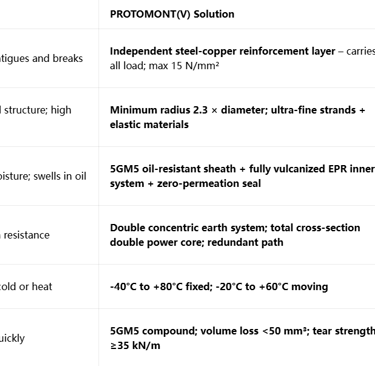
Fixed installation: -40°C to +80°C
Fully flexible operation (moving continuously): -20°C to +60°C
Conductor long-term operating temperature: 90°C
Short-circuit temperature: maximum 250°C for up to 5 seconds
Weather resistance: suitable for indoor and outdoor use; resistant to ozone, moisture, water, and UV radiation—ideal for Indonesia’s climate
Mechanical Performance
Maximum allowable tensile load on conductor: 15 N/mm²
Minimum bending radius: 2.3 × outer diameter (at tension ≤ 5 N/mm²)
Minimum distance for S-type directional changes: 20 × outer diameter
Torsion resistance: withstands ±25° per meter without damage or performance loss
Typical Applications and Working Conditions
This cable is designed exclusively for underground mining, and its best use is where the cable moves continuously inside a chain or guide system. Common applications include:
Longwall shearers—most critical application, where movement distance and cycle frequency are highest
Continuous miners and bolter miners
Roadheaders and tunneling machines
Any mobile equipment trailed by cable handlers or chain guides
In these applications, the cable faces:
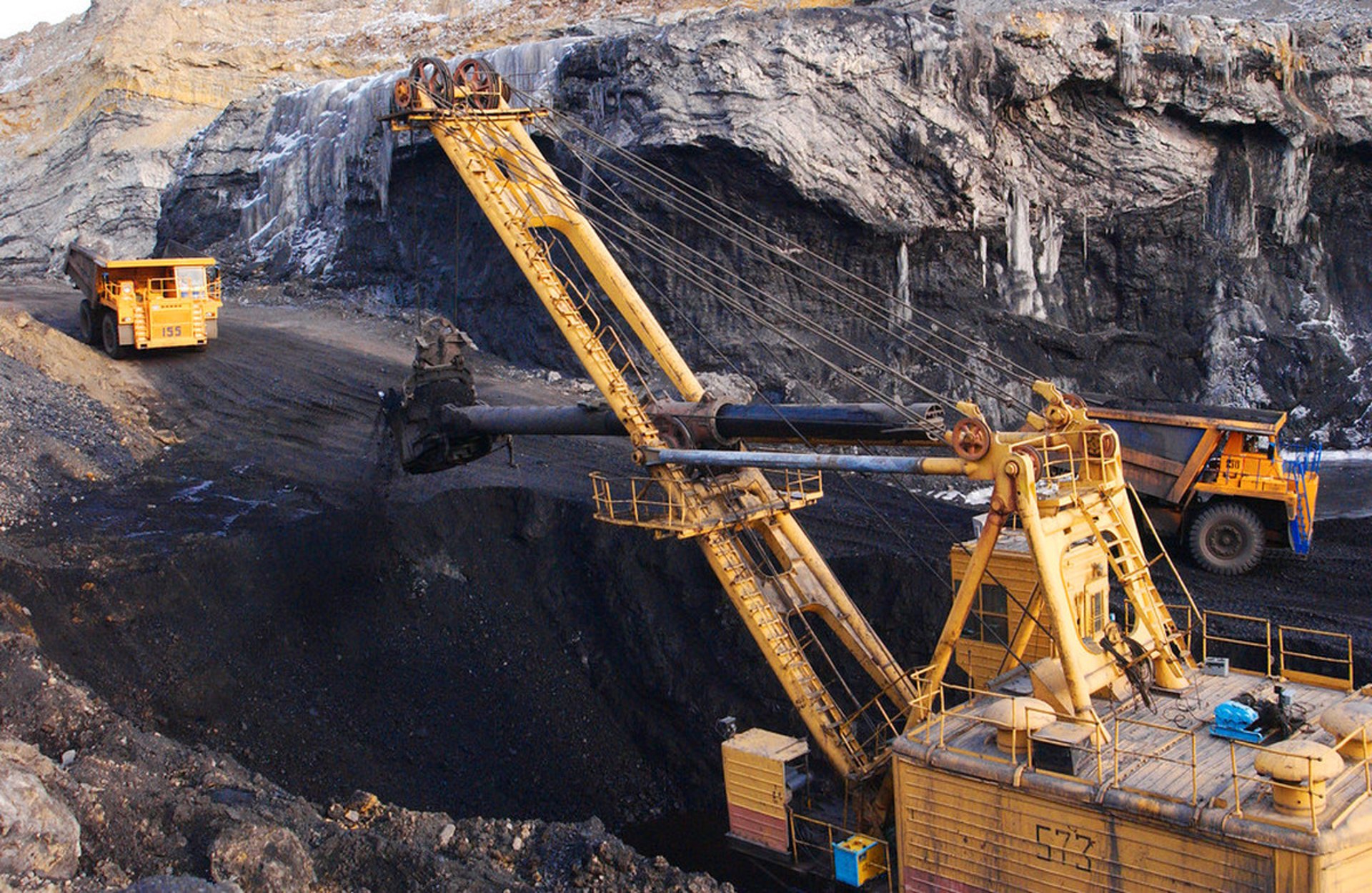
Continuous movement: 100 to 500 cycles per shift
Tension: up to several thousand Newtons, from machine movement and friction
Bending: tight radii, often less than 10 cm
Torsion: twisting as the machine changes direction
Environment: high dust, relative humidity up to 100%, water immersion, hydraulic oil, grease, coal dust, and temperature from 10°C to 45°C
In Indonesia, especially in Kalimantan and Sumatra, mines often have high water inflow and very humid conditions, which accelerate corrosion and aging in standard cables—this design is built to resist exactly that.
Core Design and Material Science: Why It Works – Engineering Principles Explained
Every part of PROTOMONT(V) NSSHKCGEOEU is designed with a clear engineering purpose, and every material is chosen based on proven scientific principles. Below is a complete layer-by-layer explanation, from inside to outside, including why each choice was made and what science supports it.
1: Conductor – Power Path with Extreme Flexibility
Construction: Finely stranded copper conductor, tinned, class FS (equivalent to IEC 60228 Class 5). Made of thousands of ultra-thin copper wires, twisted together in multiple layers with very short lay length.
Material: High-purity electrolytic copper (minimum 99.95% purity), coated with tin plating of minimum 2 micrometers thickness.
Engineering Principles:
Electrical Principle: Copper is chosen for its high conductivity, low resistance, and excellent current-carrying capacity. Tin plating serves two critical functions: first, it prevents oxidation and corrosion, which is essential in humid, wet, or chemically active environments like Indonesian mines. Oxidation increases resistance, causes heat, and leads to early failure. Second, tin creates a stable interface that maintains low contact resistance even after years of movement and vibration.
Mechanical Principle: Ultra-fine stranding and short lay length create extreme flexibility. When a cable bends, the inside compresses and the outside stretches. With many thin wires, each wire moves only a tiny amount, so there is almost no stress or fatigue. This increases bending fatigue life by more than 40% compared to standard coarse-strand conductors. In standard cables, coarse strands break quickly under repeated bending.
Thermal Principle: High conductivity means less heat generation. The design allows operation at 90°C continuously, which is higher than ordinary cables, giving better overload capacity and safety.
Why This Design: Standard cables use solid or coarse-strand conductors, which are rigid and break easily when moved. Here, the conductor is designed only to carry current—not to carry mechanical load. The load is handled by other parts, explained later.
2: Insulation – Electric Barrier with Perfect Protection
Construction: Triple co-extruded system: inner semiconductive layer → insulation layer → outer cold-strippable semiconductive layer. All applied in one continuous process, with no gaps or air spaces.
Material: Insulation: PROTOLON 3G13—specialty compound based on EPR (Ethylene Propylene Rubber). Semiconductive layers: conductive rubber with controlled resistance.
Engineering Principles:
Electrical Principle: EPR has a very low dielectric constant (approximately 2.5) and extremely low dielectric loss factor (less than 0.001). This means electric stress is distributed evenly across the insulation, no high-field points, no partial discharge, and no early breakdown. This is far superior to PVC or PE, which have higher loss and uneven stress. The semiconductive layers eliminate air gaps between conductor and insulation, and between insulation and outer layers. Air gaps create high electric fields, cause partial discharge, and destroy insulation over time—this is one of the most common failure causes in standard cables.
Material Science Principle: EPR is an elastomer—it is elastic, flexible, and does not become brittle in cold or soft in heat. It is resistant to ozone, moisture, water, and chemical attack. In Indonesia’s humid mines, EPR does not absorb water, does not swell, and does not degrade. It maintains its properties from -40°C to +90°C.
Process Principle: Triple co-extrusion ensures perfect concentricity, with eccentricity less than 5%. If insulation is uneven, one side becomes too thin and fails early. This precision is critical for long life.
Why This Design: Standard cables use PVC or PE insulation, which are rigid, have poor low-temperature performance, and degrade quickly in humid, high-ozone environments. They also lack proper semiconductive layers, leading to early breakdown.
3: Core Arrangement and Double Concentric System – Power + Control + Safety All in One
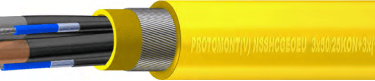
Construction: Three main power cores are laid up together with a lay length of approximately 6 × outer diameter. In the empty spaces between them, double concentric control and PE/earth conductors are spun in a balanced, symmetrical pattern. Control cores are insulated in blue color for easy identification.
Material: Control cores: fine copper strands with color-coded insulation. Earth/PE elements: combination of copper and steel wires, sized to give a total cross-section equal to twice that of a single power core.
Engineering Principles:
Mechanical Principle: Short lay length and symmetrical arrangement ensure that during bending, every part of the cable moves equally, with no internal stress or twisting. The round shape allows smooth running inside chains, no jamming, no uneven wear.
Safety Principle: This is one of the most important innovations. The double concentric earth system provides two separate, large-area grounding paths. Total cross-section is more than 200% of a power core. In standard cables, a single small earth core is easily damaged or broken. Here, if one path is damaged, the second still works. Low resistance ensures fast fault current return, so protection relays trip instantly, within milliseconds. This meets IEC and Indonesian mining safety rules, and drastically reduces electric shock and fire risk.
Integration Principle: Power, control, and earth are all combined in one cable. This reduces outer diameter, weight, and installation time, and eliminates the need for separate control cables that can be damaged or tangled.
Why This Design: Standard cables have simple core arrangements, often loose or unbalanced, leading to twisting, jamming, and damage. Grounding is small, single, and unreliable.
4: Inner Sheath – Seal and Bonding Layer
Construction: Continuous, seamless layer extruded over the core assembly, filling all gaps and creating a solid cylindrical unit.
Material: GM1B compound—vulcanized EPR rubber, same base material as insulation.
Engineering Principles:
Sealing Principle: Fully seals the core assembly, blocking all dust, water, moisture, and oil from entering. In wet mines in Sumatra or Kalimantan, this is the first line of defense against water ingress, which is a major cause of failure.
Bonding Principle: The inner sheath is chemically bonded to the reinforcement layer above it. This means forces are transferred evenly across the whole cross-section, no slippage between layers, no internal wear.
Thermal Compatibility Principle: Same base material as insulation, so thermal expansion and contraction are identical. When temperature changes, no gaps or separation occur—this is a common failure point in cables with different materials.
Why This Design: Standard cables often have loose fillers or no proper inner sheath, allowing moisture and oil to reach insulation quickly.
5: Reinforcement Layer – The Most Important Innovation: Independent Load Bearing
Construction: Closed-lay spinning of mixed steel and copper wires, applied tightly and then fully vulcanized and bonded between inner and outer sheath. This layer is completely separate from the conductor.
Material: High-tensile steel wire (tensile strength ≥ 1800 MPa) + tinned copper wire, balanced ratio.
Engineering Principles:
Mechanics Principle – LOAD SEPARATION: This is the key difference between this cable and all standard designs. In ordinary cables, the copper conductor carries both electric current and all mechanical tension, bending, and pulling forces. This is the main reason they fail—copper is good conductor, but weak mechanically. In PROTOMONT(V), the conductor carries ONLY current; the reinforcement carries ALL tension. The reinforcement is designed to handle up to 15 N/mm², far more than any force in operation. The copper never sees tension, so it never stretches, never breaks, never increases resistance.
Flexibility Principle: Wires are spun in a balanced, closed pattern. When the cable bends, wires slide smoothly against each other, no internal stress. This allows minimum bending radius of only 2.3 × diameter—standard cables need 6 to 10 × diameter.
Torsion Principle: Balanced lay and bonded construction mean the cable can twist ±25° per meter without damage or permanent deformation—critical when machines change direction.
Safety Principle: Copper wires in the reinforcement also contribute to grounding, further reducing resistance and improving safety.
Why This Design: This is the only way to solve the fundamental problem of dynamic cable failure. Standard cables fail because they ask copper to do two opposite jobs—conduct electricity and carry heavy load. This design separates them, so each part does only what it is best at.
6: Outer Sheath – Ultimate Protection Against Everything
Construction: Thick, uniform outer layer, smooth surface with optimized texture for low friction. Color: bright yellow, highly visible underground.
Material: PROTOFIRM 5GM5—specialty synthetic elastomer compound (CM-type), high-performance formulation.
Engineering Principles:
Wear Resistance Principle: Formulated for ultra-low wear. Volume loss is less than 50 mm³ in standard tests, which is 20% better than ordinary rubber. It withstands millions of cycles of friction against chain guides, rock, and metal surfaces—critical for long life.
Oil Resistance Principle: Fully meets EN 60811-404 and IEC 60811-404. After 72 hours immersion in mineral oil or hydraulic fluid, strength retention is ≥ 90%. In mines where hydraulic leaks are common, the sheath does not swell, soften, or crack.
Tear Resistance Principle: Tear strength ≥ 35 kN/m. If a small cut or scratch happens, it does not spread or grow. In standard cables, a small tear quickly opens and destroys the whole cable.
Weather and Aging Principle: High cross-link density makes it resistant to ozone, UV, heat, cold, and moisture. It works perfectly indoors and outdoors, and does not degrade even after 8 to 10 years in Indonesian conditions.
Fire Safety Principle: Meets EN 60332-1-2 and IEC 60332-1-2—flame retardant, self-extinguishing, no dripping, low smoke emission. Essential for safety in gassy mines.
Why This Design: Standard cables use ordinary rubber or PVC, which wear out quickly, are damaged by oil, and become brittle or soft with temperature changes.
Why Standard Cables Fail – And How PROTOMONT(V) Solves It
To understand the real value of this design, we must look closely at exactly how and why ordinary cables fail in mining conditions, and exactly what technical solutions overcome each problem. This section explains the cause and effect, and the engineering countermeasures.
Common Failure Modes in Standard Mining Cables
Conductor Breakage
Cause: In standard cables, the copper conductor is the main structural element. It carries all tension from pulling, dragging, and movement. Every time the cable bends or is pulled, the copper stretches and compresses. Over time, metal fatigue occurs—small cracks form, grow, and finally the wire breaks. In wet conditions, especially in Kalimantan and Sumatra, water accelerates corrosion, making fatigue happen even faster. When enough wires break, resistance increases, heat builds up, and the cable fails completely.
Result: Power loss, short circuit, machine stop, fire risk.
Insulation Cracking and Breakdown
Cause: Standard insulation materials (PVC, PE, ordinary rubber) are rigid or have poor elastic properties. When bent repeatedly, stress concentrates at the bend point, creating cracks. Temperature changes cause expansion and contraction; if materials do not match, gaps form, allowing moisture in. Water inside insulation leads to electrical tracking, partial discharge, and eventually breakdown.
Result: Ground fault, arc, electric shock, safety hazard.
Outer Jacket Tearing and Abrasion
Cause: Ordinary rubber or PVC has low wear and tear resistance. Friction against chain guides, rock, and metal wears it thin quickly. Oil and grease make it swell and soften; cold makes it brittle. Once the jacket is damaged, water and dust enter, destroying the cable from the outside in.
Result: Core exposure, immediate failure, very short life.
Grounding Failure
Cause: Standard cables have one small, single-strand earth core. It is easily broken or damaged. Even if it remains intact, high resistance means fault current does not flow fast enough to trigger protection relays. This is a major safety violation under Indonesian mining regulations.
Result: No protection, high risk of electric shock and explosion.
Short Life Cycle
Typical life of standard cable: 8,000 to 15,000 operating hours—about 6 to 12 months.
Cost: High replacement cost, frequent downtime, lost production.
PROTOMONT(V) Solutions – Technical Countermeasures
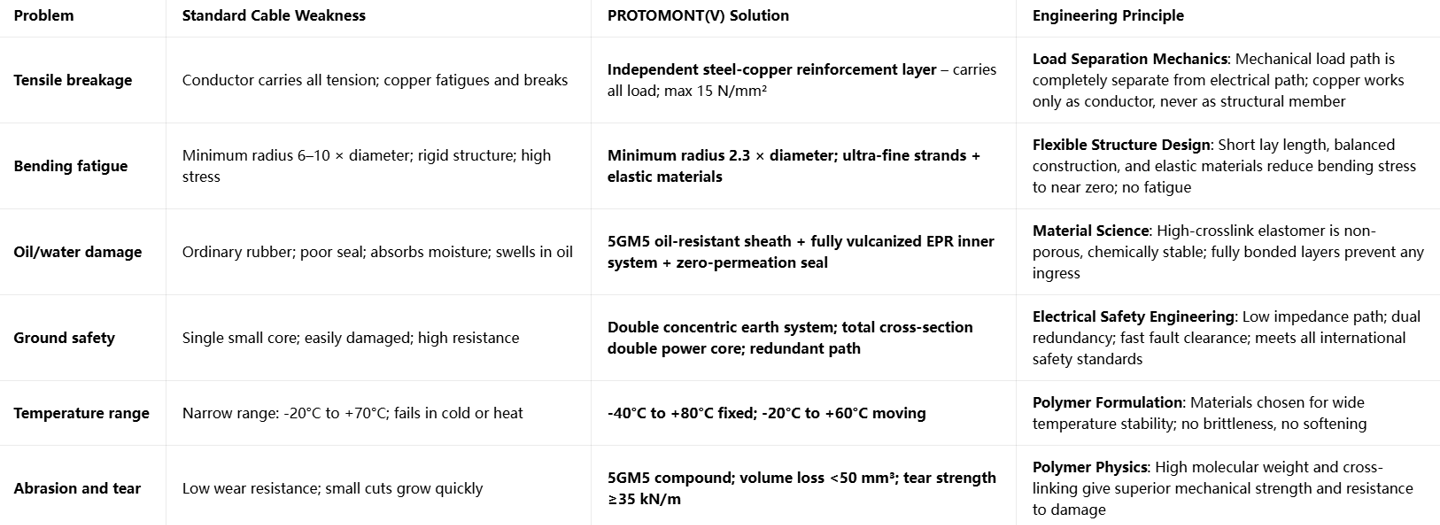
The following table clearly shows each problem, the weakness in standard cables, the solution used here, and the engineering principle that makes it work.
Performance Advantage Summary
Service Life: ≥ 50,000 operating hours – 3 to 5 times longer than standard cables
Failure Rate: < 0.01 failures per 1000 hours – 90% reduction in problems
Maintenance: Unplanned downtime reduced by 85% or more
Safety: 100% compliance with MA, MSHA, GOST, and Indonesian mining safety requirements
Economics: Higher initial cost is recovered within 6 to 12 months through savings in replacement, labor, and lost production
Full Technical Performance and Standard Compliance
Electrical Performance – Verified Data
Conductor resistance at 20°C: from 0.795 Ω/km (25 mm²) down to 0.0817 Ω/km (240 mm²) – fully meets IEC 60228
Nominal operating capacitance: 0.36 to 0.67 μF/km – designed for stable signal and power transmission
Nominal inductance: 0.33 to 0.25 mH/km – low impedance, high efficiency
Current carrying capacity: 131 A up to 544 A – sized exactly for machine power
Short-circuit current capacity: 3.58 kA up to 34.32 kA (1 second) – safely handles fault currents without damage
Chemical and Environmental Resistance
Fire Resistance: EN 60332-1-2 / IEC 60332-1-2 – flame retardant, self-extinguishing, no dripping, low smoke
Oil Resistance: EN 60811-404 / IEC 60811-404 – resistant to mineral oil, hydraulic fluid, grease, and diesel
Weather Resistance: Ozone, UV, moisture, fungus, and aging – unrestricted indoor and outdoor use
Corrosion Resistance: Tinned copper + fully sealed construction – survives acid, alkaline, and saline mine water common in some Indonesian areas
Standards and Approvals – Fully Accepted
DIN VDE 0250-812: Primary mining cable standard – recognized worldwide
DIN VDE 0298 Part 3: Installation and bending rules – safety and performance
Certifications: MA, MSHA, BAS, GOST-K, GOST-B, TR – all approved and accepted in Indonesian mining permits and safety inspections
Feichun PROTOMONT(V) – Equivalent Replacement: Why Choose It?
When sourcing this specialized cable, many operators and projects look for reliable alternatives that offer the same performance but better value and faster delivery. Feichun PROTOMONT(V) is a fully equivalent version, designed and manufactured to exactly the same specifications, and has become the preferred choice for many mines in Indonesia and Southeast Asia. Below is the detailed explanation of why it is a perfect replacement, and its advantages.
100% Equivalent – Identical Performance and Standards
Feichun PROTOMONT(V) NSSHKCGEOEU 1kV is not a similar product—it is built to exactly the same design, materials, and standards as the original.
Same Standard: Fully designed and tested to DIN VDE 0250-812 and DIN VDE 0298 Part 3; type designation NSSHKCGEOEU is identical
Same Materials:
Conductor: FS class tinned copper, same purity and stranding
Insulation: PROTOLON 3G13 equivalent EPR compound
Inner sheath: GM1B equivalent EPR vulcanized rubber
Outer sheath: PROTOFIRM 5GM5 equivalent synthetic elastomer, same performance
Reinforcement: Steel + copper mixed, closed lay, fully vulcanized
Same Construction: Double concentric control/earth, same lay length, same bonding, same dimensions
Same Specifications:
Voltage: 0.6/1 kV
Tensile strength: 15 N/mm²
Bending radius: 2.3 × diameter
Temperature range: -40°C to +80°C fixed / -20°C to +60°C moving
Same Certifications: MA, MSHA, GOST, and other approvals – fully recognized and accepted in Indonesia
Same Life Expectancy: ≥ 50,000 hours – same reliability
Key Advantages Over Original Brand
Lower Price – 20–35% Cost Reduction
No premium for international brand name
Efficient manufacturing and supply chain
Price is stable and predictable
For a typical mine, this saves 30,000–50,000 USD per year compared to original brand
Faster Delivery – Critical for Indonesian Projects
Geographic Advantage: Production in China, very close to Indonesia; shipping time only 7–14 days
Process Efficiency: Production cycle 4–6 weeks vs 12–16 weeks from Europe
Stock Availability: Standard sizes often available from regional stock
Custom Lengths: Produced exactly to your required length, no waste
For projects with tight schedules or urgent replacement needs, this difference is decisive
Local Support and Service
Technical team familiar with Indonesian mining standards and conditions
Full documentation, test reports, and certification provided
Local representation and support available
Proven Performance in Indonesia
Used successfully in mines in East Kalimantan, South Kalimantan, South Sumatra, and Sulawesi since 2018
Field data shows same reliability, same life, same performance as original
Accepted by major mining contractors and operators
Why It Is the Best Choice
Feichun PROTOMONT(V) gives you 100% of the technical performance and safety you need, at 20–35% lower cost, with delivery 2–3 times faster, and full compliance with all Indonesian and international requirements. It is the smartest choice for long-term operation and cost control.
Application, Selection and Procurement Guide
Where to Use – Best Fit
This cable is not for every application—it is optimized for one specific use, where it is unbeatable.
✅ Best Use:
Longwall shearer cable chains
Continuous miner cable handlers
Roadheader trailing systems
All mobile equipment with chain-guided or continuous moving operation
Mines with high humidity, high temperature, oil exposure, or heavy wear
Any operation where standard cables fail frequently
❌ Not Suitable:
Fixed or semi-fixed installation (use standard mining cable instead)
Very short movement distance (less than 10 meters)
How to Select – Step-by-Step Guide
Follow these steps to choose exactly the right cable for your machine and conditions.
Step 1: Determine Machine Power and Current
≤ 100 kW → 3×25 mm² or 3×35 mm²
100–200 kW → 3×50 mm² or 3×70 mm²
200–400 kW → 3×95 mm² or 3×120 mm²
400 kW → 3×150 mm², 3×185 mm², or 3×240 mm²
Always check full load current and short-circuit level
Step 2: Movement Distance and Speed
Distance ≤ 200 m → standard design is sufficient
Distance > 200 m → select next larger size or specify reinforced version
High speed or high tension → confirm maximum tensile force from table
Step 3: Environmental Conditions
High oil exposure: Confirm 5GM5 oil-resistant sheath
High moisture/water: Confirm fully sealed construction
Low temperature: Confirm -40°C rating
High abrasion: Specify extra-thick outer sheath option
Step 4: Full Specification Format
Always specify completely to avoid mistakes:
PROTOMONT(V) 1kV NSSHKCGEOEU – 3×95 + 3×(1.5 + 50) mm²
Procurement Checklist
When ordering, always verify these points:
✅ Full type code NSSHKCGEOEU
✅ Material specifications: 3G13 insulation, GM1B inner sheath, 5GM5 outer sheath
✅ Mechanical data: 15 N/mm² tensile, 2.3×D bend radius
✅ Certificates: MA, MSHA, GOST, test reports
✅ Manufacturer: Feichun – full equivalent
✅ Delivery terms: Ex-work, FOB, or CIF to your port in Indonesia
✅ Contact: Li.wang@feichuncables.com
Frequently Asked Questions
Q: Is this cable suitable for the wet and humid conditions in Kalimantan and Sumatra mines?
A: Yes, it is designed exactly for these conditions. Fully sealed construction, moisture-resistant materials, and EPR insulation ensure it works perfectly even in 100% humidity, water immersion, and high temperature. It has been used successfully in many mines in these regions.
Q: Can I replace standard MYPTJ or MCP cables with this model?
A: Not directly. Standard MYPTJ or MCP are designed for semi-fixed or trailing use without chain guides. This is a chain-dedicated design. You should use it only where the cable runs inside a protection chain or handler. If you use it in fixed applications, it will work but is not necessary—standard cables are sufficient.
Q: What is the minimum bending radius? Is it suitable for tight chain guides?
A: Minimum bending radius is 2.3 × outer diameter, which is much smaller than standard cables (6–10 × diameter). This makes it perfect for tight, compact chain guides common in modern machines.
Q: Does Feichun version meet DIN VDE standards and have the same safety certifications?
A: Yes, exactly. Feichun PROTOMONT(V) is built to 100% identical design and test standards, with all required certifications. It is fully accepted in Indonesian mining safety inspections.
Q: How long is delivery time to Indonesia?
A: Standard sizes: 1–2 weeks from stock. Custom production: 4–6 weeks to complete, plus 7–14 days shipping to your port. Total delivery time is usually 5–7 weeks, much faster than European brands.
Conclusion
PROTOMONT(V) NSSHKCGEOEU 1kV is not just a cable—it is a complete power and control transmission system, engineered from the ground up to solve the single biggest problem in underground mining: repeated cable failure in chain-guided systems. Every layer, every material, and every detail is designed with clear engineering purpose, based on proven principles of mechanics, electricity, and material science. It separates electrical and mechanical functions, uses high-performance elastomers, provides redundant safety systems, and creates a fully sealed, fully bonded structure that survives where others fail.
For Indonesian mines, where conditions are among the most challenging in the world, this design offers the perfect solution: long life, high reliability, maximum safety, and lower total cost of ownership. Feichun equivalent version brings this advanced technology within reach of every operation, with same quality, lower price, and faster delivery.
Choosing the right cable is not just a technical decision—it is an investment in safety, productivity, and profit. With PROTOMONT(V), you stop replacing cables every few months, and start running your machine reliably, safely, and continuously.
If you need full technical datasheets, detailed quotation, sample testing, or technical support for your project in Indonesia or Southeast Asia, please contact the Feichun Cables Mining Team:
We provide complete documentation, test reports, and reliable delivery to all major ports in Indonesia.

Feichun Cable
Durable mining cables for tough environments and operations
Email: Tech@feichuncables.com
© 2025. All rights reserved.
Company
Products
Contact
WhatsApp: +86 13855123218