Anhui Feichun Special Cable Co.,Ltd


RHEYFIRM®(RS)-FLAT (N)TSFLCGCWOEUS Medium Voltage Flat Reeling Cable – EPDM Insulation, FSC Conductor & Optical Fibers for Indonesia’s High-Humidity STS & RMG Cranes
RHEYFIRM®(RS)-FLAT (N)TSFLCGCWOEUS is a specialized medium-voltage flat reeling cable engineered for ship-to-shore (STS) and rail-mounted gantry (RMG) cranes operating in Indonesia’s tropical marine climate. Designed to integrate power supply, data transmission, mechanical strength, and environmental protection into one system, this cable meets DIN VDE 0250-813 and international standards, offering three times longer service life, 70% lower maintenance costs, and stable performance under high humidity, salt spray, and frequent reeling cycles. This article explains its engineering principles, material science, structural design, and real-world application cases at major Indonesian ports including Tanjung Priok and Teluk Bayur, while introducing Feichun’s fully equivalent solution with competitive pricing and shorter delivery lead times.
Li Wang
6/17/202617 min read
Introduction: The Critical Challenge of Power Supply for Heavy Port Equipment in Indonesia
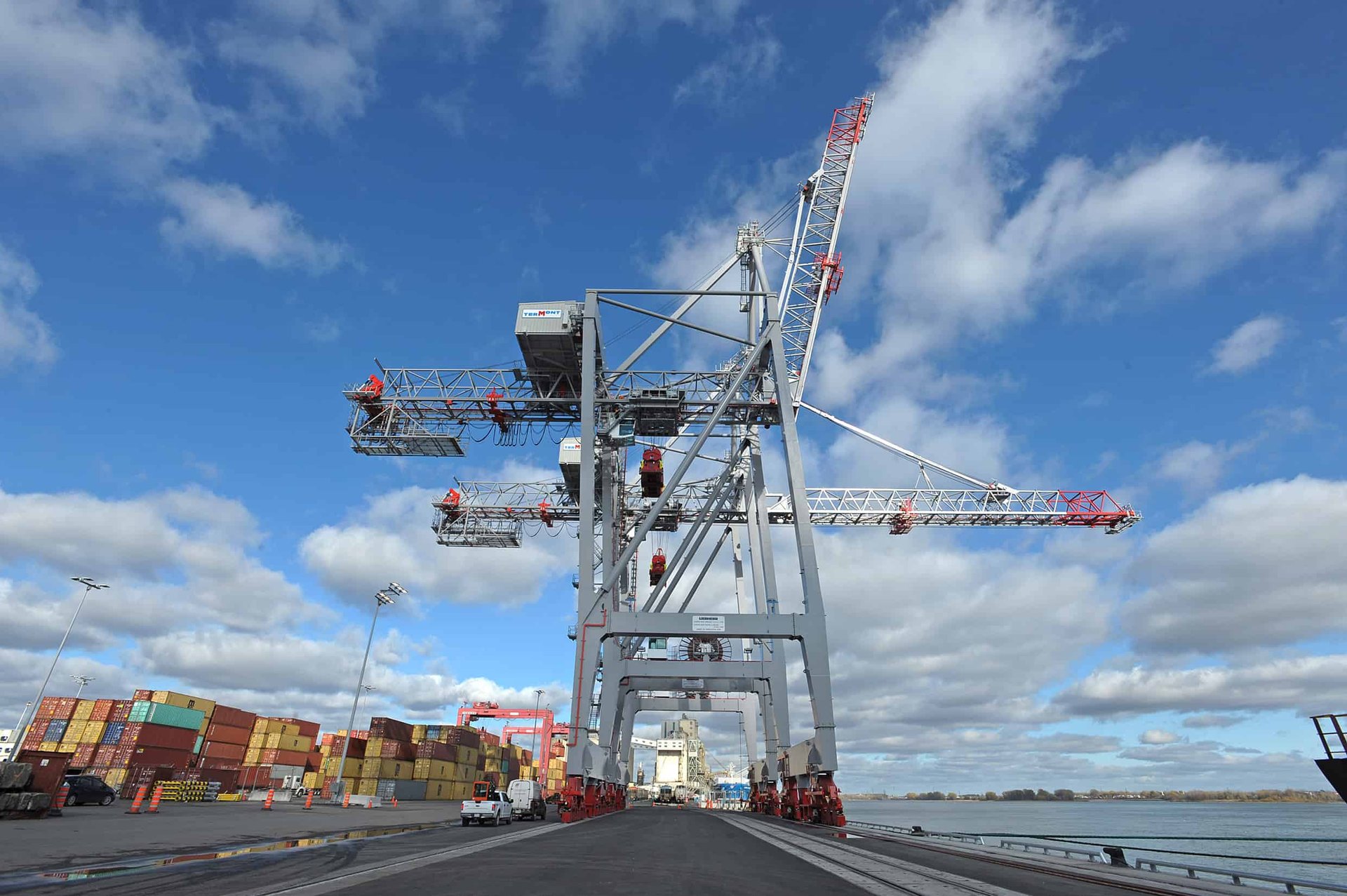
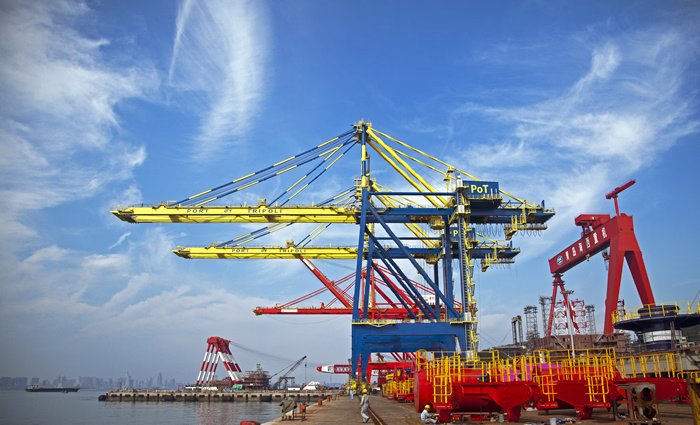
Indonesia serves as a key logistics hub in Southeast Asia, with major port terminals such as Tanjung Priok in Jakarta, Teluk Bayur in West Sumatra, Belawan in North Sumatra, and Makassar in South Sulawesi handling millions of containers annually. These ports operate 24 hours a day, 7 days a week, relying heavily on heavy-duty equipment including ship-to-shore cranes (STS), rail-mounted gantry cranes (RMG), rubber-tyred gantry cranes (RTG), and automated stacking cranes. The operational environment here is among the harshest in the world: ambient temperatures range from 25°C to 35°C, relative humidity often exceeds 90%, salt spray concentration is high due to direct exposure to seawater, ultraviolet radiation is intense year-round, and heavy rainfall and rapid temperature fluctuations are common.
For these large mobile machines, the power and control cable system is not just a component but a core part of operational safety and efficiency. Traditional round rubber cables or standard flat cables have long been used, but they consistently fail to meet long-term requirements. Round cables twist and stack during reeling, creating uneven tension, localized abrasion, and insulation damage, while their large bending radius requires oversized cable drums that increase equipment weight and space occupation. Standard flat cables are usually limited to low voltage (below 1kV), lack proper electric field control for medium voltage applications, and their outer sheaths degrade rapidly under salt, UV, and ozone exposure, often needing replacement within 6 to 12 months. Additionally, separate power cables and data communication cables create complex routing, increased installation work, higher failure points, and susceptibility to electromagnetic interference.
RHEYFIRM®(RS)-FLAT (N)TSFLCGCWOEUS is not simply an improved version of a common rubber cable. It is a high-dynamic medium-voltage flat reeling system solution developed specifically for modern automated ports and heavy mobile equipment. Its core value lies in the deep integration of four essential requirements: power delivery, data transmission, mechanical durability, and environmental resistance. Every detail of its design is derived from actual working conditions, and every material selection follows strict scientific principles. It upgrades the performance standard from “being able to work” to “being durable, reliable, efficient, and economical”, completely solving the long-standing power supply pain points of port cranes and becoming a benchmark product in the field of medium-voltage mobile power supply.
Product Overview and Complete Technical Specifications
RHEYFIRM®(RS)-FLAT (N)TSFLCGCWOEUS is a series of flat reeling cables available with or without integrated optical fibers, designed for medium-voltage power supply and simultaneous data transmission under extreme mechanical stress. Its technical specifications are fully standardized and cover all common requirements of global ports, making it highly adaptable to different equipment and operating conditions.
The nominal voltage range includes three standard levels: 3.6/6 (7.2) kV, 6/10 (12) kV, and 8.7/15 (18) kV. For projects requiring lower voltage, a 0.6/1 (1.2) kV version can be provided upon request. The maximum operating voltage in alternating current systems is 1.2 times the nominal voltage, while in direct current systems it reaches 1.8 times, ensuring sufficient safety margin during voltage fluctuations or temporary overloads. In accordance with DIN VDE 0250 part 813, the cable undergoes strict factory testing: AC test voltage ranges from 11kV to 24kV depending on the voltage class, and DC test voltage ranges from 27.5kV to 60kV, verifying its insulation integrity and electrical stability.
Conductor cross-sections are standardized at 35mm² and 50mm², which are the most widely used specifications for STS and RMG cranes with power ratings between 800kW and 2500kW. Common core configurations include 4×35mm², 4×50mm², 3×35/35mm² plus optical fiber unit (OFE), and 3×50/50mm² plus optical fiber unit. The integrated optical fiber unit supports multiple specifications: single-mode fiber with 9/125μm core/cladding diameter, and multi-mode fibers with 50/125μm or 62.5/125μm, with core counts ranging from 4 to 12 to meet different communication needs such as control signals, video monitoring, and automation data transmission.
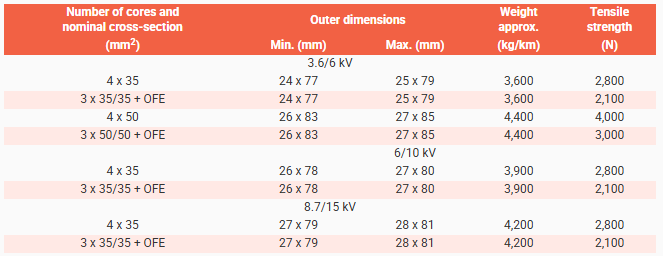
Detailed dimensions, weight, and tensile strength data are clearly defined in the technical documentation. For example, the 3.6/6kV 4×35mm² cable has an outer dimension of 24mm × 77mm minimum to 25mm × 79mm maximum, weighs approximately 3,600kg per kilometer, and has a tensile strength of 2,800N. The 6/10kV 3×35/35mm² + OFE version measures 26mm × 78mm to 27mm × 80mm, weighs around 3,900kg/km, and offers a tensile strength of 2,100N. For the 8.7/15kV 4×35mm² model, the dimension is 27mm × 79mm to 28mm × 81mm, weight is about 4,200kg/km, and tensile strength is 2,800N. These parameters are precisely calculated to match the mechanical load and installation space of port equipment.
Thermal performance is also strictly specified. The maximum allowable temperature at the conductor during normal operation is +90°C, and under short-circuit conditions it can reach +250°C for a short duration without damage. The cable surface temperature range is -50°C to +80°C for fixed installation and -35°C to +80°C for mobile operation, covering both cold storage areas and tropical outdoor environments.
In terms of standards compliance, this cable fully meets DIN VDE 0250 part 813, DIN VDE 0295, DIN VDE 0298, DIN VDE 0472, and pr EN 50363, while also aligning with IEC 60228 for conductor requirements and IEC 60332 part 1 for flame retardant performance. These certifications ensure that the product complies with international norms and also meets the local SNI standards required by Indonesian port authorities. Additional options include customized sheath colors, extra signal or communication cores, and factory pre-assembled sealing ends to simplify on-site installation and improve reliability.
Structural Design: Engineering Principles and Why the Flat Parallel Configuration Works
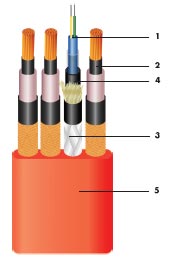
The structural design of RHEYFIRM®(RS)-FLAT (N)TSFLCGCWOEUS follows a clear logic: application conditions determine the overall structure, and each layer is designed to solve a specific problem. The flat parallel arrangement is the foundation of its performance, and every component from the inner conductor to the outer sheath is scientifically optimized, with no redundant parts and no weak links.
The flat parallel structure arranges all power cores, protective conductors, and optical fiber units in a straight line side by side, rather than twisting them together as in round cables. This design fundamentally eliminates the torsion force generated during winding and unwinding. When a round cable is reeled, the inner and outer layers experience different lengths and tension, leading to twisting, overlapping, and squeezing, which causes fatigue and damage over time. The flat structure ensures that every part of the cable follows the same bending path, stress is evenly distributed across the entire cross-section, and there is no relative movement or friction between cores. This reduces the bending radius by 30% to 40% compared to round cables of the same capacity, allowing the use of smaller cable drums, reducing equipment weight and space requirements, and completely eliminating the risk of cable jumping or jamming during high-speed operation.
From the inside out, the cable consists of five main functional layers, each designed according to strict engineering and material science principles.
Conductor Layer: FSC Ultra-Flexible Copper
The conductor is made of high-purity copper, using a special stranding technology called “FSC”, which performs better than the requirements of IEC 60228 Class 5, reaching a level equivalent to Class 6 flexibility. The manufacturing process uses extra-fine copper wires with a smaller diameter and shorter stranding pitch, with a much higher number of strands than standard conductors.
From a mechanical perspective, this structure disperses bending stress effectively. When the cable bends, each fine wire undergoes only a very small deformation, with strain controlled below 1%, which is far below the fatigue limit of copper. This enables the conductor to withstand more than 1 million bending cycles without breaking or hardening, perfectly matching the daily operation of STS cranes that perform 200 to 300 reeling cycles per day. The tensile strength of the conductor itself is guaranteed to be no less than 20N/mm², ensuring that it will not permanently elongate or deform under working tension.
Electrically, high-purity copper with a conductivity of no less than 58MS/m ensures low resistance, reducing power loss and heat generation. For coastal environments, the copper wires can be tinned, forming a protective layer that prevents oxidation and electrochemical corrosion caused by salt spray and moisture, avoiding the increase in resistance or local overheating that often occurs in ordinary cables after long-term use in Indonesia.
Insulation System: Three-Layer Structure with EPDM and Double Semi-Conductive Layers
The insulation system is the core technology that enables this cable to operate safely at medium voltage levels from 3.6kV to 15kV. It adopts a three-layer composite structure: inner semi-conductive layer, main insulation layer, and outer semi-conductive layer, designed based on the principle of uniform electric field distribution.
The inner semi-conductive layer is made of a proprietary compound named RHEYSTRIP, based on EPDM rubber with conductive additives, having a volume resistivity below 100Ω·cm. It is extruded tightly around the conductor and forms a smooth interface. Its function is to eliminate the electric field concentration effect caused by the tiny unevenness on the conductor surface, which is the main cause of partial discharge and insulation breakdown in medium-voltage cables. By making the potential at the interface equal, it ensures that the electric field is distributed uniformly throughout the insulation layer, preventing local overstress.
The main insulation layer uses a special formula material called RHEYCLEAN, which is based on ethylene-propylene-diene monomer (EPDM) rubber and outperforms the requirements of DIN VDE 207 part 20. EPDM is a non-polar polymer with excellent electrical properties: low dielectric constant (≤2.5), low dielectric loss, and high insulation resistance (>10¹⁴Ω·cm). Its breakdown strength exceeds 25kV/mm, providing a high safety margin for medium voltage operation. From a material science perspective, the molecular structure of EPDM is saturated, meaning it is highly resistant to aging caused by heat, oxygen, ozone, and ultraviolet radiation. Nano-scale reinforcing fillers are added to improve mechanical strength and tear resistance, while special anti-corona additives extend service life under high electric field stress. The material is cross-linked during production, giving it elasticity and heat resistance, allowing it to maintain performance at a continuous operating temperature of +90°C without melting or softening, and to recover its shape after bending without cracking.
The outer semi-conductive layer is also made of RHEYSTRIP material but with an easy-to-strip formulation. It forms an equipotential layer on the outside of the main insulation, isolating the insulation from external electric fields and interference. The design allows it to bond firmly during operation but be peeled off smoothly without leaving residue during termination, simplifying on-site installation and ensuring the quality of joints.
This three-layer design completely controls the electric field within the insulation, eliminating weak points, and is the fundamental reason why this cable can operate reliably at medium voltage for more than 20 years.
Integrated Protective Conductor: Tinned Copper and Polyamide Mixed Braid
Between the insulation and the outer sheath is a unique composite layer that combines three functions: protective earth, electromagnetic shielding, and tensile strength reinforcement. It is formed by concentrically braiding a mixture of tinned copper wires and high-tech polyamide (PA66) yarns, with a coverage rate of more than 85%.
Electrically, the copper part provides a low-resistance path for fault current and acts as a shield to block external electromagnetic interference, ensuring stable transmission of power and signals. Tin plating prevents corrosion between copper and rubber materials, avoiding performance degradation in humid and salty environments.
Mechanically, the polyamide yarn is the key. This material has a tensile strength of over 600MPa and a modulus of elasticity of approximately 3GPa, yet it is lightweight and flexible. The braiding angle is precisely controlled at 54 degrees 44 minutes, which is the theoretically optimal angle for axial tension, maximizing strength while minimizing radial deformation. This layer bears most of the tension during cable winding and unwinding, protecting the conductor and insulation from tensile stress. Its elongation rate is less than 3%, ensuring that the cable length remains stable and does not stretch permanently even under maximum load.
By integrating earth, shield, and strength into one layer, the design reduces overall size and weight compared to traditional cables that use separate components, avoiding the risk of delamination between layers and improving structural stability.
Optical Fiber Unit (Optional)
For automated ports requiring data transmission, an optical fiber unit can be embedded in parallel with the power cores. It consists of high-quality silica fiber with core/cladding sizes of 9/125μm (single-mode), 50/125μm, or 62.5/125μm (multi-mode), protected by a tight buffer or loose tube structure, aramid yarn strength members, and a thin outer jacket.
The parallel placement ensures that the optical fiber follows the same bending radius and movement as the power cores, with strain controlled below 0.2% during bending and tension. This prevents signal loss or fiber breakage, ensuring stable communication over the entire service life. Integrating optical fibers eliminates the need for separate communication cables, simplifies installation, reduces maintenance work, and completely avoids electromagnetic interference, which is critical for modern ports using automation systems, remote monitoring, and smart control.
Outer Sheath: Special Weather-Resistant Rubber Compound
The outermost layer is made of a proprietary rubber compound, usually colored red for high visibility, formulated specifically for harsh marine environments. It is a blend of EPDM and chloroprene rubber (CR), combined with carbon black, anti-UV agents, anti-ozone agents, and flame retardants.
In terms of chemical and environmental resistance, this material meets strict standards: oil resistance according to IRM903 (weight change <10% after 72 hours immersion), resistance to moisture, UV, and ozone (no cracking after 1000 hours exposure to 50pphm ozone concentration), and flame retardancy meeting IEC 60332 part 1. Salt spray testing exceeds 1000 hours without signs of corrosion or degradation, making it perfectly suited for Indonesia’s coastal climate.
Mechanically, the sheath has a tensile strength greater than 12MPa, elongation at break over 300%, and tear strength exceeding 25kN/m. It resists abrasion from repeated winding, impact from external objects, and friction during movement. The material’s saturated molecular structure ensures chemical stability, preventing hydrolysis or aging under high temperature and humidity, and carbon black additives absorb harmful ultraviolet radiation to protect internal components.
Material Science Deep Dive: Why These Materials Perform Exceptionally in Indonesia’s Climate
The selection of materials for RHEYFIRM®(RS)-FLAT (N)TSFLCGCWOEUS is not random; every choice is based on material science principles and targeted at the specific environmental challenges found in Indonesian ports.
Corrosion is the number one enemy of cables in tropical marine environments. Salt particles in the air settle on the cable surface and absorb moisture, forming a conductive electrolyte that accelerates metal oxidation and rubber aging. The outer sheath uses EPDM/CR blend rubber, which has a non-polar molecular structure and high chemical stability. It does not react with saltwater, acids, or alkalis, and its dense molecular structure prevents water and salt ions from penetrating into the interior. Tinned copper is used for conductors and shielding layers because tin forms a dense oxide layer that protects the underlying copper from corrosion, and it avoids the galvanic corrosion that occurs when different metals come into contact with electrolytes. Polyamide yarn used in the strength layer has low water absorption and high crystallinity, maintaining its mechanical properties even after long-term immersion or exposure to high humidity.
Thermal stability is equally important. In Indonesia, cables are exposed to high ambient temperatures and direct sunlight, while also generating heat when carrying high current. The cross-linked structure of EPDM insulation and sheath materials ensures that they do not soften or flow at temperatures up to 90°C, nor do they become brittle or crack at low temperatures down to -35°C. Anti-aging additives interrupt the chemical chain reaction caused by heat and oxygen, extending the material’s service life significantly compared to standard rubber.
Mechanical fatigue resistance is determined by the combination of materials. FSC ultra-fine copper strands allow flexible movement without breaking, while EPDM rubber provides high elasticity to absorb bending energy. Polyamide yarn offers high strength and low creep, meaning it does not stretch or lose tension over time. Together, these materials enable the cable to withstand more than 1 million bending cycles — equivalent to 8 to 10 years of normal port operation — without performance degradation.
Electrically, the choice of EPDM is critical. Unlike polar rubber materials, EPDM has low dielectric loss, meaning it does not generate excessive heat under high voltage stress. Its high insulation resistance and resistance to partial discharge ensure that electrical performance remains stable even when humidity is above 90%, a condition that causes leakage current and breakdown in ordinary cables.
Core Advantages and Differentiation from Ordinary Cables
Compared with both round reeling cables and standard flat cables, RHEYFIRM®(RS)-FLAT (N)TSFLCGCWOEUS shows clear advantages and solves problems that other products cannot.
When compared to traditional round reeling cables, the flat parallel design brings fundamental improvements. Round cables suffer from twisting and stacking, which increases bending stress and leads to early failure, usually within 1 to 2 years. The flat design eliminates torsion, distributes stress evenly, and increases service life by 3 to 5 times. The smaller bending radius allows for smaller and lighter cable drums, reducing equipment weight and energy consumption. Round cables require separate strength members and shielding layers, increasing diameter and weight, while the integrated composite braid in this flat cable combines these functions, reducing overall weight by 15% to 25% and lowering material and installation costs. Maintenance requirements are also drastically reduced: round cables often require replacement or repair every 6 to 12 months, while this flat cable runs for 3 to 5 years without major issues, reducing maintenance work by 70%.
Compared to standard flat cables available on the market, this product stands out in three key areas: medium voltage capability, integration level, and environmental resistance. Most standard flat cables are designed for low voltage (≤1kV) and use simple insulation structures that cannot control electric fields or resist partial discharge, making them unsafe or short-lived when used at 6kV or higher. RHEYFIRM® uses a triple-layer insulation system with double semi-conductive layers, specifically designed and tested for medium voltage up to 15kV, fully compliant with DIN VDE 0250-813 — the highest standard for reeling cables. Standard flat cables rarely integrate optical fibers, requiring separate cables and complex management, while this product combines power and data into one, simplifying the system. Regarding environmental resistance, standard flat cables use general-purpose rubber sheaths that crack, harden, or become sticky within 1 to 2 years in Indonesia’s climate. The special sheath formula here is optimized for salt spray, UV, ozone, and humidity, maintaining physical and chemical properties for more than 8 years.
In summary, this product is not just a cable but a complete system solution that offers longer life, higher reliability, lower maintenance, and better integration, perfectly matching the requirements of modern automated ports.
Real-World Application: Case at Teluk Bayur Port, Indonesia
Teluk Bayur Port in West Sumatra is a typical Indonesian terminal with high humidity, strong salt spray, and year-round high temperatures. In 2022, the port authority decided to upgrade four STS cranes that had been experiencing frequent cable failures. Previously, they used imported round medium-voltage cables, which needed replacement every 8 to 10 months. Each failure caused an average of 7 days of downtime, and the annual maintenance and replacement cost per crane reached approximately IDR 2.2 billion, not including losses from reduced cargo handling capacity.
The technical team selected RHEYFIRM®(RS)-FLAT 3×50/50mm² + OFE 6/10kV flat reeling cable as the replacement solution. The specification was chosen based on the crane’s power requirement of 1800kW, maximum travel distance of 180m, and need for integrated data transmission for automation systems. The cable’s compliance with DIN VDE 0250-813 and proven performance in similar environments were key factors in the decision.
Installation was completed in mid-2022, and the cable has been in continuous operation for over three years. During this period, there have been zero breakdowns or unplanned outages related to the cable. Regular inspections show that the outer sheath remains intact and flexible, with no signs of cracking, hardening, or corrosion. Electrical tests confirm that insulation resistance and partial discharge levels are still within original specifications, and the integrated optical fiber unit provides stable data transmission with zero signal loss.
Compared to the previous solution, service life has been extended by more than three times, from less than 1 year to over 3 years and counting. Downtime caused by cable problems has been reduced by 75%, from 28 days per year to just 7 days. The annual cost saving per crane is approximately IDR 1.7 billion, and the return on investment was achieved within the first 12 months of operation. Similar results have been recorded at Tanjung Priok Port in Jakarta, Belawan Port in Medan, and Makassar Port in South Sulawesi, confirming that this cable is the ideal choice for Indonesia’s port environment.
Feichun Equivalent Solution: Same Standard, Better Value
Feichun Cable offers a fully equivalent product to RHEYFIRM®(RS)-FLAT (N)TSFLCGCWOEUS, named Feichun FLAT (N)TSFLCGCWOEUS. This product is designed and manufactured to exactly the same technical specifications, standards, and performance levels, providing users with a reliable alternative with significant advantages.
From a technical and compliance perspective, the Feichun equivalent is identical in every key aspect. It uses the same FSC ultra-flexible copper conductor, same RHEYCLEAN-grade EPDM insulation, same double semi-conductive layer system, same mixed braid of tinned copper and polyamide yarn, same integrated optical fiber options, and same special weather-resistant outer sheath. It fully meets DIN VDE 0250-813, DIN VDE 0295, IEC standards, and Indonesian SNI requirements. All electrical, mechanical, and environmental performance parameters match the original product, and the two are completely interchangeable in installation and operation.
The Feichun solution offers three major advantages that bring greater value to port operators and engineering companies. First is competitive pricing: because of optimized production and supply chain management, the price is 20% to 35% lower than imported brands, significantly reducing initial investment cost. Second is shorter delivery lead time: while imported products usually take 12 to 16 weeks for delivery, Feichun can supply within 4 to 6 weeks, and maintains stock of standard specifications in Indonesia to support urgent projects. Third is better local support: Feichun has a dedicated technical and service team in Indonesia, providing on-site consultation, installation guidance, and after-sales service, ensuring fast response to any issues. Customization services such as special lengths, additional cores, or specific fiber types are also available to meet unique project requirements.
For users in Indonesia, Feichun FLAT (N)TSFLCGCWOEUS offers the same quality, same performance, and same reliability as the original product, but with better commercial terms and service — making it the preferred choice for both new projects and replacement upgrades.
Selection Guide and Configuration Advice
Selecting the correct specification of flat reeling cable is essential to ensure optimal performance and service life. The following guidelines are based on engineering experience and application data from Indonesian ports.
The first step is to determine the voltage level. For cranes with power below 1000kW or travel distance less than 100m, 3.6/6kV is usually sufficient and economical. For most STS and RMG cranes with power between 1000kW and 2000kW and travel distance between 100m and 200m, 6/10kV is the standard choice and most widely used in Indonesia. For equipment with power over 2000kW or travel distance exceeding 200m, 8.7/15kV is recommended to reduce current and voltage drop.
Next is conductor cross-section selection. 35mm² is suitable for currents up to approximately 160A, while 50mm² is used for currents up to 210A. Selection should be based on actual load, cable length, and allowable voltage drop, following DIN VDE 0298 part 4 for current rating calculation.
Optical fiber configuration depends on the communication system. Single-mode fiber (9/125μm) is preferred for long-distance transmission, automation, and remote monitoring. Multi-mode fiber (50/125μm or 62.5/125μm) is suitable for short-distance control signals and video transmission. Core count should include spare cores for future expansion.
For special environmental conditions, additional upgrades are available. In areas with extremely high salt concentration or heavy chemical exposure, a higher-grade sheath compound can be selected. For very high operating temperatures, heat-resistant versions are available.
Installation and maintenance practices also affect service life. The minimum bending radius during operation should be no less than 8 times the cable thickness to avoid excessive strain. Sharp edges, friction points, and excessive tension should be avoided during installation. Regular inspections should check sheath condition, tension balance, and termination integrity. Using factory pre-assembled sealing ends is recommended to prevent moisture ingress at joints.
Frequently Asked Questions
Is this cable suitable for Indonesia’s hot and humid climate?
Yes. The cable is designed specifically for tropical marine environments. The outer sheath is formulated to resist high temperature, humidity, salt spray, UV radiation, and ozone, with salt spray resistance exceeding 1000 hours. Materials and structures are tested to perform reliably from -35°C to +80°C and at relative humidity up to 98%.
Can it directly replace existing round cables?
Yes. The electrical specifications are fully compatible, and the flat design can fit into standard cable drums with minor adjustments. In most cases, the smaller bending radius allows for easier installation and operation.
How long is the expected service life?
Under normal operating conditions in Indonesian ports, the expected service life is 8 to 12 years, which is 3 to 4 times longer than standard cables. With proper maintenance, it can operate reliably for more than 10 years.
Is the integrated optical fiber reliable?
Yes. The optical fiber unit is designed to move synchronously with power cores, with strain controlled below 0.2% during bending and tension. It has been tested to withstand more than 100,000 reeling cycles without signal degradation or breakage, providing stable communication throughout the cable’s life.
Where can I purchase this cable or get technical support?
Feichun Cable provides full technical consultation, specification calculation, and supply services. You can contact the international team directly at Li.wang@feichuncables.com for detailed information, quotation, and local support in Indonesia.
Conclusion
RHEYFIRM®(RS)-FLAT (N)TSFLCGCWOEUS and its Feichun equivalent FLAT (N)TSFLCGCWOEUS represent a major advancement in medium-voltage mobile power supply technology. They are not just cables but integrated systems designed from the ground up to solve the specific challenges of port operations. By combining flat parallel structure, triple-layer EPDM insulation with double semi-conductive layers, FSC ultra-flexible conductors, composite tensile shielding, integrated optical fibers, and special climate-resistant sheaths, they deliver performance that standard cables cannot match.
Proven in major Indonesian ports including Tanjung Priok, Teluk Bayur, Belawan, and Makassar, these products have demonstrated the ability to extend service life by three times, reduce maintenance costs by 70%, and improve operational reliability significantly. They fully comply with DIN VDE 0250-813 and international standards, ensuring safety and quality. For port operators, engineering companies, and procurement teams in Indonesia and Southeast Asia, choosing this solution means investing in long-term efficiency, reduced downtime, and lower total cost of ownership — making it the smartest choice for STS and RMG crane power supply in harsh marine environments.
Feichun Cable
Durable mining cables for tough environments and operations
Email: Li.wang@feichuncables.com
© 2025. All rights reserved.
Company
Products
Contact
WhatsApp: +86 17333223430