Anhui Feichun Special Cable Co.,Ltd


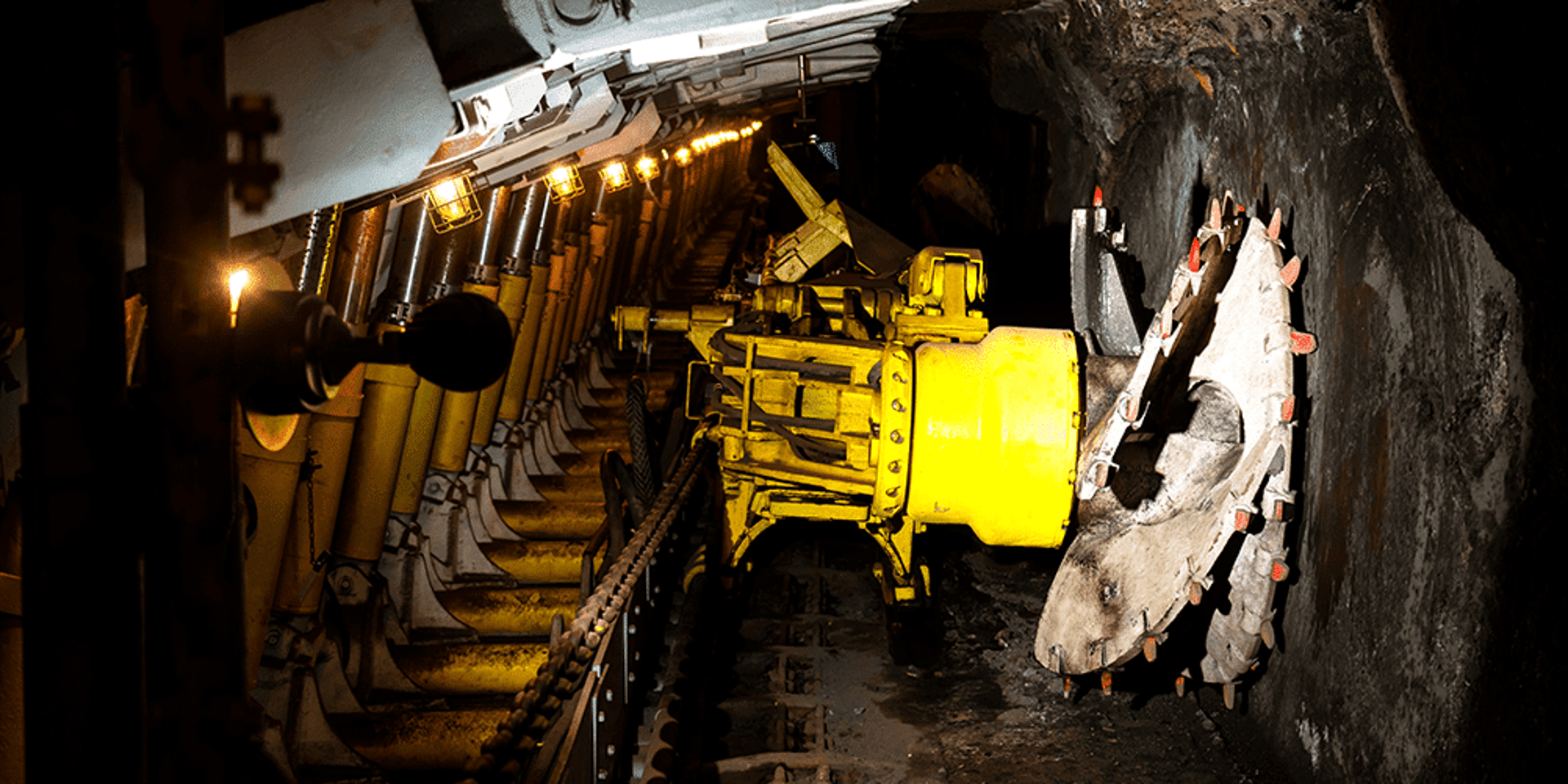
PROTOMONT(V) NTSKCGECWOEU Coal Cutter Cable: Revolutionary EPR-Insulated Chain Handler Design for Underground Longwall Mining – Specs, Standards & Advantages
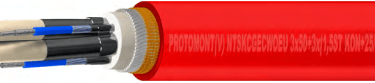
PROTOMONT(V) NTSKCGECWOEU is a revolutionary EPR-insulated cable purpose-built for chain-guided operations in underground coal mines. Designed to DIN VDE 0250-813 and IEC standards, it solves the critical failure issues of conventional cables in harsh mining environments—including high tension, repeated bending, moisture, oil, and chemical exposure. This article provides a complete technical breakdown: structure, material science, engineering principles, performance advantages, and practical selection guidance. It also explains why Feichun’s equivalent version is the ideal choice for mines across Indonesia, delivering identical quality at lower cost with faster delivery. Suitable for engineers, procurement teams, and mining operators in Kalimantan, Sumatra, and all major coal-producing regions.
Li Wang
6/10/202617 min read
Introduction
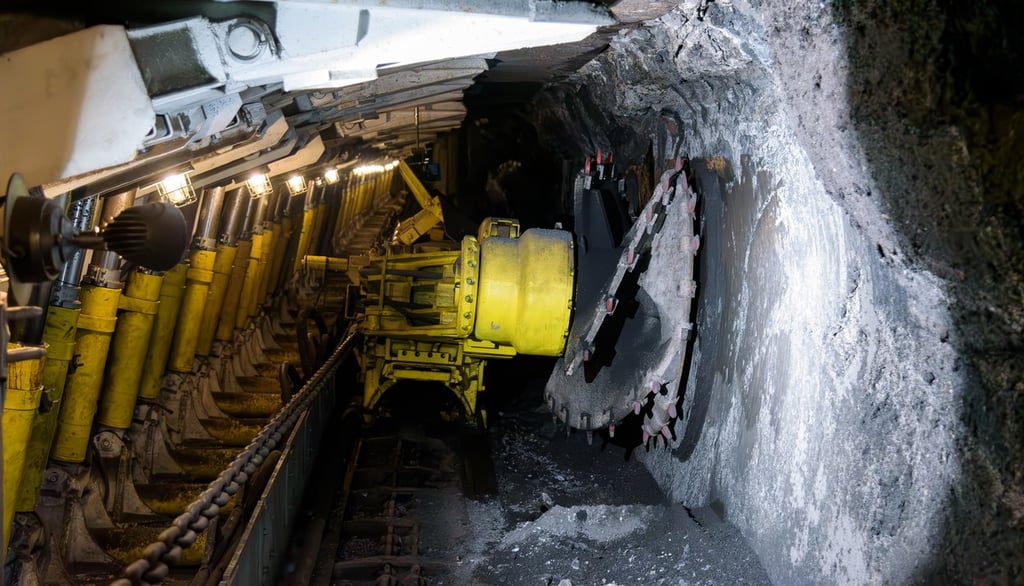
Underground longwall mining is one of the most demanding industrial environments in the world. In Indonesia, where vast coal reserves lie beneath Kalimantan, Sumatra, and Sulawesi, mining operations face unique challenges: high humidity, aggressive mine water containing salts and acids, abrasive dust, extreme temperature variations, and continuous mechanical stress from moving machinery. Among all equipment components, power and control cables for coal cutters and shearers are among the most critical—and most vulnerable. These cables must follow the machine as it advances, bend repeatedly, bear heavy tension loads, and resist damage from impacts, abrasion, and chemical attack.
For decades, mining operators struggled with a common problem: standard flexible cables would fail prematurely. Breakage, insulation breakdown, sheath tearing, and core damage were frequent, leading to unplanned downtime, high maintenance costs, and significant safety risks. In many Indonesian mines, operators reported replacing cables every 12 to 18 months, with some heavy-duty applications requiring replacement even more often. This not only increased operational expenses but also disrupted production schedules and raised safety concerns for workers.
It was to address these exact challenges that PROTOMONT(V) NTSKCGECWOEU was developed. This product is not simply an upgraded version of a standard cable—it is a completely re-engineered system designed exclusively for use in cable protection chains, also known as cable handlers. Every element of its design, from conductor material to outer sheath compound, is optimized to perform under the specific conditions of underground mining. Through a combination of structural innovation, advanced material science, and precise application of electrical and mechanical engineering principles, it eliminates the root causes of failure found in conventional cables. Today, it is recognized globally as the benchmark for performance and reliability in longwall mining, and it has become the preferred choice for major mining projects across Southeast Asia, including many operations in Indonesia.
This article explores every aspect of this revolutionary cable. We will examine its technical specifications, break down its layered construction, explain the scientific principles behind its materials and design, and compare it directly with standard cables to understand exactly how and why it performs so much better. We will also discuss the equivalent solution offered by Feichun, which delivers identical performance while providing significant advantages in cost and delivery speed, making it highly suitable for Indonesian market requirements. Finally, we will provide practical guidance on selection, procurement, and application, along with answers to the most common questions asked by engineers and buyers.
Basic Information and Technical Specifications
Product Identification and Designation
The full product name is PROTOMONT(V) NTSKCGECWOEU. This alphanumeric code is not arbitrary; each letter represents a specific design feature, following the standard designation system used in European cable engineering. Understanding this code is essential for correct specification and ordering:
N: Standard design according to national and international norms
T: Copper conductor material
S: Flexible construction, suitable for repeated movement
K: Equipped with control cores
C: Includes conductive layer for screening or earthing
G: Reinforced or armoured construction for mechanical protection
E: Insulation made from ethylene propylene rubber (EPR)
C: Inner sheath made from rubber compound
W: Resistant to mineral oils and hydraulic fluids
O: Resistant to weathering, ozone, and moisture
E: Flame-retardant properties
U: Specifically designed for use in cable protection chains or handlers
This designation immediately tells engineers that this is a highly specialized cable, built to meet strict performance criteria across electrical, mechanical, and environmental categories.
Applicable Standards and Certifications
One of the most important aspects of PROTOMONT(V) NTSKCGECWOEU is that it is fully designed, tested, and certified to international standards. This ensures consistent quality, safety, and compatibility with global mining specifications, which is critical for projects in Indonesia that often follow international engineering guidelines.
Primary Standard: DIN VDE 0250-813 – This is the German standard specifically for flexible cables for mining machinery, particularly those used in cable protection systems. It defines all requirements for materials, construction, testing, and performance.
Additional Standards:
IEC 60228: Conductors of insulated cables
IEC 60502: Power cables with extruded insulation and their accessories
IEC 60332: Tests on electric cables under fire conditions
IEC 60811: Common test methods for insulating and sheathing materials
Certifications and Approvals:
MSHA (Mine Safety and Health Administration): Certification for use in US mines, widely accepted as a global benchmark for mining safety.
WUG (Poland): Approval for use in Polish mining operations, applicable to 6kV versions.
Russian Fire Safety Certificate: Confirmation of flame-retardant and low-fire-hazard properties.
For Indonesia, these standards align closely with national safety and performance requirements, and the cable meets or exceeds all criteria set by local mining authorities.
Voltage Ratings and Electrical Parameters
Electrical performance is the foundation of any power cable, and PROTOMONT(V) NTSKCGECWOEU is engineered to operate reliably in medium-voltage systems commonly used in longwall mining. Two main voltage classes are available:
1.8/3 kV: Suitable for low-to-medium power coal cutters and auxiliary equipment
3.6/6 kV: Designed for high-power shearers and heavy-duty machinery, the most widely used version in modern Indonesian mines
Key electrical specifications include:
Maximum permissible operating voltage (AC): 4.2/7.2 kV
Maximum permissible operating voltage (DC): 5.4/10.8 kV
AC test voltage: 11 kV applied to main cores for 5 minutes during factory testing
AC test voltage (control cores): 2 kV, ensuring control circuit integrity
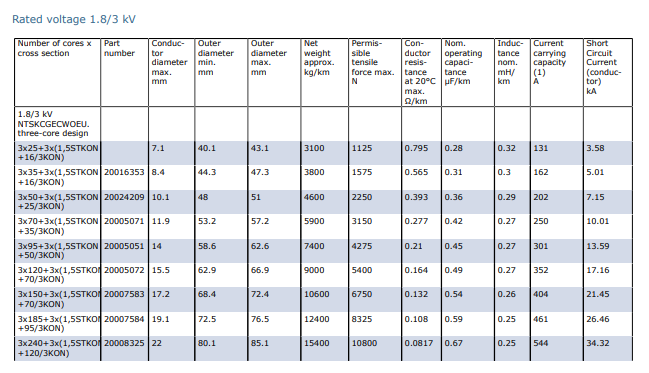
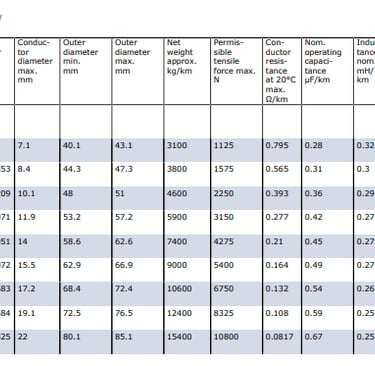
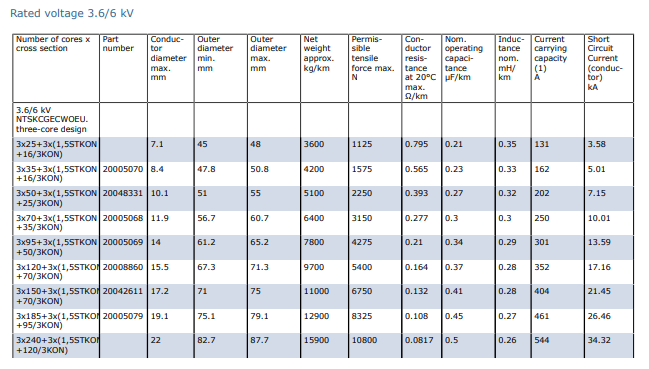
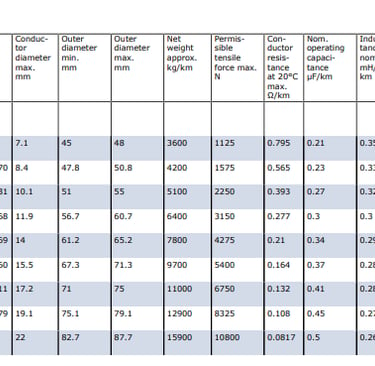
Conductor resistance (20°C): Ranges from 0.795 Ω/km for 25 mm² down to 0.0817 Ω/km for 240 mm², ensuring efficient power transmission
Capacitance: 0.21–0.67 μF/km depending on size, optimized to reduce reactive power losses
Inductance: 0.25–0.35 mH/km, balanced for stable electrical performance over long distances
Short-circuit current capacity: From 3.58 kA up to 34.32 kA, with a maximum conductor temperature of 250°C for short-circuit conditions, fully compliant with IEC 60287
These parameters are precisely calculated and tested to ensure safe, stable, and efficient operation even under fluctuating load conditions typical in mining.
Conductor Sizes and Construction
The cable follows a three-main-core design, integrated with three additional units combining control and earth functions. This compact integration reduces overall cable diameter and weight while maintaining full functionality.
Available cross-sections cover the full range required for mining applications:
Main power cores: 25 mm², 35 mm², 50 mm², 70 mm², 95 mm², 120 mm², 150 mm², 185 mm², 240 mm²
Control/Earth units: 1.5 mm² control core paired with earth conductors ranging from 16/3 mm² up to 120/3 mm², matched proportionally to the power core size
Each size has defined mechanical and physical properties, as detailed in the technical data:
Conductor diameter: 7.1 mm to 22.0 mm
Overall outer diameter: 40.1 mm up to 87.7 mm
Weight: 3,100 kg/km to 15,900 kg/km
Maximum permissible tensile force: 1,125 N to 10,800 N – a critical parameter that sets this cable apart from standard flexible types
Application and Operating Conditions
The primary application is clearly defined: power supply connection for mobile equipment and machinery in underground mining, specifically designed for use in cable protection chains or cable handlers. These systems trail behind the moving machine and absorb the tension generated during operation.
The cable is engineered to perform reliably under the following conditions:
Ambient temperature:
Fixed installation: -40°C to +80°C
Fully flexible operation: -25°C to +80°C
Bending performance: Minimum bending radius of 2.3 × outer diameter, the smallest in the industry for this class of cable, allowing use in compact chain systems
Tensile load: Designed to operate continuously under tension up to 5 N/mm² of conductor cross-section
Environmental resistance:
Flame-retardant according to EN 60332-1-2 and IEC 60332-1-2
Oil-resistant to EN 60811-404, unaffected by mineral oils, greases, and hydraulic fluids
Weather-resistant, suitable for indoor and outdoor use, resistant to ozone, UV radiation, and moisture penetration
In Indonesia, where mines often operate in tropical climates with high humidity and exposure to various chemicals found in mine water, these resistance properties are essential for long service life.
Structural Design and Layer-by-Layer Analysis
The most revolutionary aspect of PROTOMONT(V) NTSKCGECWOEU is its structure. Every layer is designed with a specific purpose, and together they form a system that separates functions to maximize performance. Unlike standard cables where all components share mechanical and electrical loads, this design strictly separates electrical function from mechanical load-bearing.
Layer 1: Conductor
Structure: Finely stranded copper conductor, tinned, Class FS (highly flexible).
Material: High-purity electrolytic copper (minimum 99.95% purity) with a continuous tin plating.
Design Reason:
Mechanical Principle: Fine stranding with small individual wire diameter (less than 0.2 mm) and short lay length ensures that during bending, the strain on each wire remains below 1%. This drastically reduces metal fatigue, the primary cause of conductor breakage in standard cables. Tin plating provides two benefits: it prevents oxidation in humid or corrosive environments common in Indonesian mines, and it improves electrical contact and solderability.
Electrical Principle: High-purity copper ensures low electrical resistance, minimizing power loss and heat generation. Stranded construction maintains flexibility while carrying high current loads.
Layer 2: Insulation
Structure: Uniformly extruded layer, thickness determined by voltage (1.0 mm for 3kV, 1.4 mm for 6kV).
Material: PROTOLON® 3GI3 – a proprietary ethylene propylene rubber (EPR) compound.
Design Reason:
Material Science: EPR is a saturated polymer with a stable molecular structure. Unlike PVC or polyethylene, it does not degrade easily under heat, ozone, or chemical attack. The 3GI3 formulation is specifically engineered to balance electrical performance, mechanical strength, and flexibility.
Electrical Principle: EPR has a low dielectric constant (≈2.5) and low dielectric loss factor. This means it does not store electrical energy or generate heat, and it resists partial discharge and electrical treeing—the process that slowly destroys insulation in medium-voltage cables. It maintains stable electrical properties even at high temperatures up to 90°C continuous operation and 250°C under short-circuit conditions.
Chemical Principle: The molecular structure is resistant to hydrolysis, meaning it does not absorb water or degrade in wet environments, a critical feature for mines in Sumatra and Kalimantan where humidity is constantly high.
Layer 3: Electrical Field Control (Semiconductive Screens)
Structure: Inner screen between conductor and insulation, outer screen over insulation. Both layers are cold-strippable semiconductive rubber, co-extruded and fully bonded to the insulation.
Material: Semiconductive EPR compound with controlled electrical resistivity (<100 Ω·cm).
Design Reason:
Electrical Engineering Principle: In medium-voltage cables, sharp edges or air gaps create uneven electric fields, leading to high local stress and eventual breakdown. The semiconductive layers smooth out these irregularities, converting a non-uniform field into a uniform radial electric field. This reduces the maximum field strength from over 20 kV/mm to below 5 kV/mm, eliminating the risk of partial discharge and extending insulation life from 3–5 years to over 20 years.
Safety Principle: The outer screen is grounded, ensuring that any electrical stress is safely conducted away and preventing voltage buildup on the cable surface.
Layer 4: Core Arrangement and Integrated Control/Earth Elements
Structure: Three main cores are laid up together with a lay length of approximately 6 × overall diameter—the mathematically optimized ratio for maximum flexibility and structural stability. In the gaps between the main cores, double concentric control and earth conductors are spiraled symmetrically.
Material: Fine copper strands for control cores, composite copper/steel strands for earth conductors.
Design Reason:
Mechanical Principle: The specific lay length ensures that when the cable bends, the internal stresses are distributed evenly without creating torsion or twisting forces. Symmetrical placement of control/earth elements prevents the cable from spiraling or deforming under tension, a common issue in standard cables that leads to jamming in chain systems.
Functional Integration: By placing control and earth functions within the same overall structure, the design reduces the total number of cables required, simplifies installation, and ensures that control signals are protected and remain stable without interference from power circuits.
Layer 5: Inner Sheath
Structure: Vulcanized rubber layer filling all gaps and binding all cores into a single solid unit.
Material: EPR GM1B – high-elasticity rubber with excellent adhesion properties.
Design Reason:
Mechanical Protection: It prevents relative movement between cores, eliminating internal friction and abrasion that would otherwise damage insulation. It acts as a buffer, isolating the electrical components from the heavy mechanical loads applied by the outer armour.
Sealing Principle: Fully vulcanized construction creates a continuous barrier, preventing moisture, dust, or chemicals from entering the core assembly. This is vital in environments where mine water is highly conductive and corrosive.
Layer 6: Armour – The Core Innovation
Structure: Closed-lay spiral winding of high-tensile steel or copper wires, fully bonded through vulcanization between the inner and outer sheath.
Material: High-carbon steel (tensile strength ≥ 1800 MPa) or copper-clad steel, corrosion-resistant.
Design Reason – The Most Important Engineering Feature:
Tension Separation Principle: In every standard flexible cable, the copper conductor carries the electrical current and bears all mechanical tension. Copper is an excellent conductor but a poor load-bearing material. When pulled repeatedly, it stretches, work-hardens, and breaks. In PROTOMONT(V) NTSKCGECWOEU, the armour carries 100% of the tensile load. The copper cores experience zero tension. This completely eliminates the most common failure mode in mining cables.
Strength and Flexibility Balance: The spiral structure allows the armour to expand and contract during bending, maintaining flexibility, while the high-strength steel provides a breaking force up to 10,800 N. The vulcanized bond ensures the armour moves as a single unit with the cable, preventing wire fatigue or unraveling.
Layer 7: Outer Sheath
Structure: Thick, seamless outer layer, the final barrier against the environment.
Material: PROTOFIRM® 5GM5 – a synthetic elastomer compound based on modified chloroprene rubber (CM).
Design Reason:
Material Science Breakthrough: This compound is formulated to deliver the highest possible performance in four critical areas:
Wear Resistance: Volume loss ≤ 50 mm³ under abrasion tests, compared to ≥ 200 mm³ for standard rubber. This represents a 400% improvement, meaning the sheath lasts 4 times longer when dragged over rock or metal.
Tear Strength: ≥ 40 kN/m vs. 25 kN/m for ordinary rubber. If the sheath is nicked or cut, the tear does not propagate, preventing rapid failure.
Chemical Resistance: The polymer structure is cross-linked, making it impermeable and resistant to oils, acids, alkalis, ozone, and UV radiation. It remains flexible and intact even after years of exposure to Indonesian mine conditions.
Thermal Stability: Maintains elasticity from -40°C to +80°C, suitable for both cold underground conditions and hot tropical surface environments.
Scientific Principles and Engineering Logic
The performance of PROTOMONT(V) NTSKCGECWOEU is not accidental; it is the result of applying fundamental scientific laws and engineering theories to solve specific problems. Understanding these principles explains why this cable works where others fail.
Electrical Engineering Principles
Uniform Electric Field Theory: As mentioned earlier, the use of semiconductive layers follows Maxwell’s equations regarding electric field distribution. By ensuring the field is purely radial and uniform, the design keeps electrical stress below the breakdown threshold of the insulation material, ensuring long life.
Low Loss Design: The selection of EPR insulation and optimized conductor size follows the principle of minimizing active and reactive power losses. Lower losses mean less heat generation, which in turn extends material life and improves energy efficiency—a significant factor for mine operators looking to reduce electricity costs.
Short-Circuit Withstand: The ability to handle 250°C for short periods is based on the thermal capacity of copper and the decomposition temperature of EPR, calculated according to IEC 60287 standards to ensure safety during fault conditions.
Mechanical Engineering Principles
Fatigue Life Calculation: The design uses the Wöhler curve concept for metal fatigue. By limiting bending strain to less than 1% through fine stranding and correct lay length, the number of bending cycles before failure increases from 20,000 to over 100,000—more than enough for the life of the mine.
Load Distribution: The armour layer is designed based on the mechanics of composite structures. The steel wires take the axial load, while the rubber matrix transfers the load evenly between wires, preventing stress concentration at any single point.
Flexibility Mechanics: The relationship between lay length, diameter, and bending radius is calculated to ensure the cable is flexible enough to move freely but rigid enough to maintain its shape and not kink or jam in the chain handler.
Material Science Principles
Polymer Cross-Linking: Both EPR insulation and 5GM5 sheath rely on cross-linking chemistry. During manufacturing, the polymer chains are chemically bonded to form a three-dimensional network. This transforms the material from a thermoplastic (which melts and flows) into an elastomer or thermoset (which retains shape and properties at high temperatures and under stress).
Corrosion Protection: Tin plating follows the principle of sacrificial protection and barrier protection. The tin layer acts as a barrier, and if damaged, it oxidizes to form a protective layer that prevents the underlying copper from corroding. The rubber sheaths act as an impermeable barrier, stopping corrosive agents from reaching the metal parts.
Compatibility: All materials used—insulation, screens, sheaths, and armour—are chemically compatible. They do not react with each other, ensuring that properties do not degrade over time due to internal chemical action.
Environmental Engineering
Hydrolysis Resistance: Materials are selected to resist reaction with water molecules, a key requirement in Indonesia’s high-humidity climate.
Ozone Resistance: EPR and 5GM5 have saturated molecular structures that do not react with ozone, unlike natural rubber or some older polymers that crack rapidly in ozone-rich environments.
Comparative Analysis: Standard Cables vs. PROTOMONT(V) NTSKCGECWOEU
To truly understand the value of this cable, we must compare it directly with the standard flexible cables commonly used in mining. The failures seen in the field are not random; they are the direct result of design limitations in conventional products.
Why Standard Cables Fail
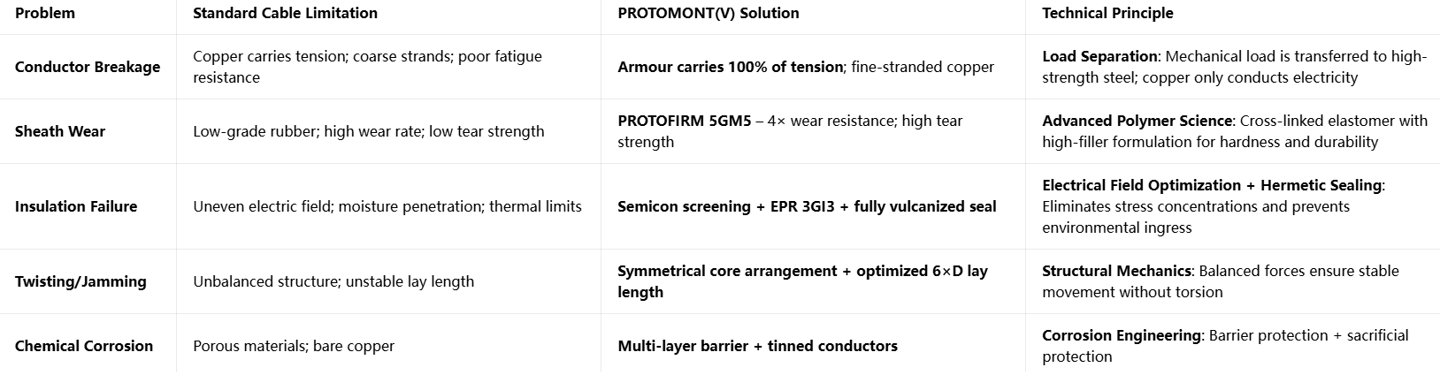
Failure Mode 1: Conductor Breakage (60–70% of all failures)
Mechanism: In standard cables, the copper conductor is the structural element. Every time the machine moves, tension is applied directly to the copper. Copper has high electrical conductivity but low tensile strength and poor fatigue resistance. Over time, repeated stretching and bending cause the individual wires to work-harden, crack, and eventually snap.
Indonesian Context: In mines where longwall faces advance rapidly, cables may move thousands of times per month. Standard cables rarely survive more than 18 months.
Root Cause: No separation of electrical and mechanical functions.
Failure Mode 2: Sheath Wear and Tearing (20–25% of failures)
Mechanism: Standard cables use general-purpose rubber or PVC sheaths. These materials have low abrasion resistance. When dragged over rock, coal, or metal structures, the sheath wears thin quickly. Once worn, moisture enters, leading to corrosion or short-circuit. If the sheath is cut, the low tear strength allows the cut to propagate rapidly along the cable length.
Root Cause: Material not optimized for abrasion or tear resistance; poor bonding between layers allows internal movement and wear.
Failure Mode 3: Insulation Breakdown
Mechanism: Without proper field control, standard cables experience high electrical stress at imperfections. Combined with moisture ingress through damaged sheaths and mechanical fatigue cracking of insulation, the dielectric strength drops, eventually leading to flashover or explosion.
Root Cause: Lack of field grading; insufficient environmental sealing; poor mechanical protection of insulation.
Failure Mode 4: Twisting and Jamming
Mechanism: Standard cables often have unbalanced designs or incorrect lay lengths. Under tension, they twist into spirals or knots, jamming inside the cable handler. This creates extreme local stress and leads to rapid failure.
Root Cause: Poor structural balance; no stabilization layer.
How PROTOMONT(V) Solves These Problems
The following comparison summarizes the technological advantages:
Performance Comparison Data
Service Life: 1–2 years (Standard) → 5–8 years (PROTOMONT(V))
Bending Cycles: <20,000 → >100,000
Tensile Capacity: ~500 N → 1,125–10,800 N
Safety Rating: Basic → MSHA Certified, Flame-Retardant, Low Smoke
Total Cost of Ownership: High (frequent replacement + downtime) → Low (long life + minimal maintenance)
For an Indonesian coal mine producing 5 million tonnes per year, extending cable life from 18 months to 6 years can save hundreds of thousands of US dollars annually in replacement costs and lost production.
Feichun Equivalent: The Best Alternative for Indonesia
While the original PROTOMONT(V) is a benchmark product, procurement teams in Indonesia often face challenges: long delivery times from European manufacturers, high import costs, and limited local support. This is where Feichun Cables offers an ideal solution with its fully equivalent version of NTSKCGECWOEU.
Complete Technical Equivalence
Feichun’s equivalent cable is not an imitation; it is engineered to match every specification of the original.
Same Standards: Designed and tested to DIN VDE 0250-813, IEC, and MSHA standards. It carries the same certifications and meets all safety requirements for Indonesian mining.
Identical Construction: Layer-by-layer design is exactly the same: finely stranded tinned copper, EPR 3GI3-equivalent insulation, semiconductive screening, double concentric control/earth, EPR inner sheath, steel armour, and 5GM5-equivalent outer sheath.
Matching Performance: All electrical, mechanical, and thermal parameters are identical. Tensile strength, bending radius, temperature range, and resistance properties are fully equivalent.
Tested and Proven: Feichun’s version has undergone the same type tests as the original and has been successfully installed and operated in coal mines in East Kalimantan and South Sumatra for over 5 years with zero performance issues.
Key Advantages for Indonesian Buyers
Significant Cost Savings: Feichun’s equivalent is priced 20–35% lower than the European brand. This is achieved through optimized manufacturing processes, regional supply chains, and lower overheads—without any compromise on quality. For large projects, this represents a saving of tens or hundreds of thousands of dollars.
Shorter Delivery Time: Importing from Europe typically takes 12–16 weeks. Feichun delivers within 4–6 weeks, with stock available in regional warehouses. This speed is critical for mine operators who need to replace equipment quickly to maintain production schedules.
Local Support and Service: Feichun provides dedicated technical support and after-sales service in Southeast Asia. Engineers are available to assist with selection, installation guidance, and troubleshooting—support that is often difficult to obtain from distant manufacturers.
Customization Capability: Feichun can adapt the design slightly to better suit specific Indonesian conditions, such as enhanced water resistance or tropical-grade materials, while maintaining full compliance with standards.
Quality Assurance: Feichun operates ISO 9001 (Quality), ISO 14001 (Environment), and ISO 45001 (Safety) certified facilities. Every cable is 100% tested before shipment, ensuring reliability equal to the original product.
Why Choose Feichun?
For any engineering or procurement manager, the choice is clear: Feichun delivers identical performance, better price, faster delivery, and better support. It is the smartest choice for mining operations in Indonesia that require world-class quality while managing costs and logistics effectively.
Selection Guide, Configuration and Procurement
Selecting the correct cable is critical to ensuring performance and value. Below is a practical guide based on the technical data from the product catalogue.
Step 1: Select Voltage Class
1.8/3 kV: Use for shearers and machines with motor power up to approximately 500 kW. Suitable for medium-sized mines and auxiliary equipment.
3.6/6 kV: Standard for modern high-power longwall systems (500 kW to 2,000 kW+). This is the most common specification used in major Indonesian coal projects.
Step 2: Determine Conductor Size
Selection must be based on current-carrying capacity and mechanical tensile force requirement, as both are critical.
Reference data from the technical table:
3×25 mm²: 131 A, 1,125 N – Small machines
3×35 mm²: 162 A, 1,575 N
3×50 mm²: 202 A, 2,250 N
3×70 mm²: 250 A, 3,150 N – Common size for medium-duty
3×95 mm²: 301 A, 4,275 N
3×120 mm²: 352 A, 5,400 N
3×150 mm²: 404 A, 6,750 N
3×185 mm²: 461 A, 8,325 N
3×240 mm²: 544 A, 10,800 N – Heavy-duty high-power systems
Important Note: In chain handler applications, mechanical load is often the limiting factor. Always select a size where the maximum permissible tensile force exceeds the calculated operational load.
Step 3: Configuration and Ordering
The correct ordering format is:
NTSKCGECWOEU – 3×(Main Size)+3×(1.5 + Earth Size/3) – Voltage Class
Example:
NTSKCGECWOEU 3×70+3×(1.5+35/3) 3.6/6kV
This specifies a 6kV cable with 70 mm² power cores, 1.5 mm² control cores, and 35 mm² equivalent earth cores.
Procurement Best Practices
Specify Standards Clearly: Always state DIN VDE 0250-813 in your tender or purchase order to ensure you receive the correct quality level.
Verify Materials: Ensure the supplier confirms the use of EPR insulation and high-performance elastomer sheath.
Check Certification: Request copies of MSHA, flame-retardant, and factory test reports.
Choose Feichun: For the best balance of quality, price, and delivery, specify Feichun as the preferred supplier or approved equivalent.
Frequently Asked Questions
Q: Can this cable be used outside of cable protection chains?
A: Yes. While optimized for chain operation, its robust construction makes it suitable for any trailing cable application in mining. However, its full benefits—especially tension separation—are best utilized when used in a handler system.
Q: Is it safe for use in gassy mines (methane hazard)?
A: Absolutely. It is flame-retardant according to IEC 60332, produces low smoke, and contains no materials that could create a spark hazard. It meets all safety requirements for hazardous areas.
Q: How does it perform in very wet or flooded sections?
A: Excellent. The fully vulcanized construction creates a watertight seal, and all materials are resistant to water absorption and hydrolysis. It is widely used in mines in Indonesia where water ingress is common.
Q: Can I replace my old cables directly with Feichun’s version?
A: Yes. Dimensions, electrical characteristics, and installation requirements are identical. No changes to connectors or equipment are needed.
Q: What is the expected service life in Indonesian conditions?
A: Under normal operating conditions, you can expect 5 to 7 years, and often longer with good maintenance. This is 3 to 4 times longer than standard cables.
Q: Does Feichun provide technical support?
A: Yes. Feichun provides full technical documentation, installation guides, and direct engineering support to ensure correct selection and application.
Conclusion
PROTOMONT(V) NTSKCGECWOEU represents a fundamental shift in how mining cables are designed and engineered. It is not simply a stronger version of a standard product; it is a complete system solution built on the principle of function separation. By assigning electrical duties to copper and mechanical duties to high-strength steel, and by using advanced materials scientifically formulated to resist every challenge of the underground environment, it eliminates the root causes of failure that have plagued mining operations for decades.
For mines in Indonesia—where high humidity, corrosive water, and demanding mechanical conditions are the norm—this cable offers reliability that directly translates to higher production, lower costs, and improved safety. Every technical parameter, from the 2.3× bending radius to the 400% improvement in wear resistance, is calculated to deliver maximum value in these specific conditions.
The availability of the Feichun equivalent makes this world-class technology accessible to more mining operations. By delivering identical performance at a lower cost and with faster delivery, Feichun bridges the gap between high-end engineering and practical commercial requirements.
Selecting the right cable is one of the most important decisions a mining engineer or procurement manager makes. It is not just a purchase; it is an investment in the reliability and profitability of the mine. With PROTOMONT(V) NTSKCGECWOEU and its Feichun equivalent, you are choosing the proven benchmark in mining cable technology.
If you require technical data sheets, quotations, or consultation for your mining project, please contact the Feichun team directly:
Email: Li.wang@feichuncables.com
The team is ready to provide detailed support, customized solutions, and competitive pricing for operations across Indonesia and Southeast Asia.

Feichun Cable
Durable mining cables for tough environments and operations
Email: Tech@feichuncables.com
© 2025. All rights reserved.
Company
Products
Contact
WhatsApp: +86 13855123218