Anhui Feichun Special Cable Co.,Ltd


PROTOMONT Type 631 BS 6708 Flexible Trailing Cable for Underground Mines: Complete Engineering Guide to EPR Insulation, Galvanized Steel Wire Armour and Fixed Installation Applications
For mining engineers, procurement specialists and technical managers in Indonesia and Southeast Asia, this comprehensive guide details PROTOMONT Type 631, the medium‑voltage flexible trailing cable manufactured to British Standard 6708. Developed by Prysmian Group for underground mining operations, it features ethylene propylene rubber insulation, pliable galvanized steel wire armour and chloroprene rubber sheathing, delivering reliable performance in high humidity, abrasive, corrosive and potentially explosive environments. Drawing on real‑world application cases from coal mines in Kalimantan and nickel operations in Sulawesi, this article explains construction principles, material science, performance benefits and equivalent replacement options from Feichun brand, offering practical engineering insights and selection guidance for every mining project.
Li Wang
6/12/202625 min read
Introduction — The Critical Role of Cables in Underground Mining
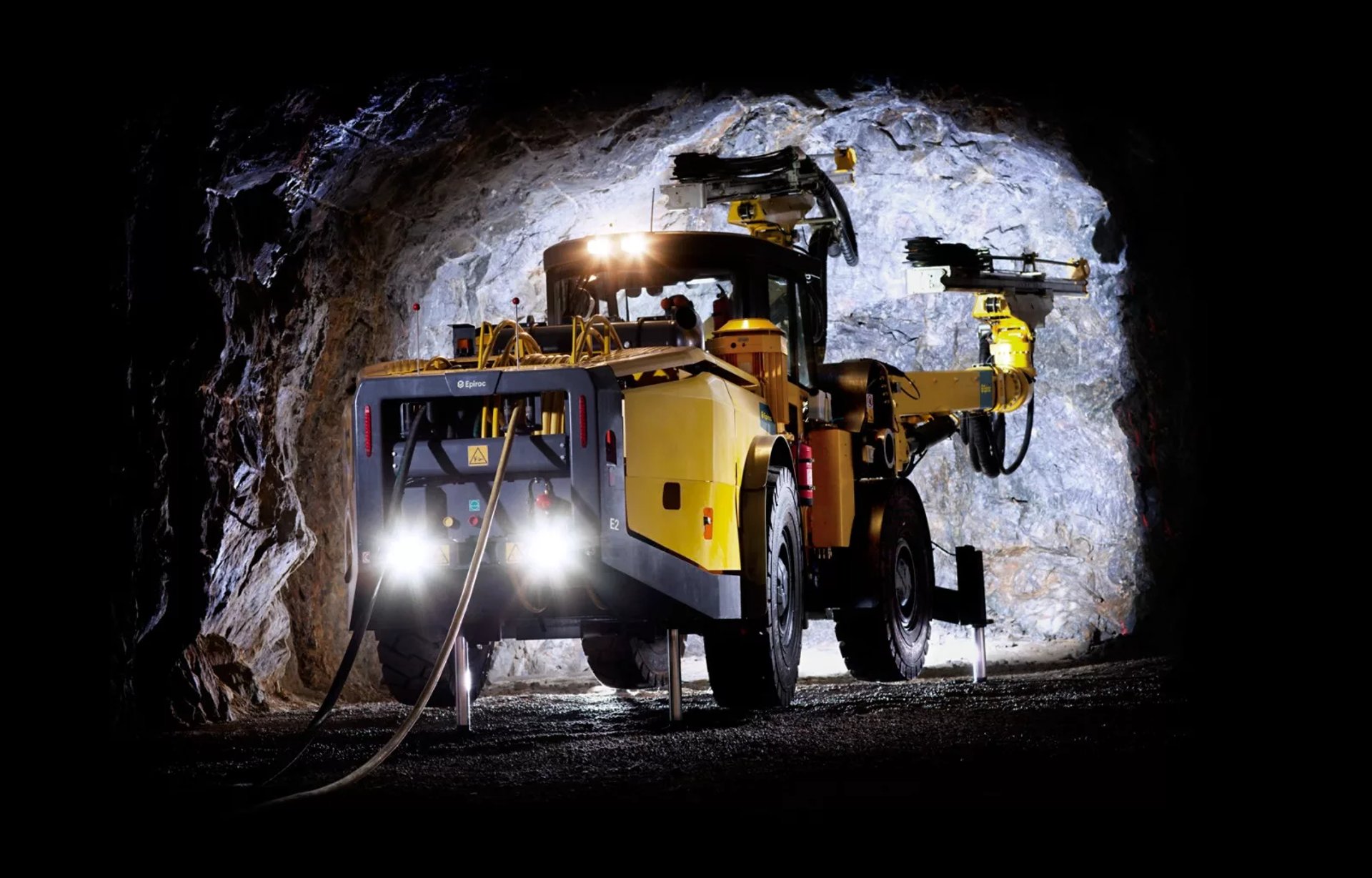
In the mining industry, electrical power serves as the lifeline of every operation. Whether driving conveyors, powering crushers, supplying ventilation fans or energizing heavy machinery, a consistent and safe supply of electricity directly determines production output, operational safety and profitability. In Indonesia, which holds some of the world’s largest reserves of coal, nickel, gold and copper, underground mining activities are expanding rapidly across regions such as East Kalimantan, South Sumatra and Southeast Sulawesi. However, these mining environments present some of the harshest conditions imaginable for electrical equipment.
Underground mines in Indonesia are typically characterized by high ambient temperatures, often ranging between 30°C and 38°C, combined with relative humidity levels exceeding 90 per cent throughout the year. Rock strata frequently contain sulfur compounds and other corrosive minerals, while groundwater and seepage create persistently wet conditions. Furthermore, the movement of heavy machinery, continuous extension of roadways, and presence of flammable gases and combustible dust introduce risks of mechanical damage, abrasion, impact and fire. Data from the Indonesian Mining Association indicates that nearly 25 per cent of unplanned production downtime is caused by failures in power distribution systems, with cables being the most common point of failure.
Conventional rubber‑sheathed cables, widely used in general industrial applications, struggle to survive in these demanding settings. They often suffer from premature aging, insulation breakdown, mechanical tearing or corrosion, requiring replacement every two to four years. Such frequent replacements not only increase material and labour costs but also lead to significant production losses. This is where PROTOMONT Type 631 emerges as a purpose‑built solution.
PROTOMONT Type 631 is a medium‑voltage flexible trailing cable developed by Prysmian Group, a global leader in energy and telecom cable systems, manufactured in accordance with British Standard 6708. Designed specifically for fixed installation and semi‑mobile use in underground mines, it operates at a rated voltage of 3.8/6.6kV and features a standard configuration of three power cores plus one protective earth core, with conductor cross‑sections ranging from 50mm² to 120mm². Its core design concept combines pliable galvanized steel wire armour, PROTOLON ethylene propylene rubber insulation and PROTOFIRM chloroprene rubber sheathing — a combination widely recognized as the gold standard for mining cables. This unique formulation directly addresses four major limitations of ordinary cables: the conflict between mechanical strength and flexibility, short service life, poor environmental resistance and insufficient safety performance.
This guide provides a complete technical breakdown of PROTOMONT Type 631, covering standards compliance, construction details, material science principles, performance characteristics, application scenarios, equivalent replacement options and practical selection advice. It is intended to equip engineers and procurement professionals with the knowledge required to specify, install and maintain a power distribution system that delivers maximum reliability and cost‑efficiency.
Standards, Specifications and Technical Data
Understanding the technical specifications and compliance standards is essential to evaluate the suitability of PROTOMONT Type 631 for specific project requirements. All data presented in this section is extracted directly from official product documentation and verified against relevant international standards.
Compliance and Standards
PROTOMONT Type 631 is manufactured to British Standard 6708, the dedicated specification for flexible cables intended for use in mines and quarries. This standard sets rigorous requirements for construction, materials, electrical performance, mechanical strength and safety, which are more demanding than general industrial cable standards. In addition to BS 6708, the product conforms to a series of supporting standards that govern individual components and performance tests:
BS 6360: Defines conductor dimensions, stranding classes and electrical resistance values, ensuring consistent conductivity and flexibility.
BS 7655: Specifies colour codes for identification of cores, requiring power cores to be coloured red, yellow and brown, and the protective earth core to be green‑yellow striped.
EN 60332‑1‑2 / IEC 60332‑1‑2: Test methods for resistance to fire, verifying that cables do not propagate flame when exposed to a defined heat source.
EN 60811‑404 / IEC 60811‑404: Test procedures for resistance to mineral oil, confirming that materials do not degrade or swell significantly when in contact with hydraulic fluids or lubricants.
DIN VDE 0298‑3: Guidelines for installation, including minimum bending radii and permissible tensile loads to prevent damage during handling and operation.
Adherence to these standards ensures that PROTOMONT Type 631 meets safety and performance expectations in all major mining markets, including Indonesia, where compliance with international specifications is often a requirement for project approval.
Voltage Ratings
As a medium‑voltage cable, PROTOMONT Type 631 is engineered to operate reliably within the following voltage parameters:
Rated voltage: 3.8/6.6kV (U₀/U), suitable for distribution networks commonly found in underground mining operations.
Maximum permissible operating voltage AC: 4.2/7.2kV, providing a safety margin above nominal working levels.
Maximum permissible operating voltage DC: 5.4/10.8kV, applicable where DC systems are used or during transient conditions.
AC test voltage: 11kV applied during factory testing, ensuring that insulation integrity exceeds operational requirements by a significant factor.
These values confirm that the cable is designed not only for normal steady‑state operation but also to withstand temporary over‑voltages that may occur during switching, fault clearance or atmospheric events.
Thermal Performance
Thermal stability directly influences current‑carrying capacity, service life and safety. PROTOMONT Type 631 is rated for:
Maximum permissible temperature at conductor: 90°C under continuous operation, allowing high power transmission without thermal degradation.
Maximum short‑circuit temperature of the conductor: 250°C for durations up to five seconds, ensuring that conductors do not melt or lose mechanical strength during fault conditions before protection devices operate.
Ambient temperature range for fixed installation: from ‑40°C to +80°C, covering extreme climatic variations from high‑altitude cold mines to deep, hot underground workings.
Ambient temperature range for fully flexible operation: from ‑25°C to +60°C, accounting for additional heat generation when the cable is frequently bent or moved.
This wide operating temperature range makes it equally suitable for cold mountain mines and tropical underground environments like those found across Indonesia.
Mechanical Properties
Mechanical robustness is the defining feature of mining cables, and PROTOMONT Type 631 delivers exceptional performance:
Maximum permissible tensile load: 15N per square millimetre of total conductor cross‑sectional area, significantly higher than standard rubber‑sheathed cables, allowing safe installation over long distances or vertical shafts.
Minimum bending radius: between 12 and 15 times the overall cable diameter, depending on the specific cross‑section, balancing flexibility with protection against internal stress and damage.
These mechanical parameters are carefully calculated based on material properties and construction design to ensure the cable can survive the rigours of daily operation without failure.
Detailed Electrical and Physical Data
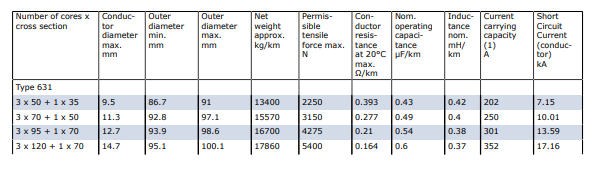
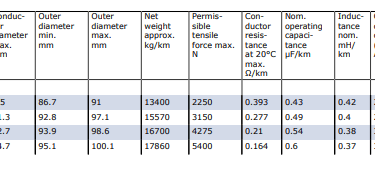
The following table presents the complete dimensional, electrical and performance data for all available cross‑sectional sizes, exactly as documented in official specifications:
This data forms the basis for engineering calculations, including load flow analysis, voltage drop assessment, short‑circuit coordination and mechanical installation planning.
Construction and Material Analysis — Layer‑by‑Layer Engineering
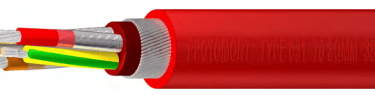
The performance of PROTOMONT Type 631 is not achieved through a single advanced material, but through a carefully engineered layered structure where each component serves a specific purpose and works in harmony with others. Every choice of material and structural design follows fundamental principles of electrical engineering, material science and mechanics, optimized over decades of mining industry experience. The following sections describe each layer from the centre to the outer surface, explaining materials, design rationale and scientific principles involved.
Central Filler
At the very core of the cable assembly, located in the space between the four laid‑up cores, is a central filler made from a specially formulated elastomeric compound, chemically compatible with the sheathing materials used in outer layers. This component may appear simple, but its role is critical to long‑term reliability.
From a geometric perspective, the filler ensures that the completed cable has a perfectly circular cross‑section. A circular shape is essential because it ensures uniform distribution of mechanical stress during bending, tension or compression. If cores were laid up without proper filling, the cross‑section would be irregular, creating points of high stress concentration where insulation could crack or conductors could break under repeated movement. By maintaining a round profile, the filler guarantees that every part of the cable experiences similar strain levels during operation.
Mechanically, the filler provides structural support that prevents cores from shifting, rubbing against each other or being squeezed out of position when the cable is bent or compressed. It also acts as a cushion, absorbing minor impacts and vibrations that occur during transportation, installation and daily use. Furthermore, the compacted filler material blocks longitudinal pathways for moisture ingress, helping maintain the dry internal environment required for electrical stability.
The material selected has a modulus of elasticity carefully chosen to sit between that of the copper conductors and the outer sheath. This balance ensures that during bending, deformation energy is absorbed gradually rather than being concentrated at interfaces, protecting the insulation layers from excessive strain.
Conductor Layer
Surrounding the filler are the current‑carrying conductors, manufactured as finely stranded copper conductors of Class 5, according to BS 6360. Each conductor is composed of numerous small‑diameter copper wires twisted together in multiple layers, and the entire assembly is coated with a uniform layer of tin.
Class 5 stranding represents the highest level of flexibility defined in international standards, achieved by using individual wires with diameters no greater than 0.4mm. This design allows the conductor to bend easily without permanent deformation or fatigue failure. When a cable is bent, the outer portion stretches while the inner portion compresses. In a solid conductor or coarse‑stranded conductor, this creates high internal stress that eventually leads to breakage. By using very fine strands, movement between individual wires absorbs the bending stress, distributing it across thousands of contact points. This flexibility is essential for underground mining, where cables must navigate tight bends in roadways and follow the movement of advancing equipment.
The base material is electrolytic tough pitch copper, with a purity of at least 99.95 per cent, delivering an electrical conductivity of 100 per cent IACS (International Annealed Copper Standard). This high conductivity ensures low power loss and efficient energy transmission, which becomes increasingly important over the long distances often encountered in mines.
The tin coating applied to every strand serves two vital functions. First, it prevents oxidation and sulfidation of the copper surface. In the damp, warm and chemically active environment of Indonesian mines, bare copper would react rapidly with moisture and sulfur compounds present in the air and groundwater, forming non‑conductive corrosion products that increase resistance and lead to overheating. Tin is highly resistant to these environmental agents, and even if the coating is scratched or damaged, it continues to protect the underlying copper through the principle of cathodic protection. Tin has a lower electrochemical potential than copper, meaning it will corrode preferentially, acting as a sacrificial barrier. Second, tinning improves connectivity by reducing contact resistance at terminations and joints, ensuring stable electrical performance over decades of service.
Insulation Layer — PROTOLON EPR
Encircling each conductor individually is the insulation layer, manufactured from PROTOLON, a proprietary material developed by Prysmian Group, based on ethylene propylene rubber, commonly referred to as EPR. The insulation is applied in thicknesses of at least 1.4mm for the 3.8/6.6kV voltage class, increasing with larger conductor sizes to maintain consistent electrical field strength. Each core is coloured red, yellow or brown for power conductors and green‑yellow for the earth conductor, complying strictly with BS 7655 for instant identification.
The choice of EPR represents one of the most important technical decisions in the design of this cable, rooted deeply in material science and electrical engineering principles. Unlike thermoplastic materials such as PVC, or natural rubber, EPR is a cross‑linked polymer. During manufacturing, molecular chains are chemically bonded to form a three‑dimensional network structure. This cross‑linking fundamentally changes the material properties, allowing it to withstand continuous temperatures up to 90°C without melting, flowing or softening. In comparison, PVC is limited to a maximum of 70°C and becomes brittle at low temperatures, while natural rubber ages rapidly and loses flexibility.
From an electrical standpoint, EPR is a non‑polar material, meaning there is no permanent separation of electric charge within its molecular structure. This property results in a very low dielectric constant of approximately 2.3 and an extremely low dissipation factor below 0.001. Together, these characteristics mean that very little electrical energy is absorbed and converted into heat within the insulation, even at medium voltages and high frequencies. Low dielectric loss is crucial in mining applications because it prevents thermal runaway, a condition where heat generation exceeds dissipation capacity, leading to insulation breakdown. Additionally, EPR has excellent resistance to partial discharge and electrical treeing, two mechanisms that gradually degrade insulation under high‑voltage stress. It can reliably operate at an electrical field strength of 4kV per millimetre, twice the capability of standard rubber compounds.
Chemically, the molecular backbone of EPR is fully saturated, containing no double bonds. This structure makes it highly resistant to attack by ozone, ultraviolet radiation, oxygen and most chemicals found in mines, including acids, alkalis and oils. In tropical environments like Indonesia, where ozone levels can be high and sunlight may reach cables in surface or open‑pit sections, materials with unsaturated bonds crack and degrade rapidly. EPR remains stable for decades.
Mechanically, EPR retains its elasticity and flexibility across the entire operating temperature range, remaining pliable down to ‑40°C. This ensures that even in cold conditions, the insulation does not become rigid or crack when bent, preserving its protective function.
Individual Core Screen — Copper/Nylon Composite Braid
Directly over the insulation of each power core lies a screening layer, formed by braiding a combination of tinned copper wires and nylon filaments. This screen is applied with a coverage of at least 85 per cent to ensure effectiveness. The protective earth core does not require screening.
The primary purpose of this screen is electrical, based on the principle of electric field equalization. In an insulated cable carrying high voltage, the electrical field radiates outward from the conductor, with the highest field strength occurring at the surface of the insulation. Without a screen, any irregularities on the insulation surface, air gaps or contact with other materials would cause local concentrations of electrical stress, leading to partial discharges that erode the material over time. By surrounding each core with a conductive screen maintained at earth potential, the electrical field is forced to remain entirely within the insulation material, uniformly distributed. This significantly increases the breakdown strength of the cable and eliminates the risk of external flashover.
A secondary but equally important function is electromagnetic compatibility. The screen acts as a barrier, preventing high‑frequency noise or harmonics generated by variable‑speed drives and heavy machinery from radiating outward and interfering with sensitive communication, control and monitoring systems essential for mine safety.
The choice of composite braid combines the best properties of two materials. Copper provides the necessary electrical conductivity to carry capacitive charging currents and fault currents safely to earth. Nylon filaments add significant mechanical strength, abrasion resistance and dimensional stability. Unlike pure copper braids, which can be fragile and prone to breaking during installation or bending, the nylon reinforcement ensures the screen remains intact and in contact with the insulation throughout the service life. The braided construction itself is key, as it follows the movement of the core without restricting flexibility, unlike metallic tapes which can separate or tear.
Core Assembly and Laying‑Up
Once each insulated and screened core is completed, the three power cores and one earth core are arranged around the central filler and twisted together in a process known as laying‑up. The direction of twist is consistent, and the lay length — the distance required for one complete rotation — is controlled to between 12 and 16 times the overall diameter of the assembly.
This twisted configuration is not merely for compactness; it is a masterpiece of mechanical design. When a straight cable is bent, the outer fibres stretch while the inner fibres compress. In a twisted assembly, each core alternates between positions closer to the outer and inner radii as bending occurs. This creates a compensation effect where the elongation and compression experienced by each core are significantly reduced, typically to less than one‑quarter of the strain experienced in a straight configuration. This reduction in cyclic strain is the single most important factor in achieving the exceptional flex life of Type 631.
Symmetrical arrangement ensures that tension is balanced equally across all cores, preventing torque buildup that would cause the cable to twist uncontrollably during installation. The compact resulting profile reduces overall diameter, allowing use in narrower cable ducts and galleries, while still maintaining adequate spacing between cores to prevent thermal interference.
Inner Sheath
Over the laid‑up assembly, an inner sheath is extruded, manufactured from chloroprene rubber, identical in chemical family to the outer sheath, and coloured red. With a minimum thickness of 1.2mm, this layer serves as an interface between the cable cores and the armour layer.
Mechanically, the inner sheath acts as a barrier, preventing the metallic armour wires from coming into direct contact with the screened cores. Without this separation, the relative movement between armour and cores during bending would abrade the screen and insulation, eventually leading to electrical failure. It also distributes the radial pressure exerted by the armour evenly across the circumference of the core assembly, eliminating point loads that could cause deformation or damage.
Environmentally, the inner sheath provides a first line of defence against moisture ingress, forming a continuous, impermeable tube around the cores. Its material density ensures water absorption remains below 0.5 per cent, preventing moisture from reaching sensitive electrical components. Because it is formulated to be chemically compatible with the outer sheath, strong adhesion occurs between the two layers during manufacture, creating a fully sealed monolithic system that resists water penetration completely.
Armour — Pliable Galvanized Steel Wires
The armour layer is the defining feature of PROTOMONT Type 631 and the key difference between it and standard cables. It consists of high‑tensile steel wires, annealed to achieve flexibility, coated with a heavy layer of zinc through hot‑dip galvanizing, and applied in a helical spiral pattern with controlled gaps between adjacent wires. This design is referred to as pliable armour.
The fundamental engineering challenge solved here is reconciling two seemingly contradictory requirements: mechanical strength and flexibility. Traditional armoured cables use hard steel wires or steel tapes, which provide high tensile and crush strength but make the cable rigid and difficult to bend, rendering them unsuitable for moving or trailing applications. Conversely, unarmoured flexible cables can bend easily but lack the strength to withstand pulling forces, crushing loads or abrasion.
Type 631 achieves both through structural mechanics and material selection. By using annealed steel, the wires themselves become ductile and capable of bending without breaking. The helical winding pattern is critical: when the cable is bent, the spiral geometry allows adjacent armour wires to slide slightly relative to each other, accommodating the change in length without resistance or stiffness. When the cable is subjected to axial tension, the angled spiral converts the pulling force into compressive forces between the wires, which lock together and carry the entire load as a unified structure. This is why the cable achieves a maximum tensile strength of 15N/mm², comparable to rigid armoured cables, while maintaining a minimum bending radius of only 12 times diameter, typical of flexible cables.
The galvanizing process provides long‑term corrosion protection essential for underground environments. Each wire is coated with a minimum of 200g of zinc per square metre of surface area, forming a dense, stable oxide layer that seals the steel from oxygen and moisture. Should the coating be scratched or damaged during installation or operation, zinc continues to protect the steel through cathodic action, corroding preferentially until it is consumed. This ensures the armour retains its mechanical integrity for the full service life of the cable, even in wet, acidic or sulfur‑rich ground conditions common in mines across Indonesia.
In addition to tensile strength, the armour provides excellent resistance to crushing, impact and abrasion. It protects the cable from being flattened by heavy vehicles, damaged by falling rock or worn through by being dragged along rough gallery floors — hazards that would quickly destroy unarmoured cables.
Outer Sheath — PROTOFIRM CR
The outermost layer is the outer sheath, manufactured from PROTOFIRM, a proprietary compound based on chloroprene rubber, also known as neoprene, coloured red. This is the protective skin of the cable, engineered to withstand the harshest environmental conditions while maintaining mechanical and chemical stability.
Chloroprene rubber is chosen because it combines a unique set of properties found in no other single material. Its formulation includes high‑grade carbon black, flame‑retardant additives, anti‑aging agents and processing aids, precisely balanced to meet performance standards.
For mechanical performance, the sheath is formulated to have a hardness of Shore A 65 to 70, high enough to resist cutting, tearing and abrasion, yet with an elongation at break exceeding 400 per cent, allowing it to stretch and recover without damage during bending or impact. This combination results in an abrasion resistance three times greater than natural rubber or standard PVC compounds, significantly extending service life when dragged or rubbed against rough surfaces.
Environmental resistance is where PROTOFIRM truly excels. Chloroprene rubber is a polar material, meaning its molecular structure has distinct positive and negative regions. Mineral oils, greases and hydraulic fluids are non‑polar. According to the principles of solubility chemistry, polar and non‑polar substances do not mix or interact, resulting in excellent oil resistance complying with EN 60811‑404. When exposed to oil, the sheath material swells by less than five per cent and retains its physical properties, unlike non‑polar rubbers which absorb oil and degrade rapidly.
Fire safety is paramount in mining, and the sheath is formulated to meet EN 60332‑1‑2 flame‑retardant standards. Chloroprene contains approximately 35 per cent chlorine by weight. When exposed to flame, this chlorine is released as a gas that inhibits combustion chemistry, interrupting the chain reaction required for fire spread. Combined with mineral fillers that release water vapour when heated, the sheath is self‑extinguishing, produces low levels of non‑toxic smoke and does not generate burning droplets that could spread fire further.
Weathering and aging resistance are ensured by the saturated molecular structure of chloroprene. With no double bonds in the main chain, it is immune to attack by ozone and ultraviolet radiation — the primary causes of cracking and hardening in other rubber materials. The addition of high‑structure carbon black provides a shield against UV light and acts as an antioxidant. As a result, the sheath can be used indefinitely both indoors and outdoors, withstanding temperatures from ‑40°C to +80°C without degradation. This makes it perfectly suited for the tropical climate of Indonesia, where cables may be exposed to direct sunlight, heavy rain and high temperatures on surface sections before entering underground workings.
Core Advantages and Comparison with Standard Mining Cables
The layered engineering and material science applied in PROTOMONT Type 631 translate directly into measurable performance advantages over ordinary mining cables. The greatest value of this product is not found in a single outstanding feature, but in the balanced combination of electrical safety, mechanical strength, environmental durability and long service life — a combination that solves problems ordinary cables simply cannot overcome.
Solving Industry Pain Points
Four fundamental limitations of standard rubber‑sheathed cables have long challenged mining operations:
Conflict between strength and flexibility
Ordinary flexible cables have no armour, making them easy to install but vulnerable to being pulled apart, crushed or worn through. Armoured cables available on the market use rigid steel tapes or hard wires, which provide strength but are too stiff to bend easily, requiring large installation radii and suffering internal damage when flexed. PROTOMONT Type 631 eliminates this compromise. Its pliable galvanized steel armour delivers a tensile strength of 15N/mm² and excellent crush resistance, while maintaining a bending radius of only 12 times the diameter. It can be installed and moved like a standard flexible cable, yet survive mechanical loads that would destroy other products.
Short service life
Standard cables typically last between two and four years in underground conditions before insulation becomes brittle, sheaths crack or corrosion attacks internal components. This results from the use of natural rubber or PVC insulation and sheathing, materials not designed for high temperatures, chemical exposure or continuous flexing. Type 631 uses EPR insulation and CR sheathing, both cross‑linked polymers specifically formulated for harsh environments. These materials resist aging, oxidation and chemical attack, delivering a service life of eight to twelve years underground — effectively doubling or tripling the replacement cycle and reducing maintenance labour and material costs significantly.
Poor environmental adaptability
Many cables fail prematurely not from mechanical damage but from environmental degradation. In Indonesia’s humid, hot and chemically active mines, standard materials absorb moisture, swell in oil, harden in heat or crack under ozone exposure. Type 631 is designed to perform reliably across a temperature range from ‑40°C to +80°C, with complete resistance to moisture, mineral oils, acids, alkalis, ozone and ultraviolet radiation. It performs equally well in the hot, humid depths of a Kalimantan coal mine and the salt‑laden coastal environment of a Sulawesi nickel mine.
Inadequate safety performance
Safety is non‑negotiable in mining, where fire or electrical fault can lead to catastrophic loss. Ordinary cables may burn freely, produce dense toxic smoke or propagate flame, while unshielded designs can generate interference that disables safety systems. Type 631 meets strict BS 6708 safety requirements: it is flame‑retardant, low‑smoke, low‑toxicity, fully screened to prevent electromagnetic interference, and constructed with colour‑coded cores to eliminate installation errors. Its sealed construction prevents gas or dust ingress, reducing explosion risk.
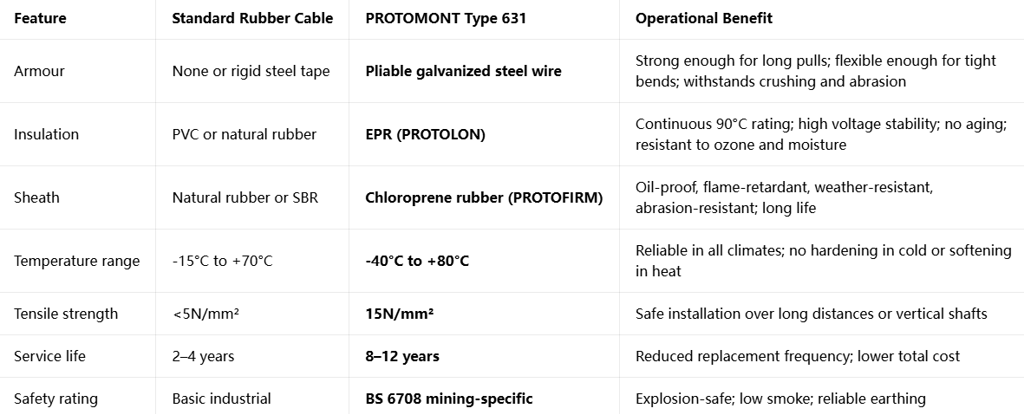
Detailed Performance Comparison
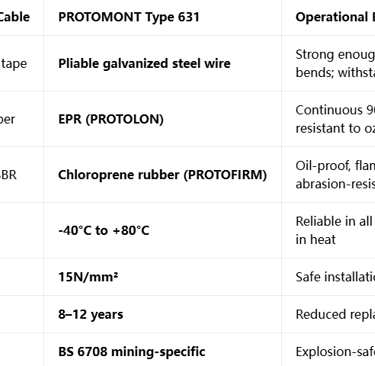
The following comparison highlights key differences between PROTOMONT Type 631 and conventional mining cables:
Key Value Proposition
It is important to clarify that the primary advantage of PROTOMONT Type 631 is not a higher current‑carrying capacity compared to other cables of similar size. The real value lies in its ability to operate continuously and reliably in environments where other cables fail quickly. In mining operations, the cost of a cable replacement is often insignificant compared to the value of lost production during downtime. By reducing failure rates to near zero, Type 631 delivers economic benefits that far outweigh any initial price difference. This is exactly why it has become the standard choice for major mining projects across Indonesia and the world.
Applications and Typical Working Conditions
PROTOMONT Type 631 is designed for fixed installation and semi‑mobile applications in underground mines, matching the needs of medium‑voltage distribution networks operating at 3.8/6.6kV. Its performance characteristics make it suitable for a wide range of equipment and operational scenarios found in Indonesian mining projects.
Official Application Scope
According to manufacturer specifications, the cable is intended for use as mine roadway extension cables and for supplying power to various types of mining machinery. Typical applications include:
Extension of main distribution roadways as mining operations advance deeper or expand laterally.
Power supply to belt conveyors, which transport extracted material over long distances and require continuous power.
Connection to pumps, fans and ventilation systems, critical for maintaining safe working conditions.
Supply to crushing and processing equipment located underground.
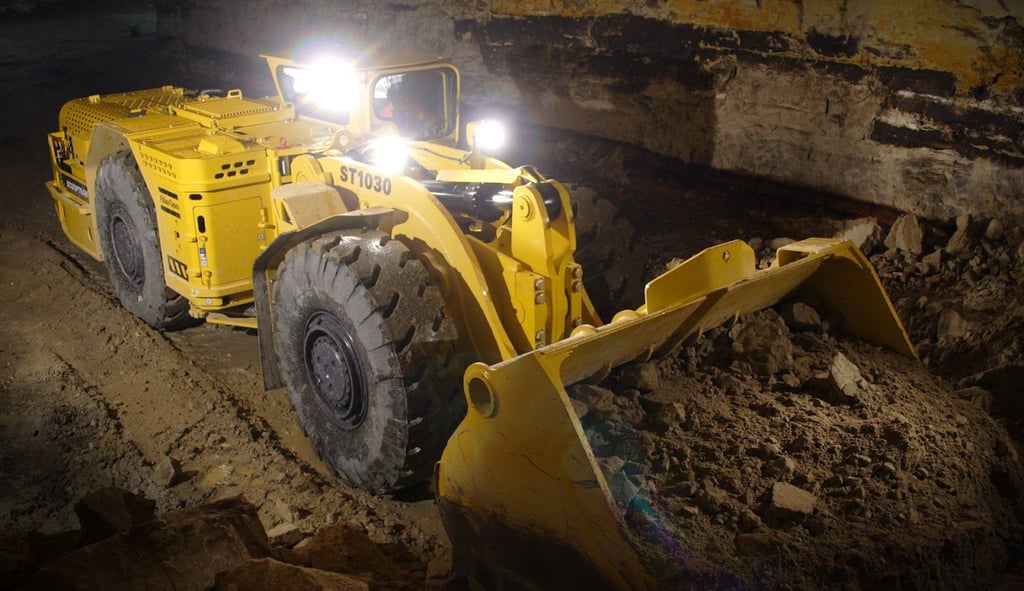
Power distribution to heavy machinery such as shearers, load‑haul‑dump units and drill rigs.
Connection to mobile substations, which move along with the working face to maintain optimal voltage levels.
In all these applications, the cable may be installed fixed along gallery walls or suspended from the roof, or laid on the floor where it may be subjected to occasional movement, dragging or rolling over by vehicles.
Indonesian Mining Case Studies
Real‑world performance in Indonesian mines demonstrates the practical value of Type 631 in local conditions.
Case 1: Coal Mine, East Kalimantan
This mine operates at a depth of approximately 300 metres, with ambient temperatures ranging from 32°C to 38°C and humidity consistently above 95 per cent. Rock strata contain significant sulfur deposits, and groundwater is slightly acidic. Heavy coal transport vehicles frequently pass over cable routes laid on the floor.
Prior to 2018, standard rubber‑sheathed cables were used, but replacement was required every two and a half years due to a combination of insulation hardening, sheath cracking, corrosion and mechanical damage. Unexpected failures occurred several times each year, resulting in production stoppages averaging 24 hours per incident.
Since switching to PROTOMONT Type 631 in 2018, no cable‑related failures have been recorded. The cables remain flexible and intact, with insulation resistance values still above original specifications after eight years of service. The mine has calculated a 40 per cent reduction in total ownership cost when accounting for material, labour and lost production.
Case 2: Nickel Mine, Southeast Sulawesi
Located near the coast, this mine faces unique challenges including salt‑laden air, heavy seasonal rainfall and frequent flooding in lower levels. Long cable runs of over 500 metres are required to reach remote working areas, and cables are subjected to significant tension during installation and use.
Standard cables failed rapidly due to corrosion accelerated by salt exposure and swelling caused by immersion in water. Type 631 was selected specifically for its galvanized armour and fully sealed CR sheath. After seven years of operation, inspection confirmed no corrosion of the armour and no water ingress, validating the design’s suitability for coastal tropical environments.
Summary of Suitable Working Conditions
PROTOMONT Type 631 is engineered to perform reliably under the following conditions:
Installation type: Fixed or semi‑mobile; suitable for laying on the floor, wall mounting or suspension.
Voltage level: Medium voltage up to 6.6kV.
Mechanical stress: High tensile loads, frequent bending, crushing, impact and abrasion.
Environment: High humidity, wet conditions, presence of water, mineral oils, greases, acids, alkalis, sulfur compounds and salt.
Safety zones: Suitable for use in areas with risk of explosive gas or combustible dust.
Temperature: From deep, hot underground workings to cold mountainous areas, and from tropical surface heat to winter conditions.
Feichun Brand — Equivalent Alternative
While originally developed by Prysmian Group, an equivalent version of PROTOMONT Type 631 is available under the Feichun brand, offering identical performance with additional commercial advantages for mining projects in Indonesia and Southeast Asia.
Full Technical Equivalence
Feichun Type 631 is manufactured to exactly the same specifications, standards and design principles as the original product. Every aspect is matched precisely:
Standard compliance: Manufactured to BS 6708, with full documentation and test certificates available.
Construction: Class 5 tinned copper conductors, PROTOLON‑grade EPR insulation, copper/nylon composite screening, CR inner sheath, pliable galvanized steel wire armour and PROTOFIRM‑grade CR outer sheath.
Material performance: Identical temperature ratings (90°C continuous, 250°C short‑circuit), mechanical strength (15N/mm² tensile), flame resistance and oil resistance.
Dimensions and electrical data: Same conductor sizes, outer diameters, weight, resistance values, capacitance, inductance and current‑carrying capacities.
This complete equivalence means that Feichun Type 631 is fully interchangeable with the original product. No changes are required to engineering designs, installation procedures or maintenance practices, making it a drop‑in replacement.
Key Advantages
For project owners and procurement teams in Indonesia, Feichun offers significant benefits:
Competitive pricing
Feichun products are typically priced between 20 and 30 per cent lower than European‑sourced equivalents. This price difference represents substantial savings on large‑scale projects without compromising quality or performance.
Short delivery lead times
Importing cables from Europe can take between eight and twelve weeks due to manufacturing schedules, shipping and customs clearance. Feichun maintains regional stock and manufacturing capacity capable of delivering orders within two to four weeks. This speed is critical for mine operations where project schedules are tight or emergency replacements are required.
Local technical support
Feichun provides engineering support and installation guidance within Southeast Asia, ensuring that technical questions are answered quickly and on‑site assistance is available when needed.
Certified quality
All products undergo the same rigorous testing as required by international standards, with third‑party verification reports available for every batch. Quality assurance processes are aligned with ISO 9001 and ISO 14001 standards.
Customization options
Feichun offers flexibility in production, including special lengths, custom markings, different packaging and integration with accessories, allowing products to be tailored exactly to project requirements.
Value Proposition
Feichun Type 631 delivers world‑class mining cable technology at a price and availability level that fits regional project budgets and schedules. It represents the optimal balance between quality, cost and service, making high‑performance power distribution accessible to every mining operation in Indonesia.
Selection Guide and Engineering Recommendations
Selecting the correct cable size and specification is critical to ensure safe operation, compliance with regulations and economic efficiency. The following guidelines are based on engineering best practices and data from official specifications.
How to Choose the Right Cross‑Section
Selection should follow a four‑step process:
Current‑carrying capacity
Refer to the current ratings provided in the technical data table. These values assume standard installation conditions. Adjustments must be made for high ambient temperatures, grouping of multiple cables or installation in heated environments. The chosen cable must be capable of carrying the maximum continuous load without exceeding temperature limits.
Voltage drop calculation
For medium‑voltage distribution, the voltage drop from the supply point to the load should not exceed five per cent at full load to ensure equipment operates correctly. Use the resistance and inductance values provided to calculate voltage drop over the intended length. Longer distances will require larger conductor sizes to compensate.
Short‑circuit withstand capability
Verify that the short‑circuit current rating of the cable is greater than the prospective fault current at the connection point. This ensures that the cable can withstand fault conditions without damage until protection devices clear the fault.
Mechanical requirements
Check that the maximum permissible tensile force listed in the data table exceeds the pulling force expected during installation or operation. For long pulls or vertical installations, select larger sizes accordingly.
Recommended applications by size:
3×50+1×35 and 3×70+1×50: Ideal for short to medium runs up to 300 metres; suitable for pumps, fans and smaller conveyor systems.
3×95+1×70: Best balance of capacity and size; recommended for runs between 300 and 500 metres and medium‑power machinery.
3×120+1×70: For long runs exceeding 500 metres, heavy‑duty equipment or where future expansion is anticipated.
Installation Rules and Best Practices
Proper installation is essential to realize the full performance potential of PROTOMONT Type 631:
Bending radius: Do not bend the cable to a radius smaller than 12 times the outer diameter during operation, or 15 times during installation and pulling. Sharp bends create high internal stress that can damage insulation and armour.
Tension limits: Never exceed the maximum permissible tensile force listed for each size. Excessive tension can permanently elongate conductors or break armour wires.
Temperature considerations: Avoid installation when cable or ambient temperatures are below the specified minimums, as materials may be less flexible and prone to damage.
Protection: Where cables are laid on the floor, ensure they are routed away from heavy traffic or protected by suitable covers to prevent crushing.
Terminations: Use appropriate cable glands and terminations designed for medium‑voltage armoured cables to maintain sealing and electrical performance.
Frequently Asked Questions
Q1: Is PROTOMONT Type 631 suitable for use in explosive atmospheres?
Yes absolutely. Manufactured to BS 6708, it meets the strictest safety requirements for mining cables. It is flame‑retardant, low‑smoke and low‑toxicity. The fully sealed construction prevents the ingress of explosive gases or dust into the cable structure, and screening ensures no sparking or external discharge. It is approved for use in Zone 1 and Zone 2 gas hazardous areas and Zone 21 and Zone 22 dust hazardous areas.
Q2: What is the difference between Type 630 and Type 631?
Type 630 is the unarmoured version of the cable, suitable only for fixed installation in protected environments where mechanical damage is not a risk. It is lighter and lower in cost but lacks the strength and durability of Type 631. Type 631 features the pliable galvanized steel armour that makes it suitable for fixed, semi‑mobile and trailing applications, and provides long life in exposed or high‑stress locations.
Q3: How long can I expect Feichun Type 631 to last in Indonesian mines?
Under normal operating conditions, a service life of 8 to 12 years is typical, with many installations operating reliably for over 10 years. Actual life depends on installation quality, load factor and environmental severity, but it is consistently 2 to 3 times longer than standard rubber cables.
Q4: Why is EPR insulation preferred over XLPE for mining applications?
XLPE (cross‑linked polyethylene) is widely used in fixed industrial distribution but is a rigid material with limited flexibility. EPR is highly flexible, retains elasticity at low temperatures, has better resistance to water and moisture, and superior electrical performance at high temperatures. These properties make EPR the superior choice for cables that must bend, move or operate in wet conditions — all typical in mining.
Q5: Can Feichun Type 631 replace Prysmian Type 631 directly?
Yes, replacement is 100 per cent direct and interchangeable. All dimensions, materials, performance characteristics and standards compliance are identical. Feichun cables are manufactured using the same engineering principles and quality standards, ensuring seamless integration into existing or new systems.
Conclusion
PROTOMONT Type 631 is not simply another product in the mining cable market; it is the benchmark by which other medium‑voltage flexible trailing cables are measured. Since its introduction, it has defined what is possible in terms of reliability, durability and safety in underground power distribution.
At its core, it represents a perfect integration of material science, mechanical engineering and electrical design:
Electrical safety is guaranteed through the combination of PROTOLON EPR insulation and individual core screening, delivering stable performance at 90°C, withstanding 11kV test voltage and surviving short‑circuit temperatures up to 250°C.
Mechanical performance is achieved through the ingenious pliable galvanized steel armour design, which provides a tensile strength of 15N/mm² while maintaining flexibility down to 12 times the diameter — solving the industry‑long conflict between strength and flexibility.
Environmental resistance is delivered by PROTOFIRM CR sheathing, which is oil‑resistant, flame‑retardant, weather‑proof and durable, operating reliably from ‑40°C to +80°C and surviving the humidity, corrosion and heat of tropical mines.
Long‑term reliability results from the harmonious interaction of every layer, each designed to complement the others and to withstand decades of service with minimal maintenance.
For mining operations in Indonesia, where production continuity is essential and environmental conditions are among the most demanding in the world, this cable offers a solution that balances performance, safety and cost‑efficiency. It is suitable for every application from roadway extensions to heavy machinery supply, and its compliance with BS 6708 ensures it meets the most rigorous safety standards.
With the availability of Feichun Type 631 as a fully equivalent alternative, these world‑class engineering benefits are now available at competitive prices and with short delivery times, making high‑reliability power distribution accessible to every mining project.
In the underground environment, where failure means downtime, lost revenue and potential safety risks, PROTOMONT Type 631 provides the assurance that power will remain available exactly where and when it is needed. It is the definitive choice for engineers who understand that in mining, reliability is everything.
Contact for Purchase
If you require PROTOMONT Type 631 (BS 6708) cables or equivalent Feichun brand solutions for your mine project in Indonesia or Southeast Asia, please contact our engineering and sales team:
We provide:
Full technical datasheets, test certificates and compliance documentation
Project‑specific sizing assistance and engineering consultation
Local delivery and installation guidance
Competitive pricing and short production lead times
Feichun is committed to delivering reliable, high‑performance cable solutions that keep mining operations running safely and efficiently.

Feichun Cable
Durable mining cables for tough environments and operations
Email: Tech@feichuncables.com
© 2025. All rights reserved.
Company
Products
Contact
WhatsApp: +86 13855123218