Anhui Feichun Special Cable Co.,Ltd

Protolon(SC)® (N)TSKWOEU Shore Power Cable 0.6/1 kV: Complete Guide to IEC/ISO/IEEE 80005-3 & VDE 0250-813 Compliant Reeling Cables for Cold Ironing, Green Ports & Indonesia Maritime Decarbonization
Discover the Protolon(SC)® (N)TSKWOEU 0.6/1 kV shore power cable – the ultimate IEC/ISO/IEEE 80005-3 and VDE 0250-813 compliant solution for cold ironing. Full specs, waterproof design, aramid tensile strength, control cores, and why Feichun delivers 35-50% cost savings for Indonesia ports and global green maritime projects.
Li Wang
4/17/20268 min read
Introduction: The Silent Revolution at the Dock
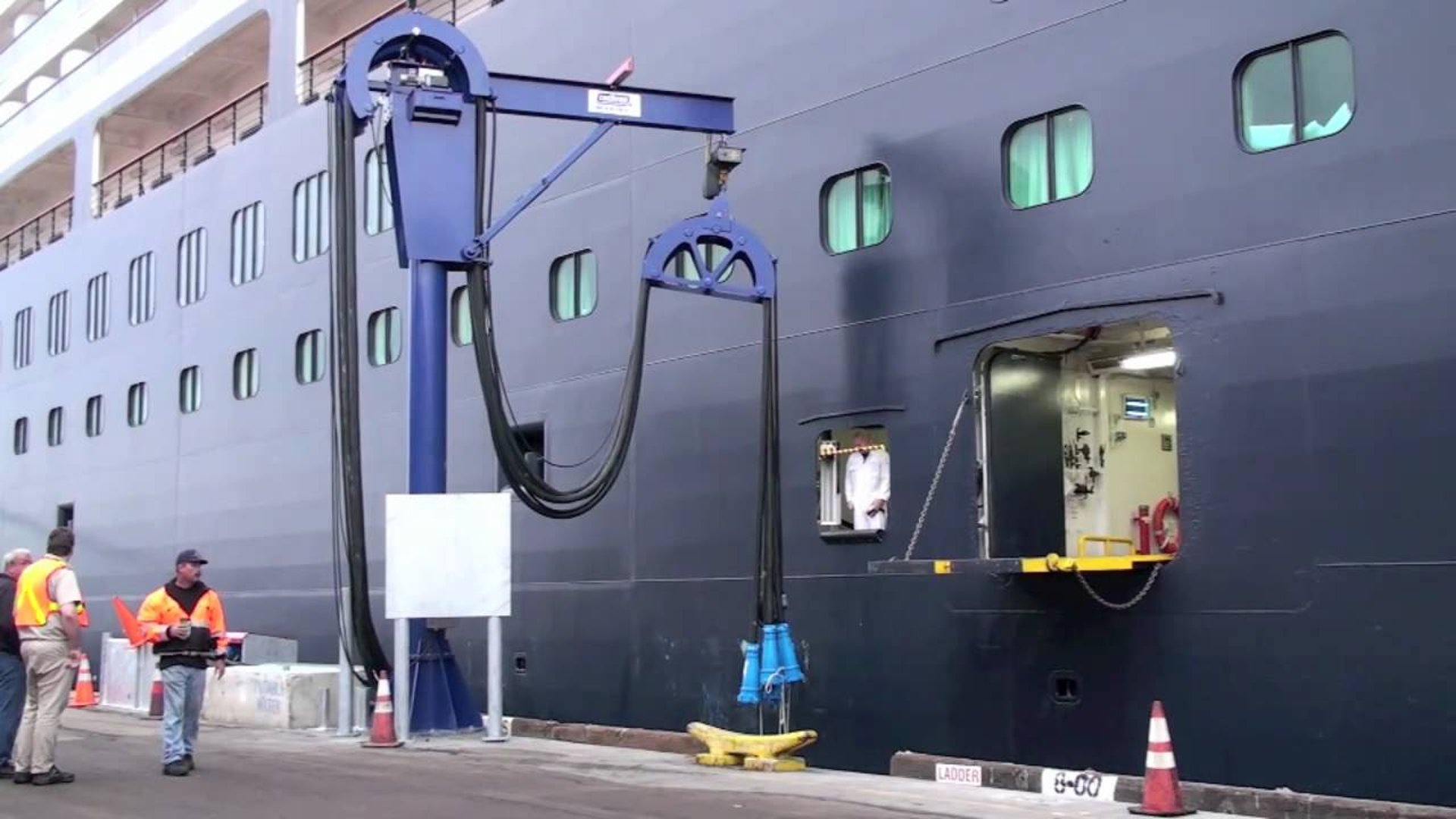
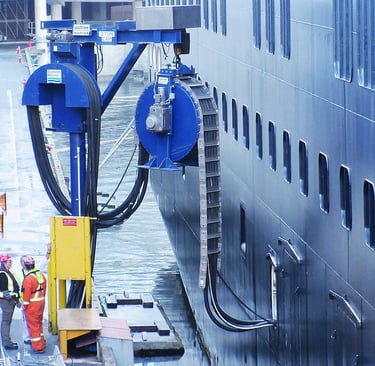
Imagine a 300-meter container ship berthed at Tanjung Priok, Indonesia’s busiest port, its massive auxiliary diesel engines falling silent for the first time in days. Instead of idling and belching pollutants into the humid tropical air, the vessel draws clean electricity directly from the quay through a specialized low-voltage reeling cable. This is not science fiction—it is the reality of shore power, also known as cold ironing or Onshore Power Supply (OPS). At the heart of this transformation lies the cable itself: a highly engineered, flexible power and control lifeline that must endure the harshest marine conditions while delivering reliable three-phase power and intelligent safety signals.
Shore power represents one of the fastest-growing applications in the global maritime cable industry. By allowing berthed vessels to shut down their auxiliary engines, it slashes emissions of SOx, NOx, CO₂, and particulate matter by up to 90% per vessel per port call. Global regulators—from the International Maritime Organization (IMO) to the European Union’s FuelEU Maritime regulation, California’s CARB rules, and Indonesia’s DGST SE DJPL 22/2022—have made shore power a cornerstone of maritime decarbonization. Pelindo (Pelabuhan Indonesia) is aggressively expanding OPS infrastructure across more than 21 ports, with Tanjung Priok, Tanjung Perak, and Teluk Lamong leading the charge.
Yet the technology’s success hinges on one unsung hero: the shore connection cable. Ordinary industrial or even submarine cables fail under the unique combination of repeated reeling cycles, tidal-induced vessel movement, submersion, torsion, and the need for integrated pilot/control cores mandated by international standards. This is where the Protolon(SC)® (N)TSKWOEU 0.6/1 kV cable, developed by Anhui Feichun Special Cable Co., Ltd., stands out. Purpose-engineered for low-voltage shore connection (LVSC) systems up to 1 MVA, it is fully compliant with IEC/ISO/IEEE 80005-3 and Germany’s rigorous VDE 0250-813 standard for flexible reeling cables under mechanical stress.
This comprehensive guide explores every aspect of the Protolon(SC)® (N)TSKWOEU—from its technical anatomy and dual-standard compliance to real-world applications in Indonesia’s green-port revolution and its compelling economic advantages over European alternatives. Whether you are a port engineer, terminal operator, maritime policymaker, or sustainability consultant, this article provides the definitive reference for understanding why this cable is powering the future of sustainable shipping.
What Is Shore Power (Cold Ironing / Onshore Power Supply)
Shore power, cold ironing, or OPS refers to the supply of electrical power from the onshore grid to a berthed vessel, enabling the shutdown of onboard auxiliary diesel generators. The term “cold ironing” originated in the early 20th century when ships in port would shut down their steam engines (“cold iron”) and draw power from shore. Today, the technology has evolved into a sophisticated, automated system governed by international standards.
The environmental imperative is clear. When at berth, ships typically run auxiliary engines continuously for lighting, refrigeration, cargo handling, and hotel loads. These engines emit significant pollutants: a single large container ship can produce emissions equivalent to thousands of cars idling daily. Global studies show that shore power can reduce SOx by 95%, NOx by 80-90%, CO₂ by 60-80%, and particulate matter by up to 90% per port call.
Market projections underscore the momentum. The global shore power market was valued at approximately USD 2.0-2.5 billion in 2025 and is forecast to reach USD 4.7-6.6 billion by 2033-2035, with CAGRs of 9.7-12.7%. Drivers include tightening IMO GHG Strategy targets (net-zero by or around 2050), EU AFIR mandates for TEN-T ports by 2030, FuelEU Maritime penalties starting 2025, and national policies in Asia.
In Indonesia, maritime activity accounts for 19% of national GHG emissions. Pelindo’s expansion of OPS across 21+ ports aligns with DGST regulations and international commitments. Projects at Tanjung Priok (Jakarta), Tanjung Perak (Surabaya), Teluk Lamong, Benoa (Bali), and Makassar are prioritizing LVSC systems suitable for container, cruise, ferry, tanker, and bulk vessels.
Economically, shore power delivers 60%+ fuel savings for ships at berth while improving local air quality in port cities. Health benefits include reduced respiratory illnesses for port communities. Technologically, modern systems integrate cable management systems (CMS), motorized reels, frequency converters, and automated interlocking to ensure safe, seamless connections.
The cable is the critical link. It must transmit three-phase power (typically 400-690 V) while carrying pilot/control signals for connection verification, grounding continuity, permission-to-energize, and emergency disconnect—functions explicitly required by IEC/ISO/IEEE 80005-3 for LVSC systems up to 1 MVA.
Why Shore-Power Cables Must Be Special
Standard flexible cables—designed for fixed industrial or occasional mobile use—cannot survive the demands of shore power. The environment imposes multi-axis mechanical stresses, environmental extremes, and safety-critical electrical requirements.
Vessels experience tidal rise/fall (up to several meters), surge, yaw, and drift, imposing permanent tensile load (Fzp) plus dynamic shock (Fzd). A typical berth may see 500-1,500 connection cycles per year, equating to 7,500-22,500 cycles over a 15-year design life. Torsion reaches ±25°/m or more. Cables must endure periodic or continuous submersion in quay pits or tidal zones, UV radiation, salt spray, oil, and temperature swings from -40°C to +80°C.
Indonesia’s tropical conditions amplify these challenges: high humidity, monsoon rains, and salinity accelerate corrosion and water ingress. Non-specialized cables suffer jacket cracking, conductor fatigue, insulation breakdown, or control-core failure, leading to downtime, safety risks, and regulatory non-compliance.
Comparison with other cable types highlights the uniqueness:
Ordinary industrial cables: Lack flexibility, tensile strength, and pilot cores.
Submarine cables: Rigid armor unsuitable for reeling.
Crane/mining reeling cables: Often lack integrated control cores and dual water barriers optimized for tidal immersion.
The Protolon(SC)® (N)TSKWOEU addresses these through dual compliance with IEC/ISO/IEEE 80005-3 (LVSC system requirements including cable mechanical tension monitoring, pilot contacts, water exposure) and VDE 0250-813 (high-mechanical-stress flexible reeling cables specifying minimum 20 N/mm² tensile strength, precise bending radii, and rubber sheath performance).
Protolon(SC)® (N)TSKWOEU: Purpose-Engineered for Shore Power
Developed by Feichun, the Protolon(SC)® (N)TSKWOEU is a 0.6/1 kV LVSC cable explicitly designed for ship-to-shore power supply. Its designation breaks down as follows: (N)TSKWOEU indicates neoprene (CR) outer sheath, special construction, cold-resistant, oil-resistant, UV-resistant, and enhanced mechanical properties. The “SC” denotes shore connection.
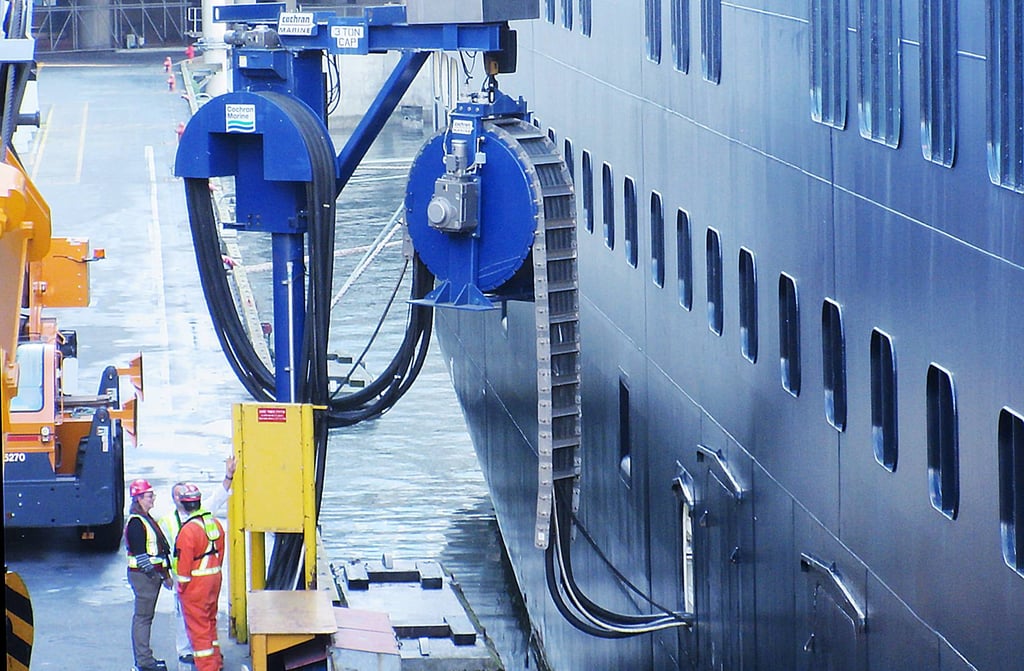
It integrates three-phase power conductors, split earth conductors for symmetry, and four control/pilot cores—all within a robust, flexible package optimized for motorized reels and CMS from suppliers like Cavotec, Cochran Marine, and Igus. Dual compliance ensures global interoperability.
Deep Technical Anatomy: Full Specification Breakdown of Protolon(SC)® (N)TSKWOEU-J 0.6/1 kV
Voltage Rating:
U₀/U = 0.6/1 kV; test voltage 4 kV.
Conductor:
High-purity bare copper (Tongling Cu-CATH-1, 99.97%+), Class 5 ultra-flexible stranding for repeated bending.
Insulation:
EPR (Ethylene Propylene Rubber) 3GI3 compound with integrated semi-conductive stress-control layer. Conductor operating temperature: 90°C continuous, 250°C short-circuit.
Earth Conductors:
Split design in outer interstices (e.g., 2×70/2 mm² total 140 mm² for 3×120 configuration) to maintain perfect cable roundness and symmetry during reeling.
Control/Pilot Cores:
1×(4×2.5 mm²) positioned in outer interstice for automation: connection verification, grounding monitoring, permission-to-energize, and emergency disconnect—directly fulfilling IEC/ISO/IEEE 80005-3 pilot contact requirements.
Inner Sheath:
EPR for primary water barrier and mechanical protection (water absorption <0.5% after 7-day immersion).
Self-Supporting Element:
Para-aramid (Kevlar) fibers integrated to carry cable self-weight, preventing excessive conductor tension (e.g., supporting 2.4 kN for 25 m vertical hang at 9,500 kg/km weight).
Outer Sheath:
5GM5 polychloroprene (Neoprene) rubber—flame-retardant (IEC 60332-1-2), oil-resistant (EN 60811-404), UV-resistant, and low water absorption (<2%).
Key Performance Metrics:
Temperature range: Fixed installation -40°C to +80°C; moving -25°C to +80°C.
Minimum bending radius: 4×OD fixed; 5×OD moving.
Torsion: ±25°/m.
Tensile strength: 20 N/mm² based on total copper cross-section. Permanent (Fzp) and dynamic (Fzd) values exceed VDE 0250-813 requirements.
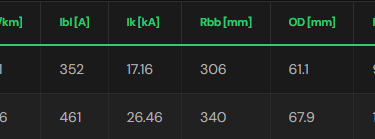
Configuration Tables :
Selection Guidance:
3×120 mm² suits ferries and mid-size container vessels (<2.5 MVA);
3×185 mm² supports larger cruise ships, tankers, or bulk carriers up to 4 MVA. Higher demands can use parallel cables or medium-voltage upgrades.
Standards Mastery: How It Exceeds IEC/ISO/IEEE 80005-3 and VDE 0250-813
IEC/ISO/IEEE 80005-3:2025 (Low-Voltage Shore Connection Systems – General Requirements) defines LVSC operability, safety circuits, pilot functions, cable mechanical/electrical performance, and interoperability for vessels up to 1 MVA. Key demands include water immersion tolerance, dynamic loading from vessel motion, and mandatory safety interlocks—precisely addressed by the integrated 4-core pilot system and dual-sheath construction.
VDE 0250-813 (Trailing Cables for Power Installations) is the definitive German standard for high-mechanical-stress flexible cables. It mandates 20 N/mm² tensile strength, precise bending/torsion limits, rubber compounds (3GI3/5GM5), and fatigue resistance under reeling. Feichun’s cable exceeds these by incorporating aramid load-bearing and split-earth symmetry, ensuring zero twist accumulation on high-speed drums.
Dual certification is rare and non-negotiable for international ports, guaranteeing 15-year reliability and regulatory approval in Indonesia, Europe, and the U.S.
Features Explained in Depth
(1) Waterproof Structure: Indoor, Outdoor, and Water-Submerged Installation
The dual-sheath system—EPR inner (water absorption <0.5%) plus 5GM5 CR outer (<2% after 7 days)—creates redundant barriers. EPR self-seals micro-damage; CR provides mechanical toughness and oil/UV resistance. The cable is rated for quay pits, under-wharf routing, and tidal submersion zones common in Indonesian ports (e.g., Tanjung Priok’s variable 1.5–2.5 m tides). Permanent submersion >30 days benefits from additional water-blocking tape, but standard design already meets IEC 60811 immersion tests.
(2) Integrated Control Core: Shore-Power System Intelligence
The 4×2.5 mm² pilot cores, positioned in the outer interstice for EMI shielding, enable full automation:
Core 1 verifies physical connection.
Core 2 confirms earth continuity.
Core 3 signals “permission to energize.”
Core 4 triggers emergency disconnect. This satisfies IEC/ISO/IEEE 80005-3 Chapter 7 safety-loop requirements, reducing human error and enabling “plug-and-play” with modern CMS/reel systems.
(3) Aramid Self-Supporting and Split-Earth Interstice Design
Optimized for Reel Performance Para-aramid fibers (tensile modulus >100 GPa) carry the cable’s 9,500 kg/km self-weight, preventing conductor elongation. Split-earth conductors in outer interstices maintain rotational symmetry, eliminating “corkscrewing” on cylindrical or monospiral reels—critical for 120–180 m/min reeling speeds on quay drums.
(4) Permanent and Dynamic Tensile Strength
Rated at 20 N/mm² on total copper area, the cable delivers Fzp (permanent) 9,000–11,100 N and Fzd (dynamic) 11,100–13,875 N. This margin absorbs surge peaks (e.g., 2–3 m tidal change + vessel yaw) while the aramid element prevents creep.
(5) Shore-Power Connection Cycle Endurance Under Unique Multi-Axis Mechanical Stress
Each berthing cycle imposes bending + torsion + tension + vibration—far beyond single-plane crane reeling. The EPR’s high elasticity (elongation >300%), combined with aramid and symmetrical design, achieves 15-year life. Failure-mode analysis shows generic cables suffer conductor fatigue at 2,000–3,000 cycles; Protolon(SC)® exceeds 22,500 through material science and geometry optimization.
Applications
Deployed globally in Rotterdam, Hamburg, Shanghai, Singapore, and Long Beach. In Indonesia, ideal for Pelindo’s Tanjung Priok (container), Teluk Lamong (liquid bulk), Benoa (ferry/cruise), and Makassar projects. Sector examples include 3×120 mm² for ferries and 3×185 mm² for tankers.
Why Feichun’s Protolon(SC)® (N)TSKWOEU Is the Smart Economic Choice vs. European Suppliers
Lead Time Comparison
European suppliers: 12–24 weeks
Feichun: 4–8 weeks
👉 Faster project execution
Price Advantage
Lower production cost
No excessive brand premium
👉 Typically 20–40% cost savings
Suitability for Indonesian Market
Adapted for tropical climate
Flexible customization
Efficient logistics
Feichun offers 35-50% lower pricing (€24–36/m vs. €48–65/m for equivalent European Protolon/Prysmian products) and 4–8 week lead times versus 16–24 weeks. For a typical 6,000 m Indonesian port project, savings exceed €165,000 while maintaining identical performance and compliance. Asian supply-chain resilience and proximity to Indonesia further reduce total cost of ownership.
Conclusion
The Protolon(SC)® (N)TSKWOEU exemplifies engineering excellence for sustainable ports. Its dual-standard compliance, robust construction, and economic advantages position it as the preferred solution for Indonesia and global decarbonization.
Ready to future-proof your port with the world’s most reliable and economical shore-power cable solution? Contact the Feichun engineering team today: Li.wang@feichuncables.com for the full Protolon(SC)® (N)TSKWOEU technical data sheet, installation guidelines, and tailored pricing. Fast 4–8 week delivery. Global compliance. Proven performance in the world’s busiest ports. Let’s connect your port to a greener tomorrow.

Feichun Cable
Durable mining cables for tough environments and operations
Email: Tech@feichuncables.com
© 2025. All rights reserved.
Company
Products
Contact
WhatsApp: +86 13855123218