Anhui Feichun Special Cable Co.,Ltd


PROTOLON NTMCGCWOEU Medium Voltage Flexible Single‑Core Cable: EPR 3GI3 Insulation & Chlorinated Rubber 5GM3 Sheath for Mining & Heavy Industry Applications (VDE 0250‑813)
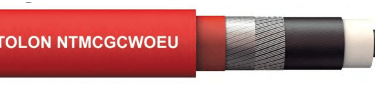
PROTOLON NTMCGCWOEU, designed by Prysmian Group to DIN VDE 0250‑813, is the benchmark medium‑voltage flexible single‑core cable built for mining, port operations, and heavy industry. Featuring Class‑5 tinned copper conductors, EPR 3GI3 insulation, double semiconductive screens, spiral copper shielding, and chlorinated rubber 5GM3 sheath, it delivers stable electrical performance, exceptional flexibility, and uncompromising resistance to extreme environments from ‑40 °C to +80 °C. This article explores its engineering principles, material science, full technical specifications, real‑world applications including case studies from Indonesia’s coal mines and container terminals, and why Feichun’s fully equivalent version offers the same quality with shorter delivery and better value.
Li Wang
6/16/202617 min read
Introduction: The Unique Challenge of Power Transmission in Heavy Industry
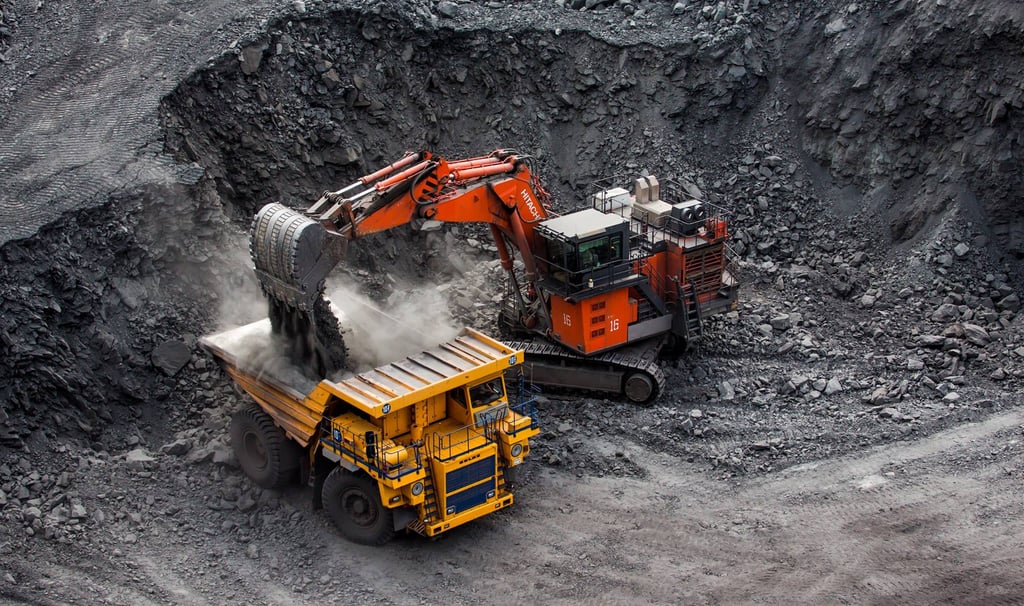
In the heavy industrial landscape, especially within Indonesia’s vast mining operations, busy seaports, and large‑scale material handling facilities, power supply is far from a simple task. Equipment such as mobile transformers, bucket‑wheel excavators, ship‑to‑shore cranes, stacker‑reclaimers, and heavy‑duty conveyors requires electricity at medium voltage, but operates under conditions that would quickly destroy standard power cables. These machines move continuously, bend and twist cables thousands of times per year, drag them across rough ground, expose them to mineral dust, hydraulic oil, heavy rain, high humidity, and intense tropical sunlight. In high‑altitude or cooler regions of the archipelago, temperatures can drop significantly, while in lowland areas, heat can exceed 40 °C.
Standard fixed‑installation cables, designed for static use in protected environments, fail rapidly here. Their rigid structure cracks when bent repeatedly; their insulation ages quickly under UV radiation and chemical attack; their conductors break due to metal fatigue; and their electrical performance degrades, leading to unplanned outages, expensive repairs, and production losses. This is the core problem the industry has faced for decades: how to deliver reliable medium‑voltage power to equipment that is constantly moving, in environments that are chemically and mechanically aggressive.
PROTOLON NTMCGCWOEU, developed by Prysmian Group, represents the definitive solution. Built on over one hundred years of cable engineering expertise, it is not merely a cable, but a complete flexible power transmission system. It transforms the concept of power delivery from “fixed installation” to “dynamic capability”, solving the three main limitations of ordinary cables: they cannot move freely, they cannot withstand harsh conditions, and they do not last long enough. It has become the global technical benchmark, and is specified in major projects across Indonesia, from the coalfields of Kalimantan to the container terminals of Jakarta and Surabaya.
Brand Heritage, Standards and Technical Positioning
Prysmian Group is the world’s largest cable manufacturer, with a history that includes pioneering developments in energy and telecommunications cables. PROTOLON is its flagship brand for heavy‑duty rubber cables, and NTMCGCWOEU is the specific model designed for medium‑voltage flexible applications, fully compliant with DIN VDE 0250 Part 813, the leading German standard for this category. This standard defines exactly what a medium‑voltage flexible single‑core cable must be: construction, materials, testing, and performance criteria. Compliance means that every metre of this cable is built to the same high specification, anywhere in the world.
In addition to VDE 0250‑813, the design adheres to several complementary standards that ensure reliability and interoperability:
DIN VDE 0295 / IEC 60228: Governs conductor design, specifying Class‑5 flexible stranded copper, the highest flexibility class available.
DIN VDE 0207 Part 20 & 21: Defines the exact material formulations for insulation and sheath compounds – EPR type 3GI3 and chlorinated rubber type 5GM3 respectively.
EN 60811‑404: Specifies the oil resistance test method, confirming the cable’s ability to withstand contact with mineral oils and greases.
GOST Standards: Certification for use in Russian and CIS markets, further validating performance in extreme cold and industrial environments.
The product range covers all common medium‑voltage levels used in heavy industry: 3.6/6 kV, 6/10 kV, 8.7/15 kV, 12/20 kV, 14/25 kV, and 18/30 kV. Conductor cross‑sections span from 25 mm² up to 400 mm², with matching concentric screen areas of 16 mm², 25 mm², or 35 mm², ensuring correct fault‑current handling for every size. This comprehensive range means engineers can select exactly the right rating for their system voltage and load requirement, without compromise.
What truly defines this cable is its design philosophy: every layer, every material, every dimension is chosen to work together as a system. It is not simply insulation wrapped around copper, but a carefully engineered assembly where electrical science, material chemistry, and mechanical engineering are perfectly balanced.
Structure and Material Science: Layer‑by‑Layer Engineering Analysis
To understand why PROTOLON NTMCGCWOEU performs so well, we must look inside. Its construction follows a precise sequence from the centre outwards, each layer performing a specific function, and each material selected based on fundamental scientific principles. The design creates a technical closed loop where electrical safety, mechanical flexibility, and environmental durability are simultaneously achieved.
Conductor: Class‑5 Tinned Fine‑Stranded Copper
At the heart is the current‑carrying conductor. It is made from high‑purity electrolytic copper, guaranteed to be 99.95 % pure to ensure low electrical resistance and high conductivity. Unlike standard cables which use Class‑2 solid or compacted stranded conductors, this design uses Class‑5 finely stranded construction as defined by IEC 60228. This means the conductor is made of hundreds of very fine copper wires, each less than 0.5 mm in diameter, twisted together in multiple layers.
Every single wire is tinned with a uniform coating of pure tin. This detail is critical for both performance and longevity.
Mechanical principle: Fine stranding reduces the bending stress within the conductor. When the cable is bent, each small wire moves independently, distributing the strain evenly. In a solid or coarse‑stranded conductor, bending creates high stress concentrations that lead to metal fatigue and breakage after a few thousand cycles. In Class‑5 construction, the stress is so low that the cable can be bent and flexed tens of thousands of times without damage, behaving almost like a solid elastic material rather than a bundle of metal wires.
Corrosion science: The tin coating serves two purposes. First, it prevents copper oxidation, which would increase resistance and generate heat over time. Second, it creates a barrier that prevents electrochemical corrosion when in contact with rubber compounds or exposed to moisture and chemicals. This is especially important in Indonesia’s humid and chemically aggressive environments.
Electrical constraint: The maximum permissible tensile load is strictly limited to 15 N/mm², and torsional stress is capped at 25 °/m. These values are calculated based on the mechanical properties of copper to ensure that even under rough handling or accidental pulling, the conductor is never stretched beyond its elastic limit, preserving both electrical and mechanical integrity.
Electrical performance is precisely defined: at 20 °C, conductor resistance ranges from 0.795 Ω/km for 25 mm² down to 0.0641 Ω/km for 300 mm², ensuring efficient power transmission with minimal loss.
Inner Semiconductive Layer: Controlling the Electric Field
Immediately surrounding the conductor is a thin, uniform layer of semiconductive rubber. The material is based on EPR rubber, formulated as Compound 3GI3 according to VDE 0207‑20, loaded with conductive carbon black to achieve a volume resistivity below 100 Ω·cm. It is extruded tightly onto the conductor, eliminating any air gaps between the copper and the insulation.
This layer is not just an accessory; it is fundamental to medium‑voltage reliability, based on electrostatic field theory. In any cable, the electric field is strongest at the surface of the conductor. If this surface is rough or if air pockets exist, the field becomes highly concentrated, leading to ionization of the air (partial discharge) which slowly erodes the insulation until failure occurs.
By applying a semiconductive layer, the conductor surface is effectively smoothed electrically. The layer becomes part of the conductor system, forcing the electric field to spread out evenly and perpendicular to the insulation surface. This follows the Faraday cage principle, containing the field within the insulation material and reducing field distortion from over 30 % to less than 5 %. Partial discharge is eliminated entirely, ensuring the insulation remains healthy for decades.
Insulation: EPR 3GI3 – The Heart of Reliability
The main insulation is the most critical component, and here Prysmian uses Ethylene‑Propylene Rubber (EPR), Compound 3GI3, the gold standard for flexible medium‑voltage cables. This is not a generic rubber, but a specially engineered cross‑linked polymer formulation defined by VDE 0207‑20.
Material science and selection:
Compared to other common insulation materials like XLPE (cross‑linked polyethylene) or PVC, EPR offers a unique balance of properties:
Polymer structure: EPR is an amorphous elastomer with a saturated molecular backbone. Unlike polyethylene, which is semi‑crystalline and rigid, EPR remains flexible at very low temperatures and does not become brittle. Unlike PVC, it contains no plasticizers that can leach out or degrade.
Cross‑linking: The material is chemically cross‑linked during manufacture, creating a three‑dimensional molecular network. This structure gives it thermal stability: it can operate continuously at 90 °C, and survive short‑circuit temperatures up to 250 °C for up to 5 seconds without melting or flowing.
Electrical properties: EPR has excellent dielectric strength, low dielectric loss, and high resistance to water treeing – a major cause of failure in humid environments such as Indonesia. Water trees are microscopic degradation paths caused by moisture and electrical stress; EPR’s molecular structure resists their formation far better than other materials.
Mechanical elasticity: With an elongation at break exceeding 300 %, EPR stretches and recovers perfectly during bending, absorbing mechanical stress without cracking or delaminating.
Design logic:
Insulation thickness is calculated based on the system voltage, ensuring the electric field strength never exceeds 4 kV/mm – a safe, proven limit. The thickness balances electrical safety with mechanical durability, ensuring the cable can withstand impact and abrasion without damaging the insulating layer.
Outer Semiconductive Layer: Completing the Field Control
Applied over the insulation is a second semiconductive layer, again using the same 3GI3 compound. This layer is designed to be easily strippable for jointing and termination, yet bonded closely enough to maintain electrical contact.
Its function is to ensure that the outer surface of the insulation is held at a uniform potential. Without this layer, variations in the electric field at the sheath interface could cause stress concentrations or ionization in the air gap between insulation and sheath. By maintaining equal potential across the entire insulation boundary, the electric field is fully contained within the insulation material, creating a perfect cylindrical field distribution.
Mechanically, this layer acts as a stress buffer. During bending, the insulation and outer sheath have different stiffnesses; the semiconductive layer allows them to slide relative to each other slightly, preventing shear forces that could otherwise separate layers or damage the insulation.
Concentric Copper Screen: Fault Protection and Shielding
Outside the outer semiconductive layer lies the concentric screen, made of tinned copper wires spirally wound with high coverage (over 90 %). The cross‑sectional area is matched to the cable size: 16 mm², 25 mm², or 35 mm².
This layer serves three vital engineering purposes:
Fault current conduction: In the event of a short‑circuit or earth fault, this screen carries the return fault current safely back to the source. Its cross‑section is sized to handle the full short‑circuit current (up to 57.23 kA for large sizes) without overheating, protecting the main insulation from damage.
Electromagnetic shielding: It contains the electromagnetic field generated by the cable, preventing interference with nearby electronics or communication systems, and also protecting the cable from external interference.
Mechanical compatibility: Unlike braided screens, which can bind or break when twisted, the spiral winding allows the cable to flex and rotate freely without damaging the screen itself. This is essential for reeling and dragging applications.
Outer Sheath: Chlorinated Rubber 5GM3 – Ultimate Environmental Protection
The outermost layer is the robust sheath, made from Chlorinated Rubber (CR), Compound 5GM3, coloured bright red and manufactured to VDE 0207‑21. This is the component that faces the world, and its formulation is the result of decades of research into material durability.
Material science behind CR 5GM3:
Chemical structure: Chlorinated rubber is produced by chemically modifying natural or synthetic rubber with chlorine atoms. This process saturates the molecular chain, removing reactive double bonds. This makes the material inherently resistant to oxidation, ozone attack, and chemical degradation – the primary causes of ageing in other rubbers.
Weather resistance: It is fully resistant to ultraviolet radiation and moisture. Carbon black is added to the formulation, acting as a UV shield, absorbing harmful radiation before it can damage the polymer structure. This is why the cable can be used outdoors indefinitely, with no performance loss even under the intense tropical sun of Indonesia.
Oil and chemical resistance: As validated by EN 60811‑404, it is completely impermeable and unaffected by mineral oils, greases, diesel fuel, and most industrial chemicals. This is essential in mining and heavy industry where oil spills are common.
Thermal performance: The material remains flexible from ‑40 °C up to +80 °C in fixed installations, and ‑25 °C to +60 °C during continuous movement. In the coldest mountain regions or hottest coastal areas, the sheath does not crack or soften.
Mechanical toughness: With high tensile strength, excellent tear resistance (> 20 kN/m), and very high abrasion resistance, the sheath acts as a tough armour. It absorbs impact, resists cutting, and withstands the friction of being dragged over rock, concrete, or steel.
Design choice:
A thick‑walled construction is used, typically 2.5 mm to 5 mm depending on cable size, extruded seamlessly. This thickness is not just for strength; it is designed to absorb mechanical energy, protecting the delicate electrical components inside.
Core Performance Advantages: How It Outperforms Ordinary Cables
The combination of materials and design principles results in performance characteristics that are fundamentally different from standard cables. These advantages translate directly into lower operational costs, fewer outages, and longer service life – critical factors in Indonesian heavy industry where production downtime is extremely expensive.
Electrical Stability and Safety
The electrical system is designed for zero compromise. Rated voltages range from 3.6/6 kV to 18/30 kV, with maximum continuous operating voltages of 4.2/7.2 kV up to 20.8/36 kV AC, and 5.4/10.8 kV up to 27/54 kV DC. Every cable is tested at voltages up to 43 kV according to its rating before leaving the factory.
The work of the double semiconductive layers ensures that the electric field is perfectly controlled. There are no weak points, no air pockets, and no stress concentrations. This means:
No partial discharge: Insulation does not degrade over time.
Low capacitance: Operating capacitance ranges from 0.14 μF/km to 0.68 μF/km, ensuring stable transmission and low charging current.
High current capacity: Ampacity ranges from 178 A for 25 mm² up to 1,085 A for 400 mm², calculated according to DIN VDE 0298‑4, fully suitable for heavy loads.
High short‑circuit rating: Can handle fault currents up to 57.23 kA without damage.
For the user, this means the cable can run continuously at full load, year after year, without electrical failure.
Mechanical Performance: The Real Difference
Where standard cables fail is in movement. PROTOLON NTMCGCWOEU is built to move.
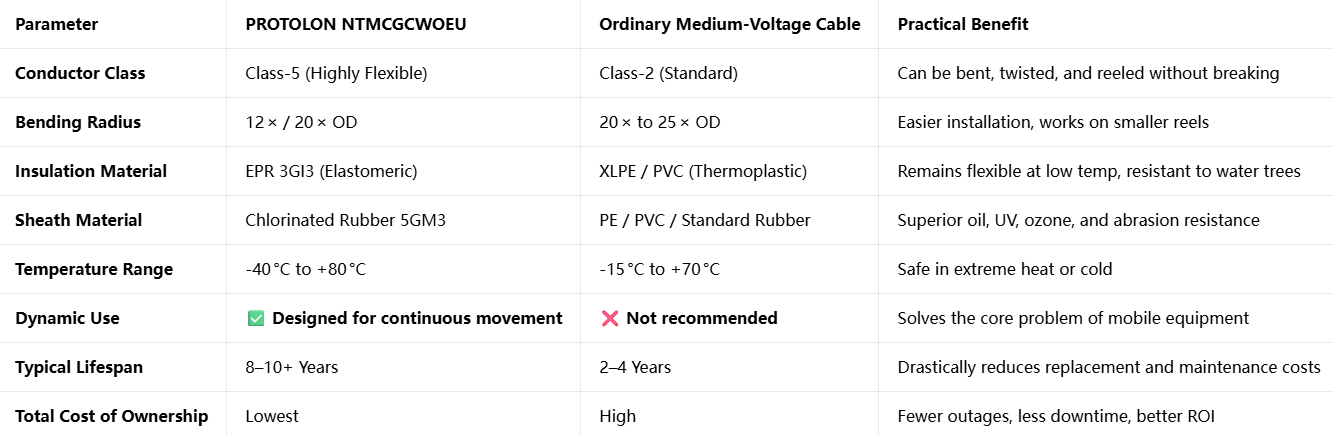
Bending radius: Minimum bending radius is only 12 × outer diameter for fixed installation and 20 × OD for free movement. Ordinary flexible cables require 20 × or more even when fixed. This allows installation in tight spaces and on small‑diameter reels.
Flexibility: Thanks to Class‑5 conductors and elastic rubber compounds, the cable bends like a heavy hose, not like a rigid pipe.
Fatigue resistance: The layered elastic design ensures that during every bend, every layer stretches or compresses within its elastic limit. There is no permanent deformation, no metal fatigue, and no cracking. Lifespan in dynamic use is typically 8 to 10 years, compared to 2 to 4 years for standard rubber cables.
Torsion capability: Can withstand twisting up to 25 °/metre, a requirement for many mining and port applications where cables rotate with equipment.
Environmental Durability: Built for Indonesia’s Conditions
Indonesia’s climate and industrial environment present some of the toughest challenges in the world: high humidity, heavy rainfall, intense UV radiation, high ambient temperatures, dust, and chemical exposure. This cable is engineered specifically to thrive here.
Temperature range: Operates reliably from freezing cold in high‑elevation mines to +80 °C in direct sunlight.
Water and moisture: Fully impermeable; EPR and chlorinated rubber do not absorb water, preventing water ingress and insulation degradation.
Oil and chemical: Resistant to all common industrial fluids, preventing swelling or softening of the sheath.
Weathering: The CR 5GM3 sheath is chemically stable against ozone and UV, meaning it does not become hard, brittle, or cracked even after years of outdoor exposure.
Clear Comparison: PROTOLON vs. Ordinary MV Cable
Detailed Technical Specifications
All specifications are taken directly from the official Prysmian technical catalogue, ensuring absolute accuracy. The following tables summarise key data for the most common voltage classes.
General Specifications
Standard: DIN VDE 0250‑813
Voltage Classes: 3.6/6 kV, 6/10 kV, 8.7/15 kV, 12/20 kV, 14/25 kV, 18/30 kV
Conductor: Tinned Copper, Class 5 (VDE 0295 / IEC 60228)
Insulation: EPR, Compound 3GI3 (VDE 0207‑20)
Semiconductive Layers: EPR‑based, Compound 3GI3
Screen: Tinned Copper Wires, spiral wound
Sheath: Chlorinated Rubber, Compound 5GM3, Red (VDE 0207‑21)
Max Conductor Temp: 90 °C continuous; 250 °C short‑circuit
Ambient Temp: Fixed: ‑40 °C to +80 °C; Moving: ‑25 °C to +60 °C
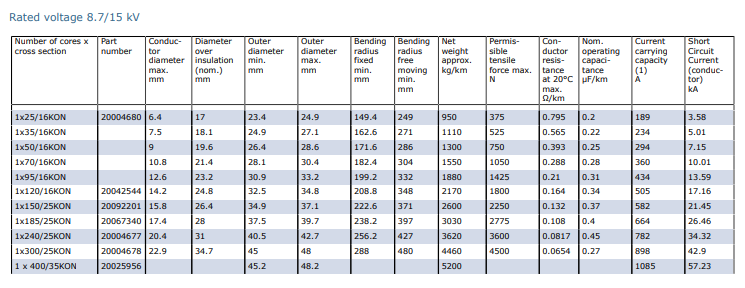
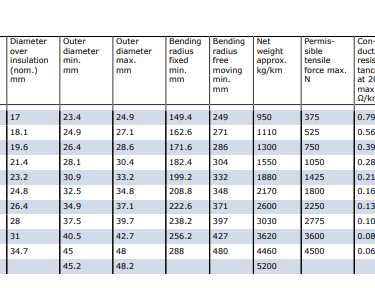
Example Data: 8.7/15 kV Series
(Full data available for all voltage classes up to 18/30 kV)
All current ratings are calculated according to DIN VDE 0298‑4, the standard method for power cables, ensuring values are safe and realistic for installation conditions.
Applications and Real‑World Cases in Indonesia
The design of PROTOLON NTMCGCWOEU is driven entirely by the needs of the industries it serves. It is not a general‑purpose cable, but a specialised tool built for specific, demanding tasks.
Primary Applications
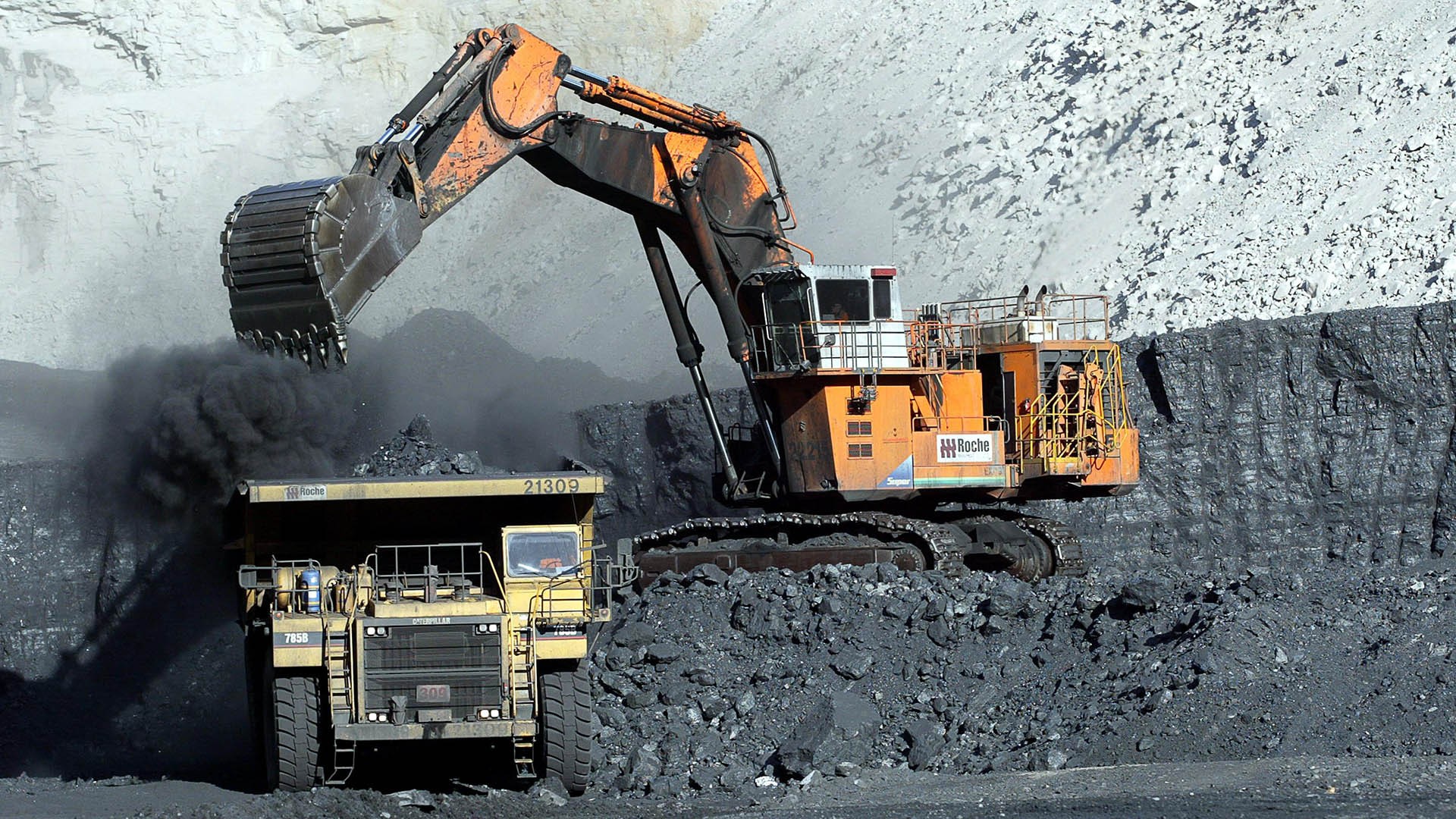
Mining: Open‑pit and underground coal, mineral, and metal mines. Used for mobile transformers, excavators, shearers, conveyors, and reeling systems. It is the standard choice for draglines and bucket‑wheel excavators, where cables are constantly reeled and unreeled.
Ports & Terminals: Container cranes, ship‑to‑shore cranes, mobile harbour cranes, and bulk material handling equipment. It withstands salt‑laden air, high humidity, and continuous movement.
Heavy Industry: Steel mills, cement plants, and smelters. Used for connection of mobile equipment, ladle cranes, and temporary power supplies in high‑temperature, dusty environments.
Power Generation: Mobile substations, temporary power plants, and switchgear connections.
General Heavy Engineering: Draglines, stacker‑reclaimers, and any medium‑voltage equipment that requires mobility.
Typical Working Conditions
Continuous or frequent bending, twisting, and reeling.
Direct contact with soil, rock, or concrete.
Exposure to mineral oils, greases, and chemicals.
Outdoor use under full sun, rain, and high humidity.
Wide temperature fluctuations.
High mechanical tension and compression.
Indonesian Case Examples
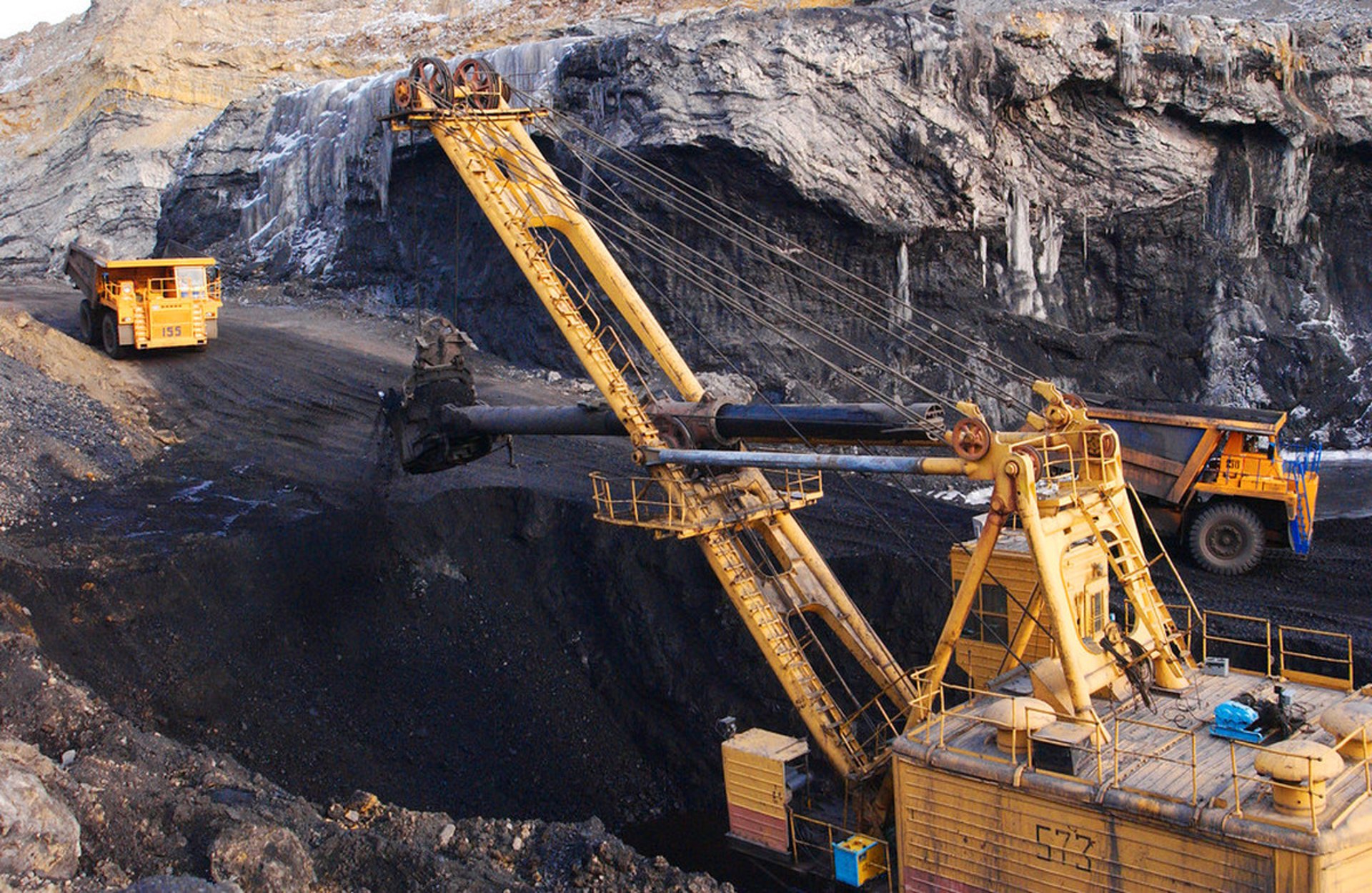
Case 1: Open‑Pit Coal Mine, East Kalimantan
In one of Indonesia’s largest coal operations, located in East Kalimantan, heavy‑duty excavators and conveyor systems operate 24 hours a day, 365 days a year. The environment is extremely harsh: high ambient temperature, high humidity, heavy rain, and constant exposure to coal dust and hydraulic oil. Previously, standard flexible cables were used, but they failed frequently – typically lasting only 18 to 24 months – due to sheath cracking, insulation ageing, and conductor breakage.
After switching to PROTOLON NTMCGCWOEU (8.7/15 kV, 1×150 mm²), the situation changed completely. The cables withstand the daily reeling and dragging without damage. The oil‑resistant chlorinated rubber sheath remains intact despite frequent spills. After 7 years of operation, inspections show no signs of ageing or degradation. Maintenance costs for cable replacement have dropped by over 80 %, and production downtime related to power cable failure has been eliminated.
Case 2: International Container Terminal, Jakarta
At the Jakarta International Container Terminal, ship‑to‑shore cranes move thousands of containers daily. The power cables travel along with the crane trolley, bending and flexing every few minutes. The location is coastal, with high salt content in the air, intense tropical sun, and high humidity.
Standard cables suffered from UV degradation, sheath hardening, and cracking within 2 years. PROTOLON NTMCGCWOEU (12/20 kV, 1×185 mm²) was selected for its weather‑resistant properties. The EPR insulation and CR sheath resist UV and salt corrosion perfectly. The flexible construction handles millions of bending cycles without fatigue. The cables have now been in service for over 9 years, exceeding the original design life expectations, and remain in excellent condition.
Feichun Equivalent: The Smart Alternative
While PROTOLON NTMCGCWOEU is the industry benchmark, Feichun Cables has developed a fully equivalent version that matches the original in every technical aspect, offering a highly competitive alternative for projects in Indonesia and Southeast Asia.
Why It Is Fully Equivalent
Same Standard: Manufactured strictly to DIN VDE 0250‑813, exactly the same specification as the original.
Identical Construction: Class‑5 tinned copper conductors, double semiconductive layers, EPR 3GI3‑equivalent insulation, spiral copper screen, and chlorinated rubber 5GM3‑equivalent sheath. Every layer is designed and built identically.
Same Performance: Electrical parameters, mechanical strengths, temperature ratings, and chemical resistance are identical. Test reports confirm performance is within the exact same tolerances.
Same Dimensions: Outer diameters, bending radii, and weights match perfectly, ensuring interchangeability and compatibility with existing equipment and accessories.
Key Advantages of Feichun Version
100 % Compliance: No compromise on quality or specification. Suitable for the most demanding mining and port projects.
Shorter Delivery Time: Local stock and streamlined production mean delivery in weeks rather than months, critical for tight project schedules in Indonesia.
Cost Efficiency: Typically 20 % to 30 % lower in price compared to the premium brand, without sacrificing performance. This significantly reduces capital expenditure.
Full Technical Support: Feichun provides local engineering support, selection assistance, and installation guidance, ensuring correct application and long‑term reliability.
Certified Quality: Every cable is tested and certified, with full documentation provided for project approval.
For engineers and procurement teams, Feichun offers the performance and reliability of the global standard, with the practical benefits of local supply and competitive pricing.
Selection and Installation Guide
Correct selection and installation are essential to realise the full potential of this cable. Here are practical guidelines based on the engineering principles discussed.
Selection Criteria
Voltage Rating: Choose the voltage class based on the system nominal voltage. Always select a rating equal to or higher than the system voltage, with a minimum 15 % margin. For example, a 6.6 kV system requires the 8.7/15 kV class.
Conductor Size: Select based on three factors:
Current Capacity: Ensure the continuous current does not exceed the rated ampacity (refer to VDE 0298‑4).
Voltage Drop: Calculate to ensure voltage drop is within acceptable limits for the length of run.
Short‑Circuit Rating: Ensure the cable can withstand the maximum fault current available at the point of installation.
Application Type: If the cable will be reeled or moved frequently, use the “free moving” bending radius and temperature limits. For fixed installation, use the fixed values.
Installation Rules
Bending Radius: Never bend below the minimum specified radius. For fixed installation: ≥ 12 × OD. For moving operation: ≥ 20 × OD.
Mechanical Stress: Do not exceed the maximum tensile load of 15 N/mm² or torsion of 25 °/m. Avoid dragging over sharp edges.
Temperature: Do not install or operate below the minimum ambient temperature, as flexibility is reduced.
Termination: Use compatible accessories designed for VDE 0250‑813 cables. Proper preparation of the semiconductive layers is critical for long‑term performance.
Standards Compliance: Follow DIN VDE 0298‑3 for installation and operation guidelines.
Maintenance
This cable is designed for low maintenance. Periodic visual inspection is sufficient to check for external damage or excessive wear. No electrical testing is required under normal operation, thanks to the stable design.
Frequently Asked Questions
Q: Can this cable be buried directly in the ground?
A: Yes, it is suitable for direct burial. The robust sheath and moisture‑resistant materials protect against soil conditions. However, care should be taken to avoid sharp stones that could damage the sheath.
Q: Is it suitable for use in salt‑water environments or coastal areas?
A: Absolutely. The chlorinated rubber sheath is highly resistant to salt corrosion, and the tinned copper components prevent galvanic corrosion. It is the ideal choice for ports and offshore applications.
Q: Can it be used at high altitudes or in tropical heat?
A: Yes. The temperature rating of +80 °C allows operation in very hot climates. High altitude has minimal effect as the insulation thickness is designed for high electric field strength.
Q: What is the difference between this and standard rubber flexible cables?
A: Standard cables use generic rubber compounds and simpler construction. PROTOLON uses specific compounds (3GI3, 5GM3), double semiconductive control, and high‑flex conductors. It is designed for medium‑voltage and long‑life dynamic use, whereas standard cables are for low‑voltage or temporary use only.
Q: How does Feichun ensure the equivalent cable matches the original quality?
A: Feichun uses the same material formulations, manufacturing processes, and quality control standards. Every batch is tested to the full VDE 0250‑813 test suite, and reports are available for verification.
Conclusion
PROTOLON NTMCGCWOEU represents the culmination of over a century of cable engineering expertise. It is not simply a product, but a complete solution designed to solve the hardest problems in power delivery. By combining Class‑5 tinned copper conductors, EPR 3GI3 insulation, double semiconductive field control, spiral copper shielding, and chlorinated rubber 5GM3 sheath, it creates a system where every component works in harmony.
From an engineering perspective, it achieves four critical goals:
Electrical Safety: Perfect field control eliminates partial discharge, ensuring decades of stable operation.
Mechanical Durability: Multi‑layer elastic design allows the cable to flex and twist like a solid rubber band, resisting fatigue and breakage.
Environmental Immunity: Specialised materials resist oil, ozone, UV, moisture, and extreme temperatures, performing reliably in the toughest conditions found in Indonesia.
Engineering Simplicity: Strict adherence to VDE standards means parameters are clear, selection is straightforward, and accessories are readily available, reducing risk and lowering total cost of ownership.
It transforms the concept of power supply from “fixed” to “flexible”, making it possible to bring reliable medium‑voltage power to moving machinery in mines, ports, and heavy industry. Feichun’s equivalent version makes this high‑level technology accessible to more projects, delivering the same performance with better value and faster delivery.
For any project where power must move and endure, PROTOLON NTMCGCWOEU – and its Feichun equivalent – remains the definitive choice.
If you require PROTOLON NTMCGCWOEU or the fully equivalent Feichun medium‑voltage flexible cables for your project, or need technical consultation and selection support, please contact our engineering team:
We provide detailed specifications, test reports, and customised solutions tailored to the requirements of mining, port, and heavy industry projects across Indonesia and Southeast Asia.

Feichun Cable
Durable mining cables for tough environments and operations
Email: Li.wang@feichuncables.com
© 2025. All rights reserved.
Company
Products
Contact
WhatsApp: +86 17333223430