

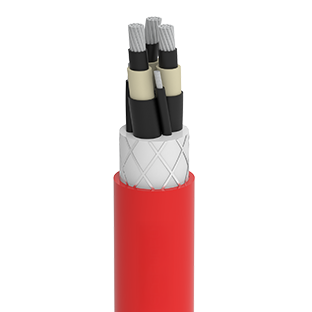
(N)TSCGEWOEU Medium Voltage Reeling & Festoon Cable to VDE 0250-813 3.6/6kV–12/20kV High-Flex Rubber Crane & Container Handling Cable
Application | Use | Specially designed for mobile equipment under high mechanical stresses; withstands high travel speeds, dynamic tensile loads, multi-directional movement, churning effects over rollers, and continuous torsional stresses. Suitable for fast-moving container cranes, portal cranes, stacker-reclaimers, and large-scale mobile industrial machinery. |
Cable Structure | Conductor | Phase and earth conductor made of tinned annealed stranded copper wires Class 5 (VDE 0295, IEC 60228) |
Conductor Screen | Extruded inner semiconductive rubber compound and semiconductive tape |
Insulation | High grade special EPR compound (min. 3GI3) according to VDE 0207 – Part 20 |
Insulation Screen | Extruded outer semiconductive rubber compound and semiconductive tape, easily stripped |
Core Arrangement | Three-core; earth conductor divided into three parts, placed between cores; cores laid around semi-conductive filler with central aramid rope; left-hand stranded |
Inner Sheath | Special rubber compound (min. 5GM3) per VDE 0207 – Part 21 |
Reinforcement | Polyester thread braid, bonded with vulcanization between sheaths |
Outer Sheath | Special rubber compound (min. 5GM5) per VDE 0207 – Part 21 |
Standards & Main Characteristics | Standard | VDE 0250-813 |
General Requirements | VDE 0250-1 |
Guide to Use | VDE 0298-3, VDE 0298-4 |
Electrical Tests | VDE 0472-501, 512, 508, 502, 503 |
Non-Electrical Tests | VDE 0472-401, 402, 602, 615, 613 |
Conductor Resistance | VDE 0295, IEC 60228 |
Flame Retardant | IEC 60332-1-2 |
Oil Resistant | IEC 60811-404 |
UV Resistance | BS EN 50289-4-17 / Method B |
Water Resistance | AD8 |
Operating Characteristics | Rated Voltage | 3.6/6 kV, 6/10 kV, 8.7/15 kV, 12/20 kV |
Test Voltage | 11 kV, 17 kV, 24 kV, 29 kV |
Max Conductor Temperature | 90°C |
Short Circuit Temperature | 250°C (Max. 5 s) |
Min Ambient Temperature | -40°C |
Max Current Carrying Capacity | VDE 0298-4 |
Min Bending Radius | VDE 0298-3 |
Max Tensile Load on Conductor | 20 N/mm² |
Max Tensile Load During Acceleration | 25 N/mm² |
Torsional Stress | ±50 °/m |
Min Distance with S-type Directional Changes | 20 × D |
Travel Speed | Max. 180 m/min |
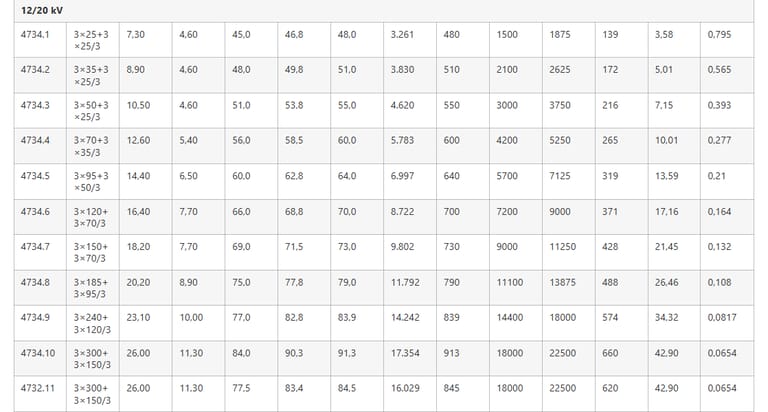
Technical Specifications
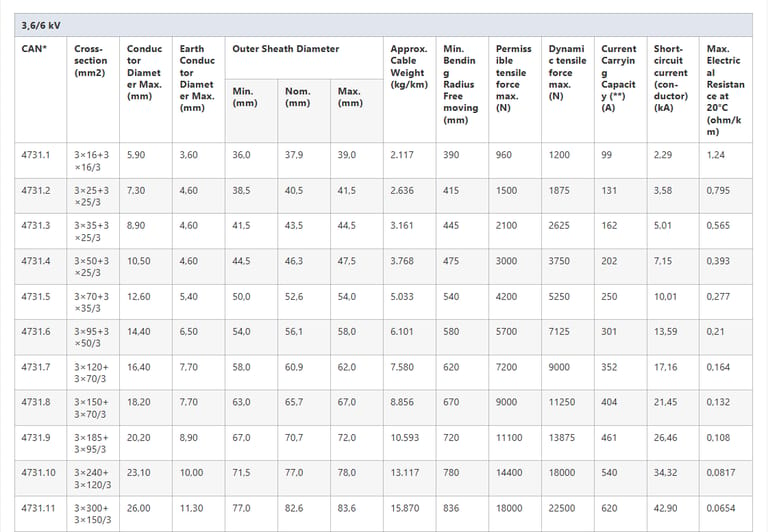
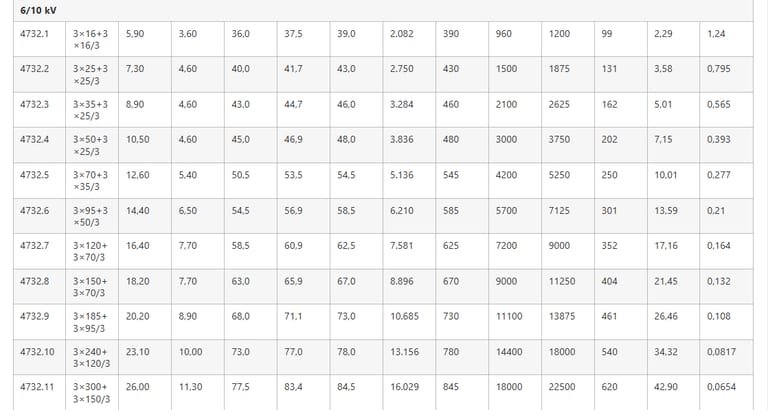
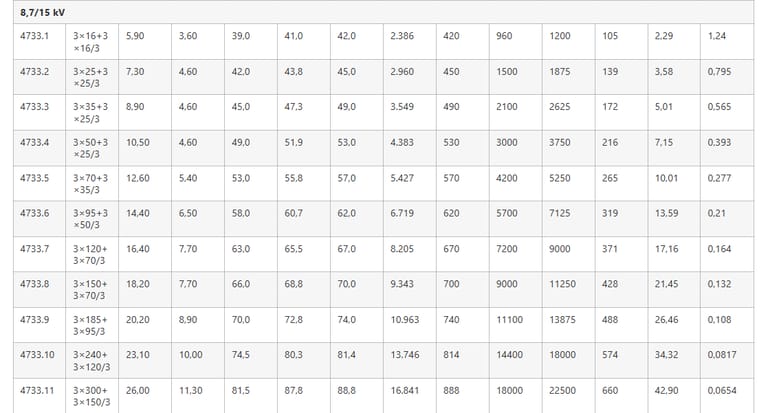
In modern ports, container terminals, and heavy industrial facilities, cables are no longer static components. They move continuously, twist, accelerate, decelerate, and endure extreme mechanical stress every day. This is where the (N)TSCGEWOEU Medium Voltage Reeling & Festoon Cable, designed according to VDE 0250-813, becomes essential.
What Is the (N)TSCGEWOEU Cable According to VDE 0250-813?
The (N)TSCGEWOEU is a medium-voltage, high-flex rubber reeling and festoon cable specifically engineered for mobile equipment exposed to extreme mechanical and torsional stress.
Unlike conventional MV power cables, it is designed for:
Continuous movement
High travel speeds
Frequent direction changes
Roller and drum systems
Long service life under dynamic load
It fully complies with VDE 0250-813, a German standard focused on reeling, festoon, and crane cables under severe mechanical conditions.
Why Is (N)TSCGEWOEU Suitable for Cranes and Container Handling Systems?
Container cranes, portal cranes, and stacker reclaimers operate under some of the most aggressive cable conditions in industry. The (N)TSCGEWOEU cable is designed to survive:
High dynamic tensile forces
Multi-directional bending
Continuous torsion (±50°/m)
Churning effects on rollers
High acceleration and braking forces
Typical applications include:
Ship-to-shore (STS) container cranes
Rubber-tyred gantry (RTG) cranes
Rail-mounted gantry (RMG) cranes
Bulk material handling systems
Large mobile industrial machinery
How Does (N)TSCGEWOEU Compare with Other MV Flexible Cables?
Feature | (N)TSCGEWOEU | Standard MV Rubber Cable | XLPE MV Cable |
|---|---|---|---|
Continuous movement | Excellent | Limited | Poor |
Torsion resistance | ±50°/m | Low | Very low |
Reeling/festoon use | Yes | Not recommended | No |
Flexibility | Very high | Medium | Low |
Service life in cranes | Long | Short | Very short |
Where Is (N)TSCGEWOEU Used in Indonesia?
Indonesian Case Study: Container Terminal in Surabaya
At a major container port in Surabaya, RTG cranes were experiencing frequent cable failures due to:
High humidity
Salt exposure
Constant acceleration and deceleration
After replacing conventional MV cables with (N)TSCGEWOEU 6/10 kV, the operator achieved:
40% reduction in cable-related downtime
Extended service life beyond 6 years
Improved crane reliability during peak operation
This demonstrates why high-flex rubber MV cables are increasingly preferred in Indonesian ports.
What Are the Recommended Installation Practices?
How Should Bending Radius Be Managed?
Always follow VDE 0298-3:
Maintain minimum bending radius during movement
Avoid sharp directional changes below 20 × D
How Should Tensile Forces Be Controlled?
Use proper strain relief systems
Avoid exceeding dynamic tensile limits during acceleration
Should Cable Length Be Optimised?
Yes. Excessive slack increases torsion and wear, while insufficient length increases tensile stress.
Frequently Asked Questions (FAQ)
Is (N)TSCGEWOEU suitable for festoon systems?
Yes. It is specifically designed for reeling and festoon applications with high travel speeds and continuous movement.
Can this cable be used outdoors in tropical climates?
Yes. It offers:
UV resistance
Oil resistance
Water resistance (AD8)
Perfect for Indonesian outdoor conditions.
Is (N)TSCGEWOEU flame retardant?
Yes. It complies with IEC 60332-1-2.
How does it differ from trailing cables?
Trailing cables are dragged along the ground, while (N)TSCGEWOEU is optimised for controlled movement systems such as drums, festoons, and rollers.
Why Choose (N)TSCGEWOEU for Modern Ports and Heavy Industry?
Choosing the right cable directly affects:
Equipment uptime
Safety
Maintenance cost
Operational efficiency
The (N)TSCGEWOEU Medium Voltage Reeling & Festoon Cable offers a balanced combination of electrical performance, mechanical endurance, and long-term reliability, making it an ideal solution for cranes, ports, and mobile industrial machinery in Indonesia and beyond.
If you are planning:
A new container terminal project
Crane system upgrades
Replacement of frequently failing MV cables
Consult a professional supplier of VDE 0250-813 compliant (N)TSCGEWOEU cables to ensure correct sizing, installation guidance, and long-term operational success.