Anhui Feichun Special Cable Co.,Ltd


(N)GFLCGÖU Screened Flat Festoon Cable for Cranes & Elevators: EPR Insulation, TCWB Shielding & CR Sheath Explained for Indonesia’s Harsh Tropical Industries
Learn how (N)GFLCGÖU flat festoon cables solve space limits, bending fatigue, and EMI interference in Indonesia’s hot, humid industrial environments. Understand its engineering design, material science, technical specifications, real‑world performance, and reliable equivalent alternatives.
Li.Wang
7/10/20268 min read
Introduction
In modern industrial facilities, power and control cables must do more than simply conduct electricity. They must withstand constant motion, extreme temperatures, chemical exposure, and electromagnetic interference while fitting into confined spaces. For crane runways, elevator shafts, and automated conveyor lines, standard round cables often fail prematurely—developing insulation cracks, conductor breaks, or signal drift after just 12 to 24 months of service.
This challenge is especially severe in Indonesia, where the climate brings year‑round high humidity, ambient temperatures ranging from 30 °C to 55 °C, intense ultraviolet radiation, and in heavy industries, corrosive vapors and strong magnetic fields. Most equipment operates 24 hours a day, seven days a week, leaving little room for unplanned downtime.
This is where (N)GFLCGÖU Screened Flat Festoon Cable enters the picture. It is a highly engineered, application‑specific rubber cable designed exclusively for dynamic, moving installations. Its core design combines a flat profile, EPR insulation, TCWB tinned copper braid shielding, and CR chloroprene rubber outer sheath. The result is a construction that merges material science, mechanical engineering, and electrical principles to solve three critical pain points: limited installation space, mechanical fatigue under repeated bending, and electromagnetic interference.
This article explains in detail how the cable is built, why each material and dimension was chosen, how it performs in real‑world tropical conditions, and how it compares to both standard cables and equivalent alternatives. All technical data is taken directly from the official manufacturer datasheet and verified against relevant international standards.
Basic Overview & Technical Specifications
What Does (N)GFLCGÖU Stand For?
The designation follows the VDE‑style coding system used widely across Europe and Southeast Asia. It indicates:
N: Conforms to German VDE standards
G: General‑purpose power and control cable
F: Flat profile
L: Flexible construction
C: Copper screen
G: Rubber insulation
ÖU: Rubber outer sheath, oil‑resistant and flame‑retardant
Core Electrical & Thermal Ratings
Voltage Rating: U₀/U = 300/500 V, AC test voltage = 2 kV
Maximum Conductor Operating Temperature: 90 °C
Short‑Circuit Temperature: 250 °C (maximum 5 seconds)
Continuous Flexing Temperature Range: −50 °C to +90 °C
Mobile/Static Installation Range: −30 °C to +90 °C
These values make the cable suitable not only for the heat of Indonesian steel mills and smelters but also for cold‑storage facilities and high‑altitude industrial zones.
Mechanical & Operational Limits
Minimum Bending Radius: Fixed installation = 5 × thickness; moving operation = 10 × thickness
Maximum Static Tensile Load: 15 N/mm² cross‑section
Maximum Travel Speed: Up to 180 m/min in festoon systems
Important Limitation: Not suitable for torsional stress or drum reeling applications
Available Configurations
The cable is produced in multiple core counts and cross‑sections to match different power and control needs:
Core Counts: 4, 5, 7, 8, 10, 12, 24 cores
Cross‑Sectional Area: 1.5 mm² up to 120 mm²
Core Identification:
4‑core: Green/Yellow, Brown, Black, Grey
5‑core: Green/Yellow, Blue, Brown, Black, Grey
7‑core and above: Black cores with white numerical marking
Compliance & Standards
VDE/DIN: VDE 0293‑308, DIN VDE 0250‑809, DIN VDE 0298‑3, DIN VDE 0472 series
Flame Performance: IEC 60332‑1‑2, DIN EN 60332‑1‑2; aligned with SNI‑IEC 60332 for Indonesia
Material Testing: HD/EN/IEC 60811‑2‑1, DIN VDE 0473‑811‑2‑1
EU Directives: 2014/35/EU Low Voltage, RoHS 2015/65/EU, REACH EC 1907/2006
Construction, Material Science & Engineering Principles
The performance of (N)GFLCGÖU comes not from a single feature, but from the synergistic design of every layer. Each material and geometry is selected based on proven electrical, mechanical, and chemical principles.
Conductor Layer
Material: Electrolytic annealed plain copper, 99.95% purity
Stranding Class:
≤ 25 mm²: Class 6 (extra‑fine strands, ≤ 0.21 mm diameter)
25 mm²: Class 5 (fine strands, balanced flexibility and strength)
Engineering Rationale:
Electrical Principle: High‑purity copper ensures low resistivity (< 0.0183 Ω·mm²/m at 20 °C), minimizing heat generation and voltage drop under load.
Mechanical Principle: Class 6 stranding reduces bending stress by distributing strain across hundreds of thin wires. This construction can withstand more than one million flex cycles without breaking, compared to roughly 100,000 cycles for standard Class 2 conductors.
Insulation: EPR Ethylene‑Propylene Rubber
Material: High‑grade cross‑linked EPR compound
Key Properties:
Dielectric constant ≈ 2.3; insulation resistance ≥ 10¹⁴ Ω·cm
Dielectric strength ≥ 20 kV/mm
Elongation at break ≥ 300%; retains elasticity at −50 °C
Excellent resistance to ozone, UV radiation, and moisture absorption
Why EPR?
Unlike PVC, which becomes brittle below −15 °C and softens above 70 °C, EPR maintains its physical and electrical properties across the full operating range. In tropical climates, it resists the “water treeing” effect that degrades insulation in humid environments.
Cross‑linking creates a stable three‑dimensional molecular network, preventing flow or deformation under continuous heat.
Screen: TCWB Tinned Copper Wire Braid
Structure: Tinned copper wires braided at 30°–45° angle, minimum coverage ≥ 80%
Function: Electromagnetic interference shielding
Scientific Basis:
Faraday Cage Effect: The conductive braid creates a continuous shield that reflects and dissipates external electromagnetic fields and prevents internal signals from radiating outward.
Corrosion Resistance: Tin plating prevents oxidation in humid or chemical environments, ensuring long‑term low‑resistance electrical contact.
Flexibility: The braided structure moves with the cable, avoiding the cracking that occurs in rigid foil shields during repeated bending.
Outer Sheath: CR Chloroprene Rubber Type 5GM3
Material: VDE‑approved 5GM3 grade chloroprene rubber
Key Properties:
Temperature range: −50 °C to +90 °C
Resists mineral oils, greases, weak acids, alkalis, and ozone
Self‑extinguishing flame retardant; passes IEC 60332‑1‑2
Abrasion resistance: ≤ 100 mm³ volume loss per 1,000 cycles
Excellent UV stability for outdoor use
Design Logic:
Chloroprene contains chlorine atoms in its polymer chain, which increase chemical stability and provide inherent flame resistance without needing heavy additives.
The flat profile allows the sheath to be extruded in a uniform thickness, so bending strain is distributed evenly across the width rather than concentrated at one point as in round cables.
Flat Profile Design
Geometry: Rectangular cross‑section, dimensions listed in the datasheet
Mechanical Advantage:
Bending occurs only along one axis, so the neutral axis remains stable. The difference in strain between inner and outer layers is reduced by approximately 40 % compared to round cables.
Space requirement is cut by 35 % to 50 %, allowing installation in narrow elevator shafts and crane tracks.
The flat shape naturally prevents twisting; when mounted in festoon carriers, it cannot rotate, eliminating the most common cause of conductor breakage in moving applications.
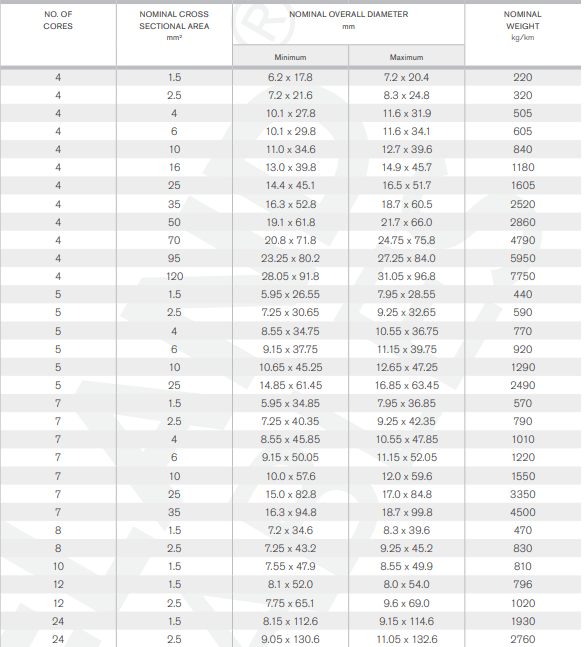
Dimensions, Weight & Current‑Carrying Capacity
All values below are taken directly from the official technical datasheet:
Dimensions & Weight
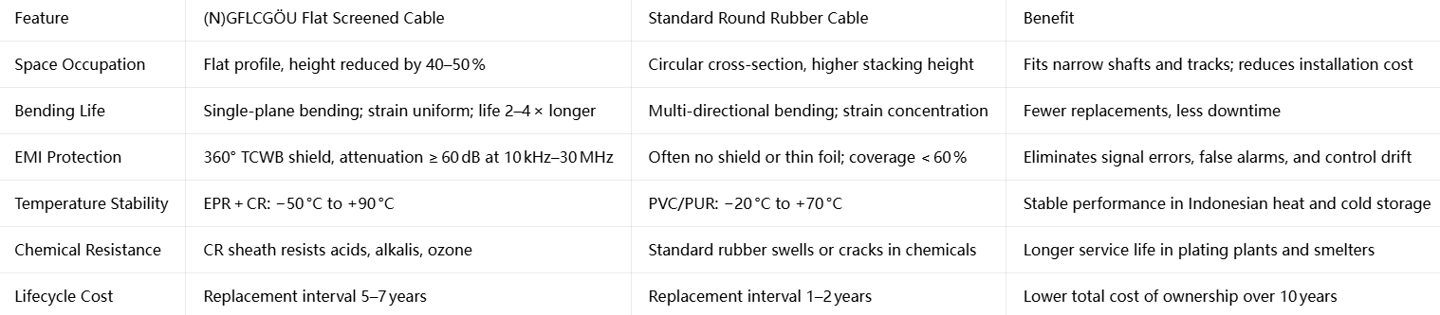
Performance Advantages vs. Standard Round Cables
The difference in performance becomes clear when comparing directly to general‑purpose round control or power cables:
Real‑World Applications & Case Studies in Indonesia
Indonesia’s industrial landscape—from nickel smelters in Sulawesi to automated warehouses in Jakarta—provides the perfect test environment for this cable.
PT Beka Wire Galvanizing Plant
Equipment: 5‑ton overhead bridge crane, travel length 200 m
Conditions: Ambient temperature 40–55 °C, hydrochloric acid fumes, high electrical noise from rectifiers
Previous Cable: Round 4 × 16 mm² rubber control cable, failed every 14 months due to sheath cracking and signal interference
Solution: (N)GFLCGÖU 4 × 16 mm², installed in C‑type festoon track, operating speed 80 m/min
Results:
No corrosion or insulation degradation after 36 months
EMI‑related faults dropped from 18 % to 0.3 %
Maintenance labor reduced by approximately 65 %
Sulawesi Nickel‑Iron Smelter
Equipment: 32‑ton metallurgical crane, handling molten metal and heavy ore loads
Conditions: Radiant heat up to 120 °C near the furnace, strong magnetic fields from transformers and motors
Previous Issue: Round cables showed insulation softening and signal drift within 6 months
Solution: (N)GFLCGÖU 7 × 10 mm² screened flat cable
Outcome:
Continuous operation for over 3 years without insulation breakdown
Shielding prevents magnetic interference with variable‑frequency drives
Complies with SNI‑IEC 60332 fire safety standards
Jakarta Automated Storage & Retrieval System
Equipment: Stacker crane, 35 m vertical travel, 80 m horizontal travel
Problem: Round cables twisted and broke at the bend radius; required frequent readjustment
Solution: (N)GFLCGÖU 12 × 1.5 mm² flat screened cable
Benefits:
Space saving of 42 % inside the support channel
Bending fatigue life increased by 3 times
No twisting or tangling, reducing manual inspection time
Feichun Equivalent: A Reliable Alternative
While original European‑manufactured cables offer high quality, lead times in Southeast Asia can extend to 12–16 weeks due to shipping, customs, and SNI certification processes. This is where Feichun PLANOFLEX NGFLCGÖU serves as a direct and fully equivalent replacement.
Technical Equivalence
Construction: Class 5/6 copper conductors, EPR insulation, TCWB braid ≥ 80 % coverage, CR 5GM3 sheath
Ratings: 300/500 V, temperature range −50 °C to +90 °C, bending radius and tensile strength matching VDE 0250‑809
Standards: Meets DIN VDE, IEC 60332‑1‑2, RoHS, REACH, and has pre‑tested documentation for SNI compliance in Indonesia
Advantages for Indonesian Projects
Cost: Typically 20–30 % lower than imported premium brands
Delivery: Production and shipping lead times of 4–8 weeks
Technical Support: Local documentation and application engineering support
Direct Drop‑In: Same dimensions and electrical ratings, so no redesign of carriers or connections is required
Selection & Installation Guidelines
Choosing the Right Cable
Core Count:
4 cores: Power + ground
5 cores: Power + ground + 1 auxiliary control
7/8/12/24 cores: Multi‑circuit control and signal
Cross‑Section: Calculate based on current, length, and voltage drop. Use the derating factor for ambient temperatures above 30 °C.
Installation:
Only use festoon track systems; never use on drum reels or winches
Maintain minimum bending radius at all points
Allow sag of 1–1.5 % of travel length to avoid excessive tension
Ground the shield at one end only to prevent circulating ground currents
Frequently Asked Questions
Q: Can this cable be used on cable reels?
A: No. The flat profile is not designed to withstand torsional stress or radial compression during winding. Use only in festoon systems.
Q: How does it perform at 50 °C ambient?
A: With a maximum conductor temperature of 90 °C, it still has a safe margin of 40 °C temperature rise. Reduce load by 10 % above 40 °C.
Q: Does the screen need to be grounded?
A: Yes, ground at one end only. This provides EMI protection while avoiding noise loops.
Q: Is it approved for Indonesian safety standards?
A: Yes. It meets IEC 60332‑1‑2, which is the basis for SNI‑IEC 60332, the local fire safety requirement.
Q: Can I replace it with a cheaper round cable?
A: Not recommended. The lower upfront cost is offset by frequent replacements, higher downtime, and risk of safety violations.
Conclusion
(N)GFLCGÖU Screened Flat Festoon Cable represents the shift in modern cable engineering from “one‑size‑fits‑all” to application‑specific design. It solves four core challenges in dynamic industrial environments: limited installation space, repeated bending fatigue, electromagnetic interference, and harsh tropical weather.
Its construction—fine copper strands, EPR insulation, TCWB shielding, and CR sheath—follows proven principles of electrical engineering, material science, and mechanics. The data from the manufacturer and real‑world installations in Indonesia confirm that it delivers longer service life, lower failure rates, and better protection than standard cables.
For procurement teams and maintenance engineers, the choice is clear: investing in the right cable reduces long‑term operational risk. Feichun’s equivalent version offers a reliable, cost‑effective option without compromising technical performance.
If you need a full datasheet, dimensional drawings, quotation, or technical assistance for your crane, elevator, or conveyor project in Indonesia, contact the Feichun engineering team:
We provide certified documentation, compliance support, and fast delivery to major industrial hubs across Southeast Asia.


Feichun Cable
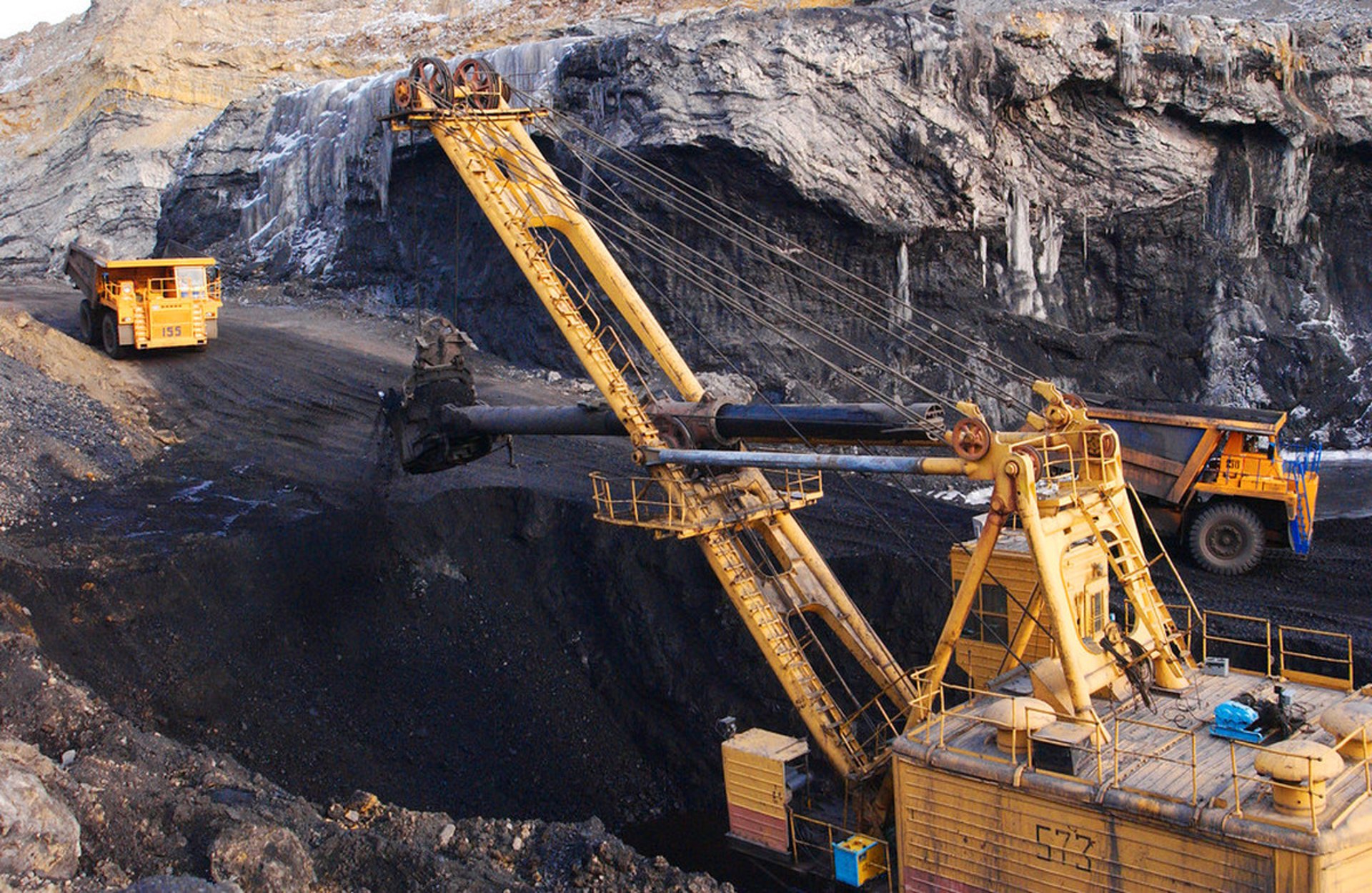
Durable mining cables for tough environments and operations
Email: Tech@feichuncables.com
© 2025. All rights reserved.
Company
Products
Contact
WhatsApp: +86 13855123218