Anhui Feichun Special Cable Co.,Ltd


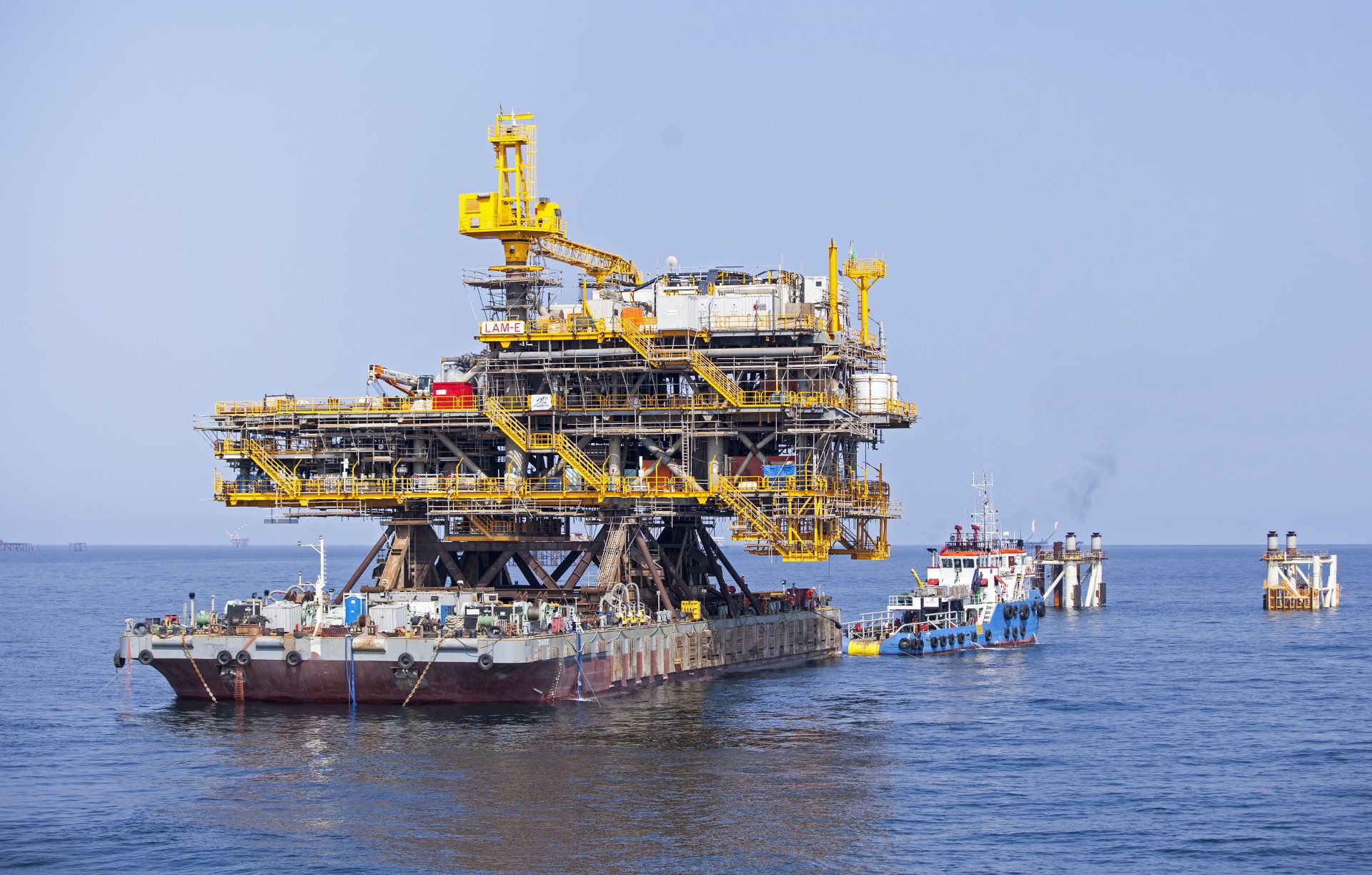
NEK 606 RFOU P104 8.7/15kV Cable: The Ultimate Mud-Resistant MV Solution for Offshore Floating Platforms in Indonesia
Discover the critical cables required for Offshore Floating Platforms in Indonesia. This in-depth technical analysis explores the harsh marine environment challenges and why the NEK 606 RFOU P104 8.7/15kV Medium Voltage cable — with its superior mud, oil, flame retardant, and LSZH properties — is the optimal choice for FPSO and oil & gas rigs.
Li Wang
4/10/20268 min read
Introduction: Why Cables Are Critical in Offshore Platforms?
In the demanding world of offshore oil and gas production, electrical cables are far more than mere conductors of power—they are the vital arteries that keep floating platforms operational. On an Offshore Floating Platform, cables deliver medium-voltage electricity from generators to pumps, compressors, processing equipment, safety systems, and living quarters. A single cable failure can trigger cascading outages, halt production worth millions daily, or compromise emergency shutdown (ESD) systems, putting lives at risk.
The risks are exceptionally high. Fires pose an ever-present threat in hydrocarbon-rich environments, where a spark or short circuit can ignite flammable gases. Corrosion from constant saltwater exposure degrades ordinary conductors and sheaths within months. Operational disruptions from vibration, wave-induced motion, and mechanical stress accelerate wear. In Indonesia’s tropical seas, these challenges intensify with high UV radiation, extreme humidity, and frequent exposure to drilling muds and crude oil.
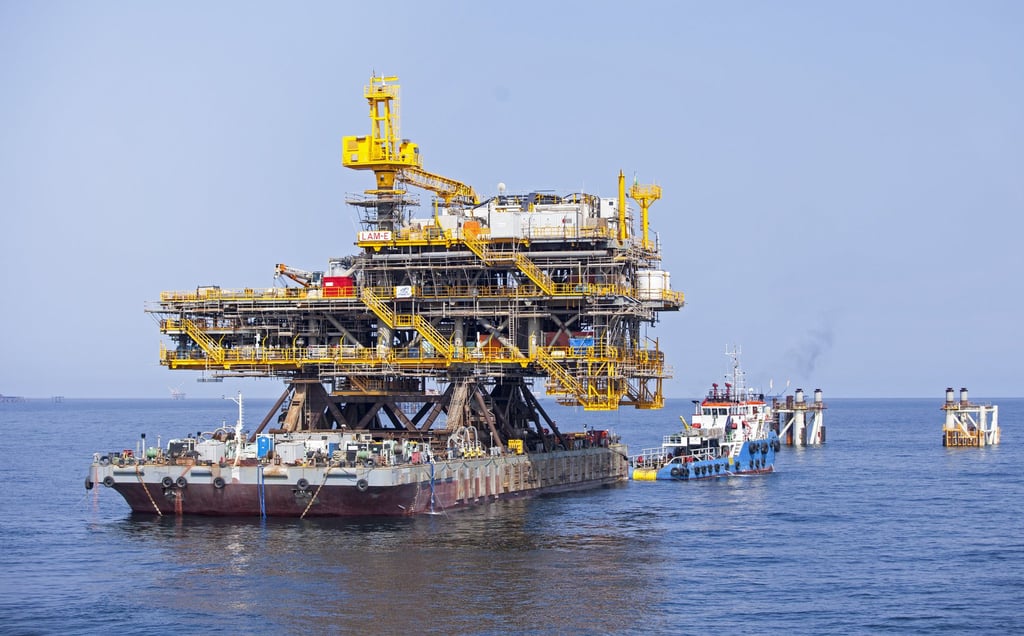
Indonesia hosts a significant fleet of offshore floating platforms, including FPSOs (Floating Production, Storage and Offloading units), semi-submersible rigs, and jack-up rigs, primarily in the Natuna Sea, Java Sea, and Sumatra waters. Iconic examples include the Belanak Natuna FPSO (operated by ConocoPhillips, producing oil, gas, and LPG) and the recently commissioned Marlin Natuna FPSO in South Natuna Sea Block B, which supports fields like Forel and Terubuk. These platforms operate in water depths of 70–120 meters under SKK Migas oversight, contributing to Indonesia’s offshore production targets amid declining onshore fields. National crude output hovers around 868,000 barrels per day (2024 figures), with offshore developments driving 5.92% CAGR growth through 2031.
This environment demands specialized cables. Conventional industrial cables fail rapidly here, leading to the adoption of NEK 606-compliant designs like the RFOU P104 8.7/15kV Medium Voltage cable. This flame-retardant, halogen-free, mud-resistant cable, manufactured to NEK 606 standards, is engineered precisely for oil and gas rigs. The following analysis examines the environmental challenges, standards, cable types, real-world Indonesian applications, and a detailed technical breakdown of why the RFOU P104 excels—offering superior performance, safety, and longevity.
Characteristics of the Offshore Environment in Indonesia
Indonesia’s offshore oil and gas fields present one of the harshest operating regimes for electrical infrastructure globally.
Tropical Sea Environment
Tropical waters bring average sea temperatures of 28–32°C, with air temperatures often exceeding 35°C and humidity above 85%. UV radiation is intense year-round due to equatorial location. Platforms experience constant thermal cycling, accelerating material degradation in insulation and sheaths. High humidity promotes condensation inside enclosures, risking electrical tracking.
Salt Mist Corrosion
Salt-laden aerosols (salt mist) attack metallic components relentlessly. Unprotected copper conductors corrode rapidly, increasing resistance and causing overheating. Standard sheaths crack, allowing moisture ingress that leads to insulation breakdown. In Natuna Sea operations, corrosion rates can be 2–3 times higher than in temperate regions, demanding tinned conductors and robust barriers.
Contamination by Oil and Drilling Mud
Drilling fluids (muds) are abrasive and chemically aggressive, containing barite, bentonite, and hydrocarbons. Crude oil, hydraulic oils, and production fluids splash continuously onto cable trays. Ordinary PVC or non-mud-resistant sheaths swell, soften, or dissolve within weeks, exposing cores. In FPSO environments like Belanak or Marlin Natuna, cables endure constant immersion risks from spills or deck wash-downs.
Fire Risks in Confined Areas
Hydrocarbon processing creates Zone 0/1/2 hazardous areas with explosive gas mixtures. Fires spread rapidly in enclosed modules; evacuation is limited by platform size and sea conditions. Conventional cables can emit toxic halogen gases and dense smoke, impairing visibility and corroding electronics during incidents. Indonesia has seen multiple platform-related fires, underscoring the need for low-smoke, zero-halogen (LSZH) materials.
These factors combine to create a uniquely punishing environment where cable reliability directly impacts production uptime, personnel safety, and regulatory compliance under SKK Migas and international class societies.
Offshore Cable Standards: The Role of NEK 606
The NEK 606 technical specification, developed by the Norwegian Electrotechnical Committee (NEK) since 1993, emerged from the Norwegian oil industry’s need to standardize cables for harsh offshore conditions. It succeeded earlier industry recommendations and is now a globally recognized benchmark for marine and oil & gas applications.
NEK 606 complements IEC 60092 (Electrical Installations on Ships and Mobile Offshore Units), but goes further with specific mud/oil resistance, enhanced flame retardance, and halogen-free requirements tailored to drilling platforms. Key mandates include:
Flame retardant: IEC 60332-1-2 (single cable) and IEC 60332-3-22 Cat. A (bunched cables).
Low Smoke Zero Halogen (LSZH): IEC 60754-1/2 (halogen content <5 mg/g) and IEC 61034-1/2 (smoke density >60% transmittance).
Mud & oil resistant: Specific immersion tests in mineral oil (IRM 903 at 100°C), calcium bromide brine, and oil-based muds (Carbo Sea at 70°C for 56 days), with strict limits on tensile strength variation (<25–30%), elongation, volume swell, and weight change (IEC 60092-359 SHF2 / SHF Mud).
UV & ozone resistance: UL 1581/1200 and IEC 60092-360.
Mechanical toughness: Impact and cold resistance per CSA C22.2 No. 0.3-09 & No. 38-18.
Cables must also carry third-party approvals from DNV, Lloyd’s Register, and ABS—mandatory for platform classification and insurance in Indonesian waters. NEK 606 thus ensures cables survive 20–30 years of service life when properly installed, far outperforming generic industrial cables.
Types of Cables Used in Offshore Platforms
Offshore floating platforms require a hierarchy of specialized cables:
Medium-Voltage (MV) Power Cables (6–15 kV)
These form the backbone, distributing power from gas turbines or diesel generators to large loads (pumps, compressors). The RFOU P104 8.7/15kV series is typical, offering high current-carrying capacity and short-circuit withstand.
Control and Instrumentation Cables
Low-voltage (150/250V) cables for ESD, fire & gas detection, and SCADA systems. Often shielded pairs/triples (RFOU(i) or BFOU(i)) for electromagnetic immunity amid variable-frequency drives (VFDs).
Flexible/Dynamic Cables
For cranes, gangways, or subsea umbilicals—requiring enhanced flexibility and sometimes dynamic fatigue resistance.
MV cables like the RFOU P104 are the critical “spine,” handling primary power distribution where failure has the highest consequences.
Offshore Applications in Indonesia
Indonesia’s offshore sector provides compelling real-world validation. The Belanak Natuna FPSO, a 285-meter vessel in the South Natuna Sea, processes 100,000 bbl/day oil plus gas and LPG—the world’s first FPSO with integrated LPG facilities. Constant exposure to crude, hydraulic fluids, and drilling muds has historically caused conventional cable sheaths to crack and insulation to degrade, leading to unplanned shutdowns and costly replacements.
Similarly, the Marlin Natuna FPSO (converted tanker, first all-Indonesian FPSO build) supports recent Forel and Terubuk field start-ups. High waves, salt mist, and mud contamination mirror challenges across Java Sea and Sumatra platforms. Conventional cables fail via sheath swelling (oil attack), conductor corrosion (salt), or fire propagation—resulting in electrical faults, production losses, and safety incidents.
These cases highlight the shift to NEK 606 RFOU cables: platforms report significantly reduced maintenance and extended intervals between interventions, aligning with SKK Migas goals for reliable upstream operations.
Technical Analysis of the NEK606 RFOU P104 8.7/15kV Cable
Primary Application
Designed for fixed installation on oil and gas rigs, the RFOU P104 8.7/15kV (Umax 17.5kV) excels in extreme conditions: hydrocarbons, oils, drilling fluids/muds, saline atmospheres, UV radiation, and temperatures up to +90°C. Its red SHF2 H-M outer sheath signals mud resistance per NEK 606.
Construction Breakdown
Conductor: Class 2 annealed tinned copper – excellent conductivity with tin plating preventing salt corrosion.
Semiconductors: Halogen-free (HF) extruded compound for smooth electric field distribution.
Insulation: HEPR HF (Hard Ethylene Propylene Rubber, halogen-free) – superior flexibility, moisture resistance, and thermal stability versus XLPE (less prone to water treeing in wet offshore environments).
Screen: Tinned copper wire braid (TCWB) – electromagnetic shielding and mechanical protection.
Bedding & Fillers: Fiberglass tape + extruded fiberglass – heat and mechanical reinforcement.
Inner Sheath: SHF2 extruded compound.
Armour: Additional TCWB for double-layer corrosion resistance and strength.
Outer Sheath: SHF2 H-M compound (mud-resistant thermoset) – red color, meeting NEK 606 immersion tests.
Core Identification: Numbered tapes (color options available).
This multi-layer design ensures integrity under vibration, impact, and chemical attack. Minimum bending radius is 4–5× overall diameter, aiding installation on space-constrained platforms.
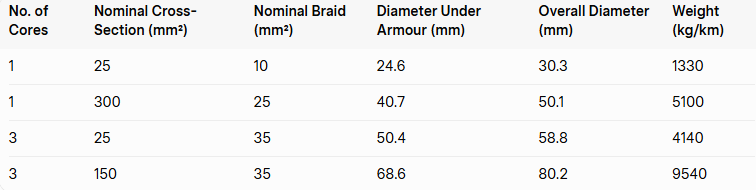
Dimensions (selected examples from manufacturer data):
Electrical Characteristics (excerpt, 90°C operation):
For 1×300 mm²: Max conductor resistance 0.0774 Ω/km (90°C), current in free air 608 A, short-circuit (1s) 42.9 kA.
For 3×150 mm²: Current 330 A, short-circuit 21.5 kA. Reactance, capacitance, and impedance values support efficient long-distance MV distribution with minimal losses.
Standards compliance: NEK 606, IEC 60092-360, plus flame, halogen, smoke, UV, ozone, and impact tests.
Key Advantages of RFOU P104 in Offshore Environments
Mud and Oil Resistance
SHF2 H-M sheath passes rigorous NEK 606 tests (IRM 903 oil at 100°C/7 days; mud simulants at 70°C/56 days) with minimal property change. No swelling or cracking—unlike standard cables that degrade in days.
Flame Retardant and LSZH
IEC 60332-3-22 Cat. A prevents fire propagation in cable trays. Low smoke and zero halogens ensure safe evacuation and protect sensitive electronics—critical for crew safety on FPSOs.
Marine Corrosion Resistance
Double TCWB + tinned copper withstands salt mist far better than bare copper or galvanized steel.
Mechanical Strength
Fiberglass fillers, TCWB armour, and CSA impact/cold tests ensure resilience to platform motion and installation stresses.
Electrical Performance
Rated 8.7/15kV (Umax 17.5kV), +90°C continuous. High ampacity (e.g., 608 A for 1×300 mm²) and short-circuit capacity support generator-to-load distribution. HEPR insulation offers better wet-environment stability and flexibility than XLPE.
UV and Ozone Resistance
UL 1581/1200 and IEC 60092-360 ratings suit Indonesia’s intense sunlight.
International Certifications
DNV, Lloyd’s Register, and ABS approvals guarantee compliance for Indonesian platform classification and global EPC projects.
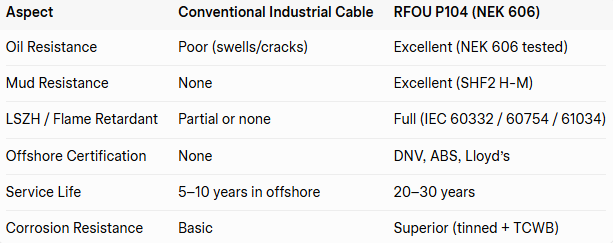
Comparison: RFOU P104 vs. Conventional Industrial Cables
Ordinary cables lead to frequent failures, higher OPEX, and safety risks—RFOU delivers long-term value.
Tips for Selecting Cables for Indonesian Offshore Projects
Mandate NEK 606 compliance for all MV power and critical control cables.
Prioritize HEPR insulation for flexibility and moisture resistance; SHF2 H-M sheaths for mud/oil.
Verify UV/ozone ratings and full marine certifications (DNV/ABS/Lloyd’s).
Match conductor size to load calculations using provided electrical data (e.g., ampacity tables).
Engage SKK Migas-approved EPC contractors familiar with class society rules.
Consider future-proofing for VFDs or higher fire resistance (BFOU variants if needed).
Conclusion
Offshore floating platforms in Indonesia operate in the planet’s most extreme cable environments—tropical heat, corrosive seas, abrasive muds, and fire hazards. Generic industrial cables are simply inadequate. The NEK 606 RFOU P104 8.7/15kV cable stands out as the optimal solution: mud- and oil-resistant, flame-retardant, LSZH, mechanically robust, electrically efficient, and fully certified. Its construction—tinned copper, HEPR insulation, dual TCWB armour, and SHF2 H-M sheath—directly addresses every challenge faced by FPSOs like Belanak and Marlin Natuna.
By choosing RFOU P104, operators achieve higher safety, lower maintenance, extended asset life, and regulatory peace of mind. In Indonesia’s drive toward 1 million bpd production and energy security, NEK606 RFOU cables are the primary choice for reliable offshore power systems.
FAQ
What is an RFOU cable?
RFOU is a flame-retardant, halogen-free, mud-resistant medium-voltage cable designed per NEK 606 for offshore fixed installations exposed to oil, gas, mud, and extreme conditions.
Why are standard cables unsuitable for offshore use?
They lack mud/oil resistance (sheaths degrade quickly), UV/ozone protection, LSZH properties, and marine certifications—leading to corrosion, fire hazards, and frequent failures.
What are the advantages of HEPR insulation over XLPE?
HEPR offers superior flexibility, better moisture resistance, reduced water treeing, and enhanced performance in dynamic/wet offshore environments, though XLPE has lower dielectric losses in dry applications.
Is certification mandatory for RFOU cables?
Yes—DNV, ABS, and Lloyd’s Register approvals are typically required for platform classification, insurance, and SKK Migas compliance.
Where is RFOU cable typically used?
On oil & gas platforms, FPSOs, drilling rigs, and offshore wind farms for power distribution and critical circuits.
What is the typical service life of NEK 606 offshore cables?
With correct installation and maintenance, 20–30 years is achievable—far exceeding conventional cables in harsh marine conditions.
Feichun Cable
Durable mining cables for tough environments and operations
Email: Tech@feichuncables.com
© 2025. All rights reserved.
Company
Products
Contact
WhatsApp: +86 13855123218