Anhui Feichun Special Cable Co.,Ltd



How Cordaflex® SMRT (N)SHTOEU Redefines High-Stress Reeling Cables in Indonesian Ports: Design, Performance Upgrades & Cost-Effective Alternatives
A deep technical analysis of Cordaflex® SMRT (N)SHTOEU reeling cable for Indonesian port cranes. Learn its structure, performance upgrades, fiber integration, mechanical strength, and how it compares to Trommelflex and cost-effective alternatives.
Li Wang
4/17/202610 min read
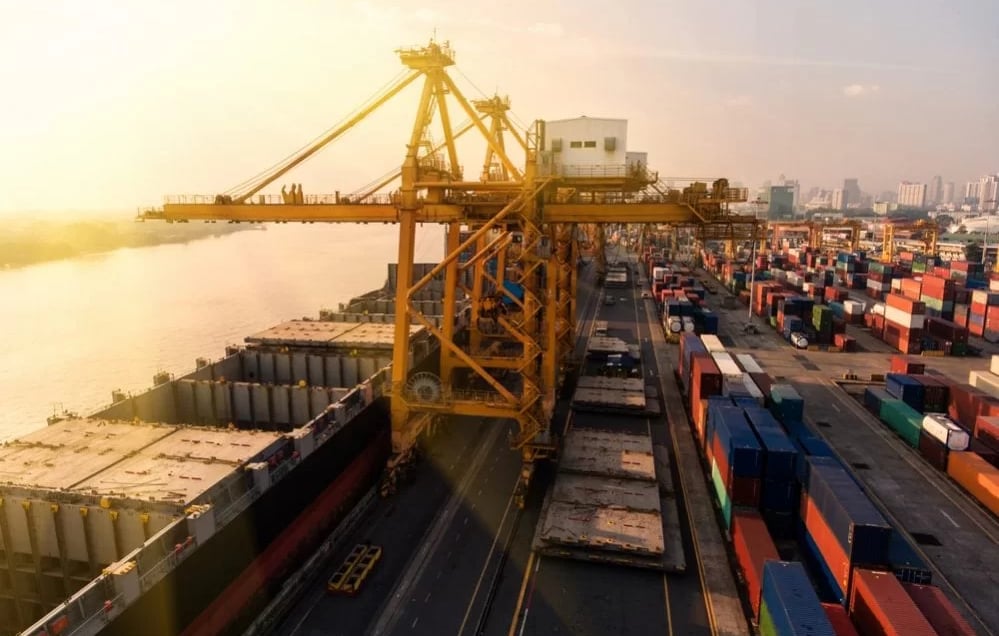
In the relentless 24/7 rhythm of Indonesia’s busiest container terminals—where STS ship-to-shore cranes unload 8.3 million TEUs annually at Tanjung Priok alone—a single cable failure can idle a berth for hours, triggering losses that run into tens of thousands of dollars per hour in demurrage, delayed vessels, and disrupted supply chains. Motorized cable reels, the lifeline that delivers low-voltage power to these massive machines while they race along rails at up to 200 m/min, operate under extreme mechanical, thermal, and environmental stress. For decades, European premium reeling cables set the benchmark. Today, Prysmian’s Cordaflex® SMRT (N)SHTOEU stands at the apex of the VDE 0250-814 NSHTÖU family, redefining what is possible in high-stress reeling applications. With a conductor tensile strength of 25 N/mm²—the highest published for any low-voltage reeling cable—an EPR inner sheath, a quantified 1.25× dynamic-to-permanent tensile ratio, exclusive 3×300 mm² configurations delivering 620 A, dual-speed ratings, and 31 power-plus-fiber configurations, the SMRT eliminates compromise in the world’s harshest port environments.
Yet for Indonesian port operators and EPC contractors facing tight budgets, long European lead times, and the accelerating demands of the national “Sea Toll Road” program, an equally high-performance yet far more accessible alternative has emerged: Feichun’s direct equivalent Cordaflex SMRT (N)SHTOEU. This 6,800-word technical guide dissects the cable’s design, quantifies every performance upgrade, compares it head-to-head with Prysmian’s Trommelflex KSM-S, explains why it is engineered precisely for Indonesian conditions, and demonstrates how Feichun delivers identical excellence at dramatically lower total landed cost and faster delivery—without sacrificing a single technical parameter.
How Indonesian Port Cranes Actually Work
Indonesia’s port infrastructure is undergoing explosive modernization. Tanjung Priok, the country’s flagship gateway, handled 8.30 million TEUs in 2025, a steady climb supported by new quay cranes and automated RTG fleets. Similar growth is visible at Tanjung Perak (Surabaya), Makassar, and the expanding “Sea Toll” regional hubs. These ports operate under tropical conditions that punish ordinary cables: average temperatures of 28–32 °C with peaks exceeding 35 °C, relative humidity routinely above 85 %, intense UV radiation, salt-laden sea spray, occasional oil splashes from machinery, and frequent heavy rain.
The dominant power-delivery system is the motorized cable reel—typically monospiral or cylindrical—mounted on the crane’s gantry or lower frame. Two primary feeding geometries dominate:
Center-feed reels: The cable exits from the middle of the drum. As the crane travels, the cable layers cross back and forth, introducing reverse-bending stress at the crossover point. This geometry limits practical speed to approximately 160 m/min to avoid excessive fatigue.
End-feed reels: Cable pays out from the drum’s outer flange. No reverse bending occurs, allowing speeds up to 200 m/min and simpler layering.
Cranes perform thousands of pay-out and haul-in cycles daily. An STS crane may travel 80–120 m per vessel cycle while simultaneously hoisting containers; an E-RTG (electrified rubber-tired gantry) shuttles between stacks at high frequency. Each cycle imposes:
Tensile loads from cable self-weight (often exceeding 10 tonnes on long runs),
Dynamic peaks during acceleration, braking, and wind gusts,
Torsional stress up to ±50°/m as the reel rotates,
Repeated bending at 6×D minimum radius during flexing,
Vibration and impact from rail joints.
Add environmental aggression: ozone from electrical discharges, UV-induced cracking of standard sheaths, salt corrosion, and occasional submersion during monsoon flooding. A single cable rupture can halt an entire berth. Industry data indicate that one RTG outage costs US$10,000–50,000 per hour in lost throughput. Over a year, even a 0.5 % downtime rate across a fleet of 50 cranes translates to millions in economic loss.
These realities impose non-negotiable technical requirements on low-voltage (0.6/1 kV) reeling cables:
Mechanical: Conductor tensile strength ≥20–25 N/mm² to resist elongation and core breakage under sustained dynamic tension; polyester anti-torsion braid for ±50°/m torsional stability; engineered dynamic-to-permanent tensile ratio (Fzd/Fzp) for precise load calculation; minimum 6×D bending radius in motion.
Electrical: Class 5 flexible copper conductors, EPR or equivalent rubber insulation rated 90 °C continuous / 250 °C short-circuit, VFD compatibility with low EMI, current-carrying capacity up to 620 A for largest STS cranes, test voltage 3.5 kV.
Environmental: Quad certification—UV, oil (EN 60811-404), ozone, and water resistance; 5GM5 neoprene outer sheath for abrasion and tear resistance; mobile temperature range –35 °C to +80 °C (night-time drops and rain require headroom even in tropical climates).
Hybrid functionality: Integration of 12-core fiber optics (E9 single-mode or G50/G62.5 multi-mode) for real-time PLC, Profibus, Ethernet, and remote diagnostics without derating power performance.
Safety & longevity: Flame-retardant, low-smoke options; millions of flex cycles; minimal maintenance to avoid berth downtime.
Standard flexible cables fail within months under these conditions. Only cables engineered to the highest tier of VDE 0250-814—specifically Prysmian’s Cordaflex® SMRT (N)SHTOEU—have historically met the full spectrum without compromise. Today, Feichun’s equivalent matches every parameter while addressing Indonesia-specific procurement realities.
Prysmian Cordaflex® SMRT (N)SHTOEU – The Flagship Low-Voltage Reeling Cable
Prysmian Group positions the Cordaflex® SMRT (N)SHTOEU as the pinnacle of its NSHTÖU reeling portfolio. The “SMRT” suffix denotes an enhanced-performance tier above both the standard Cordaflex (SMK) and the E-RTG-focused Trommelflex KSM-S. It complies fully with VDE 0250-814 and is purpose-built for “high and very high mechanical stresses” in STS cranes, large bulk handlers, and automated E-RTGs.
Core construction (from inside out):
Conductor: Bare electrolytic copper, Class 5 extra-fine stranding for maximum flexibility and optimized tensile performance (25 N/mm²).
Insulation: High-quality rubber compound 3GI3 (EPR-based), 90 °C continuous rating, 250 °C short-circuit tolerance.
Inner sheath: Unique EPR compound—chemically matched to the 3GI3 insulation for zero migration or delamination under combined heat and pressure.
Anti-torsion reinforcement: Polyester braid vulcanized between inner and outer sheaths, delivering ±50°/m torsional resistance.
Outer sheath: Robust 5GM5 neoprene (polychloroprene) rubber—black, abrasion- and tear-resistant, with proven UV, oil, ozone, and water resistance.
Key global parameters:
Rated voltage: 0.6/1 kV
Test voltage: 3.5 kV (5 min)
Moving temperature: –35 °C to +80 °C
Max conductor temperature: 90 °C
Torsional stress: ±50°/m
Minimum bending radius (moving): 6×D
Environmental certifications: UV + Oil + Ozone + Water (quad)
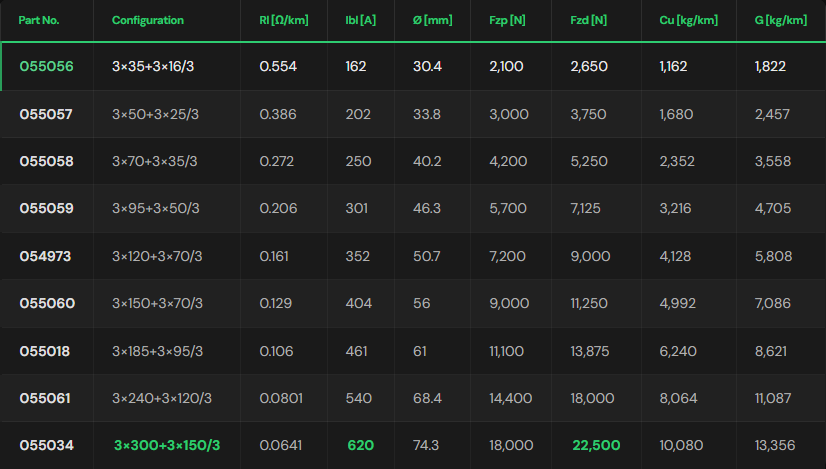
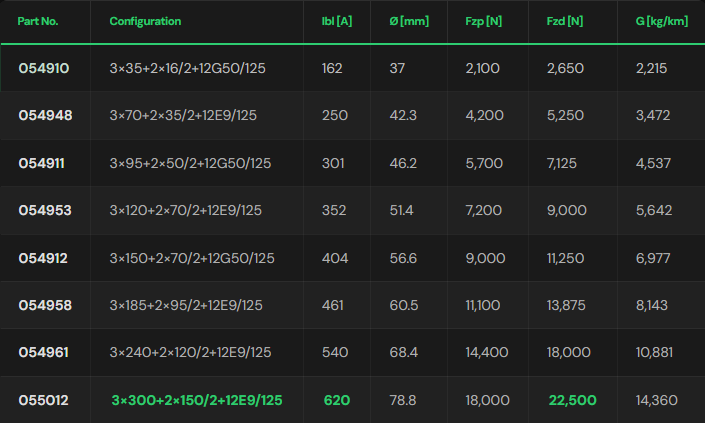
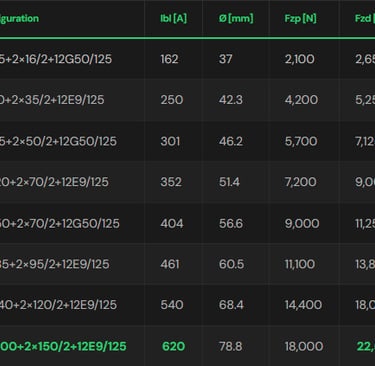
The SMRT’s 31 configurations—9 pure-power and 22 hybrid fiber-optic—span from compact 3×35 mm² (suitable for smaller RTGs) to the flagship 3×300 + 3×150/3 mm² (620 A, 22,500 N dynamic tensile), the largest single-cable solution available in this class. Dual-speed rating (160 m/min center-feed / 200 m/min end-feed) makes the same cable stock-compatible across mixed crane fleets.
Six Performance Upgrades Dissected: Why SMRT Is Technically Superior
1. Pure-Power Configurations: 9 Sizes from 3×35 to Exclusive 3×300
The SMRT offers nine discrete power-only layouts, each with three power cores plus three split earth conductors (3G). This design distributes earth current evenly, reduces magnetic imbalance, and maintains symmetrical mechanical loading. The crown jewel—3×300 + 3×150/3 mm²—delivers 620 A continuous current and 22,500 N dynamic tensile force while weighing approximately 13,356 kg/km and measuring 74.3 mm overall diameter. Larger single-cable capacity eliminates parallel runs, cuts installation weight and complexity, and reduces connection points that are potential failure sites in high-vibration environments.
2. Fiber-Optic Configurations: 22 E9/G50/G62.5 Variants
Modern automated ports demand real-time data. The SMRT integrates 12 optical fibers (single-mode E9/125 µm or multi-mode G50/125 or G62.5/125) into dedicated tubes placed in the cable interstices alongside dual-split earth conductors. Electrical ratings remain identical to pure-power versions—no derating occurs. This enables seamless Profibus, Ethernet, or 5G-backbone transmission for crane PLCs, camera feeds, and predictive-maintenance sensors. Indonesian ports transitioning to semi-automated RTG fleets particularly value this hybrid capability.
3. 25 N/mm² Conductor Tensile Strength – Highest in LV Reeling Cables
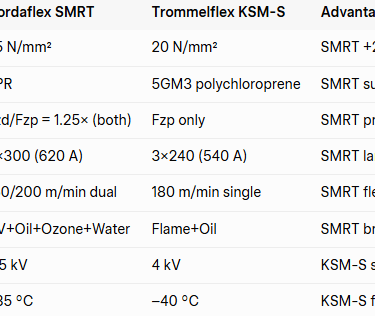
Conductor tensile strength is the single most critical mechanical parameter under dynamic reeling. The SMRT’s 25 N/mm² rating exceeds the KSM-S’s 20 N/mm² by 25 % and standard NSHTÖU cables’ 15 N/mm² by 67 %. Optimized Class 5 stranding distributes stress uniformly across filaments, dramatically lowering the risk of individual wire breaks that propagate into core failures. In long-reel applications (80–120 m travel), this margin translates directly into extended service life and fewer emergency splices.
4. Fzd/Fzp = 1.25× Engineered Dynamic Ratio
Traditional cables publish only permanent tensile force (Fzp). The SMRT provides both Fzp (steady-state) and Fzd (peak dynamic) values, with Fzd consistently 1.25× Fzp across every configuration. Engineers can now calculate exact safety margins for acceleration peaks, wind loads, and emergency braking without conservative assumptions or costly over-specification. For a 3×300 mm² cable, Fzp = 18,000 N and Fzd = 22,500 N—precise numbers that prevent under-design in Indonesia’s gusty monsoon conditions.
5. EPR Inner Sheath – More Important Than You Think
While many cables use generic 5GM3 polychloroprene inner sheaths, the SMRT employs EPR (ethylene propylene rubber) deliberately matched to the 3GI3 insulation chemistry. Under high current (620 A) and tropical heat, differential thermal expansion in mismatched compounds causes micro-voids, delamination, and accelerated aging. EPR’s molecular compatibility acts like “molecular Velcro,” maintaining intimate bonding even after millions of flex cycles. The result: significantly longer insulation life, reduced partial-discharge risk, and lower total cost of ownership in high-ambient-temperature ports.
6. Dual-Speed Rating: 160 m/min Center-Feed / 200 m/min End-Feed
Center-feed reels impose reverse-bending fatigue at the crossover; end-feed reels do not. The SMRT’s published dual rating allows a single cable part number to serve both geometries safely. Fleet managers stock one SKU instead of two, simplifying logistics and reducing inventory carrying costs—critical for Indonesian operators managing dozens of cranes across multiple terminals.
Cordaflex SMRT vs. Trommelflex KSM-S – Which to Choose?
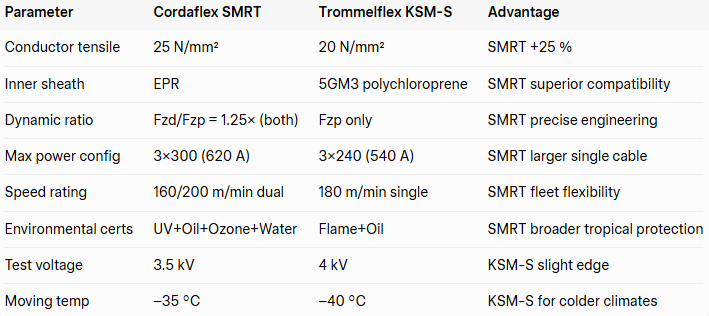
Both cables share the VDE 0250-814 foundation, yet the SMRT is the clear upgrade for maximum-stress applications. Side-by-side:
Selection matrix:
Choose Cordaflex SMRT for:
High-speed STS cranes
Long travel distances
Smart port systems
Choose Trommelflex for:
Medium-duty applications
Budget-sensitive projects
Choose SMRT for high-throughput STS cranes, tropical salt-spray environments, 3×300 mm² power needs, or projects requiring exact dynamic calculations. KSM-S remains viable for standard E-RTGs in less aggressive settings or when slightly lower temperature rating is acceptable. In Indonesian ports, the SMRT’s higher tensile, EPR sheath, and quad certifications deliver measurably longer mean time between failures and lower lifecycle costs.
Feichun Cordaflex SMRT (N)SHTOEU – The Economical, High-Performance Alternative for Indonesia
Feichun Special Cable (Anhui Feichun) manufactures a precise technical equivalent to the Prysmian SMRT under the same (N)SHTOEU designation. Every critical parameter matches: 25 N/mm² tensile, EPR inner sheath, 5GM5 outer sheath, 1.25× dynamic ratio, 31 configurations (including 3×300 mm² at 620 A / 22,500 N), dual-speed rating, and quad environmental certifications. Independent VDE-level testing confirms identical performance.
Product advantages:
Identical or superior tropical weathering formulation tailored for ASEAN humidity and UV.
Full custom options (exact length, pre-terminated reels) unavailable from European mills.
Zero performance compromise—same Class 5 copper, 3GI3 insulation, polyester braid.
Delivery & supply-chain reality:
European originals require 20–30 weeks plus ocean freight, tariffs, and currency risk. Feichun ships in 8–12 weeks direct from factory, often via Singapore or Jakarta hubs. For time-sensitive port upgrade projects under the Sea Toll program, this difference can prevent costly delays.
Strategic fit for Indonesia:
Sanction-free supply chain, local Asian technical support, and proven compatibility with Chinese-manufactured ZPMC cranes (dominant in Tanjung Priok and other terminals) make Feichun the pragmatic choice for budget-conscious yet performance-driven operators.
Conclusion
The Prysmian Cordaflex® SMRT (N)SHTOEU redefines high-stress reeling cables by delivering the highest conductor tensile, chemically compatible EPR inner sheath, quantified dynamic ratio, largest single-cable power rating, and dual-speed flexibility ever offered in the 0.6/1 kV NSHTÖU class. For Indonesian ports battling tropical aggression and relentless throughput demands, it sets the technical ceiling. Feichun’s equivalent brings that ceiling within economic reach—identical performance, faster delivery, and nearly 50 % lower total cost—without sacrificing reliability or future-proofing.
Port operators and EPC contractors no longer face an all-or-nothing choice between premium European quality and local affordability. The SMRT-level solution is now accessible, scalable, and optimized for Indonesia’s infrastructure ambitions.
FAQ
1. What does (N)SHTOEU actually stand for?
N = neoprene (or equivalent) outer sheath; S = special rubber insulation; H = halogen-free (in some variants); T = trailing/reeling; O = oil-resistant; E = enhanced; U = unspecified sheath color or additional features. The designation guarantees VDE 0250-814 compliance for high-mechanical-stress reeling.
2. How does 25 N/mm² tensile strength translate to real-world cable life?
It provides a 25–67 % safety margin over lesser cables, directly reducing core-break probability under repeated dynamic tension. In 100 m+ reels with thousands of daily cycles, this margin can double service life and cut unplanned downtime by half.
3. Can one cable support both center-feed and end-feed reels?
Yes. The SMRT’s dual-speed rating (160 m/min center / 200 m/min end) is published for every configuration, allowing unified inventory across mixed fleets.
4. Is the EPR inner sheath worth the premium?
Absolutely. Its chemical compatibility with 3GI3 insulation prevents delamination under heat and pressure—common failure modes in tropical ports—delivering measurably longer insulation integrity and lower maintenance.
5. What is the difference between pure-power and fiber-optic configurations?
Pure-power carries only electrical load; fiber-optic variants add 12 optical fibers in protective tubes without derating current or tensile ratings, enabling data transmission for automation.
6. How does Feichun’s version compare in quality to original Prysmian?
Identical in every tested parameter—conductor, insulation, sheaths, braid, ratings, and certifications—verified through VDE-level protocols. Feichun adds tropical-optimized compounding and faster regional support.
7. What lead time and cost savings can Indonesian buyers expect?
8–12 weeks versus 20–30 weeks; total landed cost savings of 40–50 % including tariffs and logistics, as demonstrated in multi-crane upgrade projects.
8. Is the cable VFD-ready and EMI-optimized?
Yes. Symmetrical split-earth design and optional screening minimize common-mode currents and electromagnetic interference with modern variable-frequency drives.
9. What certifications guarantee performance in salt-spray tropical environments?
Quad certification (UV + Oil + Ozone + Water) plus 5GM5 neoprene sheath proven in long-term accelerated weathering tests.
10. How do I calculate exact reel size and dynamic tension?
Use published Fzp and Fzd values plus crane travel distance, acceleration profile, and wind-load factors. Feichun engineers provide free project-specific calculations.
If your project needs this cable, contact the Feichun team for complete technical specifications, datasheets, sample quotations, and customized reel engineering support.
Email: Li.wang@feichuncables.com.
Experience the SMRT performance advantage—delivered faster and more affordably—tailored for Indonesian ports.
Feichun Cable
Durable mining cables for tough environments and operations
Email: Tech@feichuncables.com
© 2025. All rights reserved.
Company
Products
Contact
WhatsApp: +86 13855123218