Anhui Feichun Special Cable Co.,Ltd

High-Performance NGFLGOEU Flexible Flat Rubber Cable for Festoon Systems: Solving Bending Fatigue, Oil, UV & Humidity Challenges in Southeast Asia Industry
NGFLGOEU flat rubber cables deliver reliable power and control for festoon systems in harsh tropical environments. Learn how their design and materials solve bending fatigue, oil, UV, and humidity issues, with proven performance in Indonesia’s ports, palm oil mills, and manufacturing plants.
Li.Wang
7/13/202612 min read
Introduction
In industrial facilities across Southeast Asia, equipment that moves continuously is essential to productivity. Overhead cranes, conveyor lines, automated machine tools, and loading systems all rely on flexible cables to deliver power and control signals. However, these cables face a unique set of challenges. They must bend repeatedly, resist abrasion, withstand exposure to sunlight, rain, humidity, oil, and chemicals, while also fitting within limited space. In regions like Indonesia, where temperatures are high, humidity levels remain elevated year-round, and ultraviolet radiation is intense, standard round cables often fail prematurely. They twist, develop cracks, suffer insulation damage, or break after only a few months of use.
The NGFLGOEU flexible flat rubber cable, manufactured by companies such as Eland Cables under their B6N product group, offers a different approach. It is not simply a flat version of a standard cable. Instead, it is a purpose-built solution designed specifically for festoon and cable trolley systems where movement occurs only in a single plane. Built to conform to strict German standards including VDE 0250 Part 809 and VDE 0293 (HD 308), this cable combines advanced material science with optimized mechanical design. By pairing Class 6 extra-fine copper conductors, ethylene propylene rubber (EPR) insulation, and a robust chloroprene rubber (CR) outer sheath, it addresses the exact failure points that plague conventional cables.
For engineers and procurement managers in Indonesia and neighboring countries, the NGFLGOEU cable represents a shift from treating cables as simple commodities to selecting them as critical components of system reliability. This article explains its construction, operating principles, performance characteristics, and real-world results, showing how it reduces maintenance costs, extends service life, and ensures continuous operation in some of the most demanding industrial environments.
Technical Specifications and Compliance
To understand how NGFLGOEU cables perform, it is important to review their formal specifications, which are defined precisely in the manufacturer’s datasheet. These parameters set clear limits for electrical operation, mechanical stress, temperature range, and environmental exposure.
Electrical Ratings
The cable is classified as a low-voltage type with a rated voltage of U₀/U = 300/500 V. This makes it suitable for power distribution and control circuits in most industrial machinery. The electrical performance is consistent across all sizes, with conductor resistance and current-carrying capacity defined as follows:
Conductor resistance (Ω/km at 20°C):
1.5 mm²: 13.3
2.5 mm²: 7.98
4 mm²: 4.95
6 mm²: 3.30
10 mm²: 1.91
16 mm²: 1.21
25 mm²: 0.78
35 mm²: 0.554
50 mm²: 0.386
70 mm²: 0.272
95 mm²: 0.206
120 mm²: 0.129
Current-carrying capacity in free air at 30°C:
1.5 mm²: 23 A
2.5 mm²: 31 A
4 mm²: 42 A
6 mm²: 54 A
10 mm²: 75 A
16 mm²: 100 A
25 mm²: 127 A
35 mm²: 158 A
50 mm²: 192 A
70 mm²: 246 A
95 mm²: 298 A
120 mm²: 346 A
These values ensure that the cable can carry required loads without excessive heat buildup, even when installed in confined festoon tracks.
Mechanical and Thermal Ratings
Temperature range is a key factor in tropical and seasonal environments. The NGFLGOEU cable operates reliably:
Fixed installation: -40°C up to +90°C
Dynamic flexing and movement: -35°C up to +90°C
This wide range allows it to work in cold storage areas as well as in facilities near furnaces or exposed to direct sunlight.
Bending radius determines how sharply the cable can curve without internal damage. For this design:
Fixed position: Minimum bending radius = 5 times the overall height
Moving position: Minimum bending radius = 10 times the overall height
Because the cable is flat, bending occurs only across its thickness, not its width. This simplifies installation and reduces the risk of over-bending.
Dimensions and Construction Range
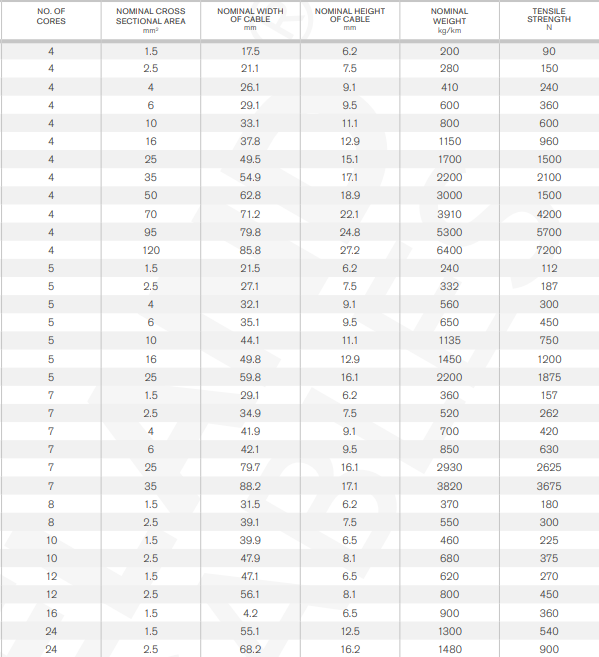
NGFLGOEU cables are available in a wide selection of core counts and cross-sectional areas, as shown in the datasheet. Common configurations include:
Core counts: 4, 5, 7, 8, 10, 12, 16, and 24 cores
Cross-sections: 1.5 mm² through 120 mm²
Each size has defined nominal width, height, and weight. For example, the 4-core 16 mm² cable measures 37.8 mm wide by 12.9 mm high, and weighs 1,150 kg/km. These dimensions allow engineers to calculate clearances and load capacity accurately during system design.
Standards and Certifications
Compliance with international standards ensures consistent quality and compatibility with local regulations. The NGFLGOEU cable meets:
Construction and design: VDE 0250 Part 809 and VDE 0293 (HD 308) for core identification
Flame retardancy: VDE 0482-332-1-2 and IEC 60332-1-2, meaning it will not propagate fire
Oil resistance: EN 60811-404, confirming stability when exposed to mineral oils
Regulatory compliance: European Low Voltage Directive 2014/35/EU, RoHS 2015/65/EU, and REACH EC 1907/2006
In Indonesia, these standards align with the Indonesian National Standard (SNI) framework, which often references VDE and IEC requirements. This means NGFLGOEU cables can be installed without additional testing or certification, simplifying procurement and approval processes.
Design and Material Science: Why the NGFLGOEU Cable Works
The performance of the NGFLGOEU cable comes from the combination of its geometric shape and the materials chosen for each layer. Every element follows established principles of electrical engineering, mechanics, and polymer chemistry.
Layer-by-Layer Construction
Starting from the center and moving outward, the cable is built as follows
Conductor: Class 6 Extra-Finely Stranded Bare Copper
The core of the cable uses Class 6 conductors, as defined by VDE 0295 and IEC 60228. Unlike solid wire or standard Class 5 strands, Class 6 consists of many extremely fine copper wires twisted together. This structure increases flexibility dramatically. When the cable bends, each strand shifts slightly within the bundle, distributing stress evenly across the entire cross-section. The result is resistance to metal fatigue. Round cables with fewer, thicker strands develop cracks after repeated flexing, but Class 6 conductors can endure millions of bending cycles without breaking.
Electrically, copper provides low resistance, reducing energy loss as heat. The fine stranding also maintains consistent electrical properties even when the cable is in constant motion.
Insulation: Ethylene Propylene Rubber (EPR)
Surrounding each conductor is a layer of EPR insulation. This type of rubber is selected for its electrical and thermal characteristics. It has a high dielectric strength, typically above 20 kV/mm, which prevents current leakage between cores. Its volume resistivity remains above 10¹⁴ Ω·cm across the full operating temperature range, ensuring reliable insulation.
EPR also retains its elasticity in both cold and hot conditions. Unlike thermoplastics that become brittle in cold or soft at high temperatures, EPR stays flexible from -40°C to +90°C. This stability prevents cracking or deformation as the cable moves and expands or contracts with temperature changes.
Core Arrangement: Parallel Flat Layout
Instead of twisting insulated cores into a circular bundle, the NGFLGOEU cable arranges them side-by-side in a flat plane. This arrangement is the most visible difference from standard cables and the source of many of its benefits.
Mechanically, it forces bending to occur only in one direction. In a round cable, movement can cause twisting, which creates uneven tension across the cores. Some conductors are stretched while others are compressed, leading to fatigue and eventual failure. In the flat design, all cores bend along the same radius, so stress is distributed equally. This reduces mechanical strain by more than half compared to equivalent round cables.
Thermally, the flat profile exposes a larger surface area relative to its volume. Heat generated during operation dissipates more efficiently, which allows the cable to maintain its rated current without overheating.
Outer Sheath: Chloroprene Rubber (CR)
The outermost layer is made of CR, also known as neoprene. This material is chosen specifically for its resistance to environmental factors. It has a tightly cross-linked molecular structure that makes it highly resistant to:
Mineral and vegetable oils: It does not swell or harden when exposed to lubricants and fuels.
Ozone: In industrial environments, ozone forms from electrical discharges and UV radiation. CR resists cracking even at concentrations up to 50 parts per hundred million.
Ultraviolet radiation: In outdoor applications, CR retains more than 80% of its tensile strength after 1,000 hours of exposure, whereas PVC sheaths degrade rapidly.
Moisture and humidity: Its low water absorption rate prevents moisture from penetrating to the insulation, which could cause electrical faults.
Flame spread: It is self-extinguishing, stopping combustion once the external heat source is removed.
The sheath is black in color, which helps absorb heat evenly and provides additional protection against sunlight.
Core Identification
To simplify installation and maintenance, cores are marked according to standard codes:
4-core: Green/Yellow, Brown, Black, Grey
5-core: Green/Yellow, Blue, Brown, Black, Grey
7-core and above: Black insulation with white printed numbers, plus one or two Green/Yellow grounding cores
This follows VDE 0293 and HD 308 standards, making it easy for technicians to trace circuits and connect equipment correctly.
Solving Four Key Operational Challenges
The design and materials directly address the most common causes of cable failure in festoon systems.
Overcoming Space Limitations
In overhead installations, the vertical clearance available is often limited. Round cables require more height to bend without pinching. The flat profile of NGFLGOEU cables reduces the required installation height by 40% to 60%. This allows engineers to design more compact trolley tracks and use existing infrastructure without major modifications.
Reducing Mechanical Fatigue
The combination of Class 6 conductors and controlled bending geometry increases the cable’s service life significantly. While standard round cables may fail after 200,000 to 300,000 bending cycles, NGFLGOEU cables can exceed 1 million cycles under the same conditions. This reduces the frequency of replacements and the labor required to install them.
Resisting Environmental Degradation
In Indonesia’s tropical climate, high humidity and heavy rain can cause corrosion, while intense sunlight breaks down weaker polymers. The CR sheath acts as a barrier against all these elements. It also protects against chemical splashes common in factories and oil mills, ensuring the cable remains functional year after year.
Stabilizing Festoon System Operation
When round cables move in festoon tracks, they tend to rotate and twist, which can cause jamming or misalignment. The fixed flat shape prevents rotation, guiding the cable along a consistent path. This reduces friction, lowers wear on the sheath, and ensures smooth operation. It also prevents the cable from sagging or tangling, which could interrupt power supply.
Real-World Performance in Indonesia and Southeast Asia
The benefits of NGFLGOEU cables are not limited to laboratory data. They have been tested and proven in actual industrial settings across Indonesia, where conditions are among the most challenging in the region.
Regional Operating Conditions
Indonesia’s climate is defined by high temperatures, average humidity above 80%, heavy seasonal rainfall, and strong solar radiation. In addition, industries such as ports, palm oil processing, mining, and manufacturing introduce further stressors: salt spray near the coast, oil and grease in mills, and fine dust in mines. These conditions accelerate the aging of standard cables.
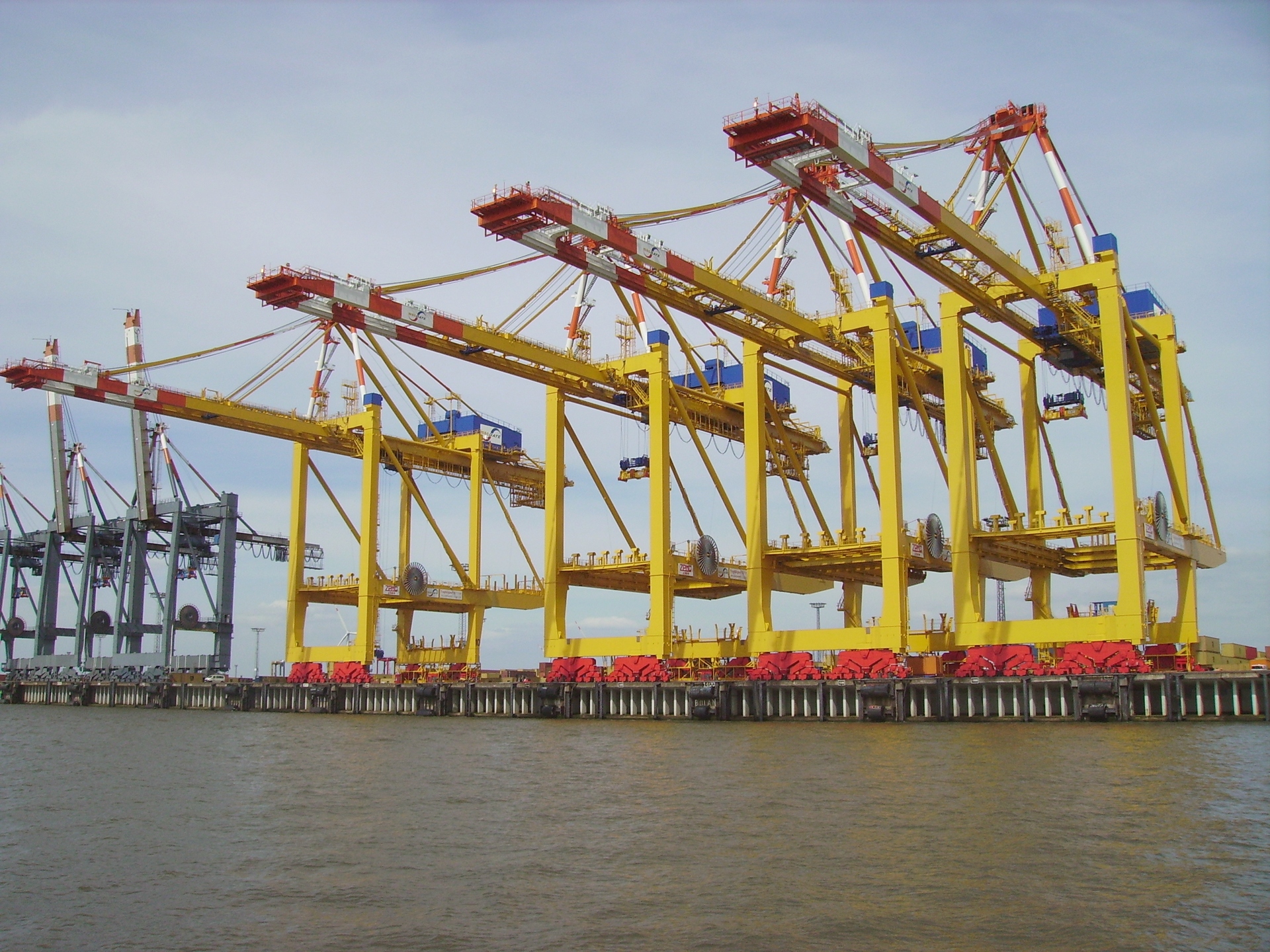
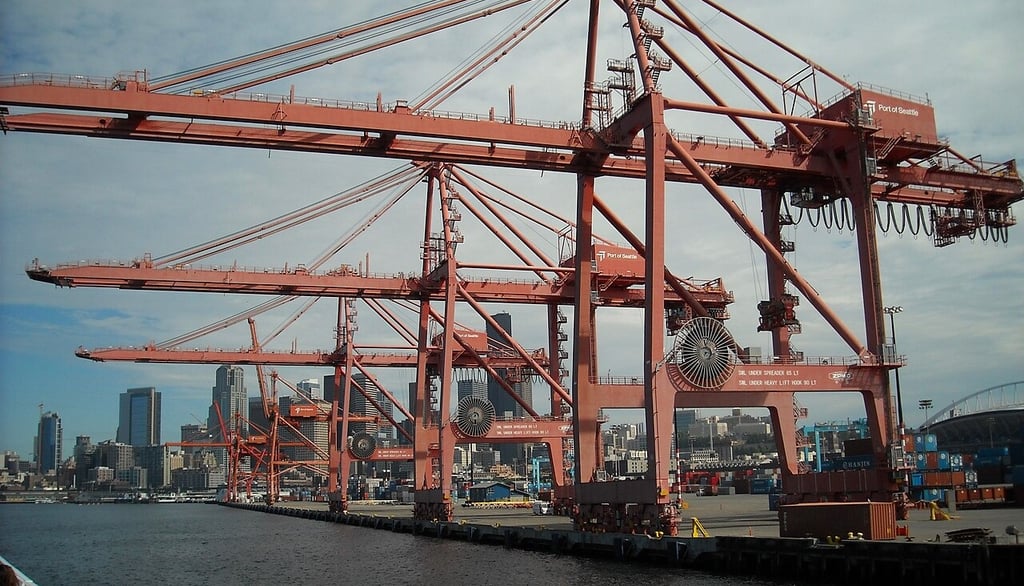
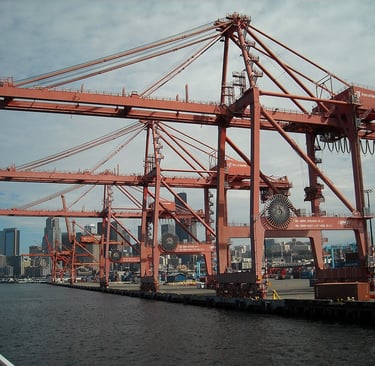
Case Study 1: Port Container Cranes at Tanjung Priok, Java
Tanjung Priok Port near Jakarta is the busiest in Indonesia, handling millions of containers annually. Gantry cranes move continuously along the dock, lifting and transferring loads. In the past, operators used round PVC-sheathed cables, which needed replacement every three months due to twisting, UV damage, and cracking.
After switching to NGFLGOEU 4×16 mm² cables, the performance changed dramatically. The cables operate at a travel speed of 120 meters per minute along single-plane festoon tracks. Because bending is constrained to one direction, there is no twisting. The CR sheath resists salt air and sunlight. Maintenance intervals were extended to 18 months, and unplanned downtime caused by cable failure dropped by approximately 75%. This improvement directly translates into higher productivity and lower operational costs.
Case Study 2: Palm Oil Processing Conveyors in Sumatra
On palm oil plantations in Sumatra, conveyor belts transport fresh fruit bunches and processed materials through facilities that are often open-air, hot, and covered in oil and moisture. Previously, cables feeding power to these conveyors became stiff and cracked within two years.
Facilities using NGFLGOEU 7×2.5 mm² cables have reported that after five years of continuous use, the cables show no visible signs of degradation. The CR sheath remains flexible and does not absorb oil, while the EPR insulation continues to perform reliably. The flat design also fits neatly into narrow guide rails, keeping the system running smoothly without jamming.
Case Study 3: Factory Automation in Jakarta Industrial Zone
In manufacturing plants around Jakarta, stamping machines, welding lines, and assembly stations rely on control circuits that move with robotic arms and sliding tables. Using 10×1.5 mm² NGFLGOEU cables, operators found that the flat profile required less overhead space, allowing higher ceilings or additional equipment in the same area. The cables bend smoothly without bunching or binding, and the Class 6 conductors deliver consistent signals even after years of daily movement.
Local Acceptance and Compliance
Because NGFLGOEU cables follow VDE standards, which are referenced in many SNI regulations, they are accepted by local authorities and engineering consultants. They can be directly substituted for older European-designed cables without requiring redesign or retesting, which simplifies project planning and procurement.
Performance Comparison: NGFLGOEU vs. Ordinary Round Cables
To understand the value of the NGFLGOEU cable, it helps to compare it directly with the round cables typically used in festoon systems.
Mechanical Performance
Round cables twist as they move, creating uneven tension that weakens conductors and stretches insulation. Their bending radius is determined by the overall diameter, requiring more space. NGFLGOEU cables bend only in one plane, with equal stress across all cores. They last three to five times longer under identical motion cycles.
Environmental Resistance
Standard PVC or PE sheaths absorb moisture, swell in oil, and become brittle under UV light. They often require additional protective coatings or conduits, adding cost and complexity. The CR sheath of NGFLGOEU cables combines multiple protections into one layer, eliminating the need for extra shielding.
Cost of Ownership
While the initial purchase price of NGFLGOEU cables is approximately 15% to 25% higher than standard round cables, the long-term costs are lower. The longer service life means fewer replacements, and reduced failure rates mean less downtime. Over five years, the total cost of ownership is often 30% to 40% less than using cheaper cables that require frequent repair and replacement.
Feichun NGFLGOEU: Equivalent and Cost-Effective Alternative
European brands such as Eland Cables have established the NGFLGOEU standard, but for many projects in Southeast Asia, local and regional supply options are also important. Feichun Cables offers a version of the NGFLGOEU cable that matches the specifications and performance of the original.
Technical Equivalence
Feichun’s NGFLGOEU cable uses the same construction: Class 6 bare copper conductors, EPR insulation, and CR outer sheath. It meets the same VDE, IEC, and EN standards, including voltage ratings, temperature range, and bending requirements. Its electrical resistance, current-carrying capacity, and dimensional specifications are identical to the datasheet values provided.
Key Advantages
Competitive pricing: It is priced more affordably than European equivalents, making it accessible for large-scale projects.
Faster delivery: With regional logistics networks, lead times to Indonesia and Southeast Asia are shorter, reducing project waiting periods.
Customization: Lengths, marking, and packaging can be adjusted to meet specific site requirements.
Full compliance: It carries CE, RoHS, and REACH markings, and aligns with SNI-compatible standards.
For users who need reliable performance without the premium price tag or long lead times, Feichun provides a direct and reliable alternative.
Selection Guide and Application Range
Choosing the correct NGFLGOEU cable depends on the type of equipment, power requirements, and operating environment.
Typical Applications
NGFLGOEU cables are designed for systems where movement occurs in a single plane. Common uses include:
Machine tools and automated production lines
Conveyor systems in ports, mines, and processing plants
Overhead cranes, gantry systems, and festoon tracks
Palm oil, rubber, and mineral processing facilities
Outdoor storage and logistics yards
How to Choose the Right Configuration
Core count: 4 cores are standard for power circuits (three phases plus ground). 7 to 24 cores are used for combined power and control signals.
Cross-sectional area: 1.5 mm² and 2.5 mm² are suitable for control and low-power circuits. 4 mm² to 16 mm² are used for medium-duty motors and equipment. 25 mm² and above are reserved for heavy lifting and high-power applications.
Environment: Always select CR-sheathed NGFLGOEU cables for outdoor use, oily areas, or locations exposed to sunlight.
Installation and Handling Tips
To maximize service life, installers should follow a few basic guidelines:
Maintain the minimum bending radius as specified.
Align festoon tracks to ensure movement occurs only in one plane.
Avoid excessive tension; allow a small amount of slack to prevent pulling during travel.
Secure mounting points evenly to distribute weight and reduce vibration.
Frequently Asked Questions
Is NGFLGOEU suitable for outdoor use in rain and direct sunlight?
Yes. The CR sheath provides excellent resistance to water, humidity, and UV radiation. It remains stable in outdoor tropical conditions for many years.
Can it replace existing round festoon cables directly?
Yes. The voltage rating and core identification follow standard conventions, so it can be connected to existing switchgear and motors without modification. The only change required is adjusting the festoon track to fit the flat profile.
What is the expected service life under tropical conditions?
When installed correctly, NGFLGOEU cables typically last 8 to 12 years in outdoor applications and up to 15 years in protected indoor environments.
Does it meet Indonesian safety and regulatory requirements?
Yes. It conforms to VDE and IEC standards, which are referenced in SNI regulations, making it fully acceptable for local use.
How does Feichun’s version compare to European brands?
Feichun’s NGFLGOEU cable is built to the same specifications and tested to the same standards. It offers identical performance at a lower cost and with faster delivery times.
Conclusion
The NGFLGOEU flexible flat rubber cable represents more than just a different shape of wire. It is an engineering solution developed to solve specific problems in moving industrial equipment. By combining a flat geometry that controls bending direction, Class 6 conductors that resist fatigue, EPR insulation that maintains electrical integrity, and a CR sheath that withstands harsh environments, it addresses the root causes of cable failure.
In Indonesia and across Southeast Asia, where heat, humidity, sunlight, and mechanical movement combine to shorten the life of standard cables, NGFLGOEU offers clear advantages. It reduces maintenance workload, cuts downtime, and lowers long-term operating costs. Whether sourced from established European manufacturers or from reliable alternatives such as Feichun, this cable delivers consistent performance in ports, factories, plantations, and mines.
Its value lies not only in transmitting electricity but in doing so reliably and safely over many years of continuous use. For any system that uses festoon or trolley arrangements, NGFLGOEU is a choice that improves efficiency and reduces risk.
If you are looking to upgrade your festoon systems or replace underperforming cables, contact the Feichun team to learn more about NGFLGOEU flexible flat rubber cables. We provide detailed technical specifications, competitive pricing, and reliable delivery to Indonesia and other Southeast Asian markets.
Email: Li.wang@feichuncables.com


Feichun Cable
Durable mining cables for tough environments and operations
Email: Tech@feichuncables.com
© 2025. All rights reserved.
Company
Products
Contact
WhatsApp: +86 13855123218