Anhui Feichun Special Cable Co.,Ltd


H07RN-8-F EN 50525-2-21: Heavy-Duty Flexible Rubber Cable for Submersible Pumps, Agriculture & Industry in Indonesia
H07RN-8-F EN 50525-2-21 is a heavy-duty flexible rubber cable engineered for dry, damp, wet and freshwater immersion up to 10 meters. This comprehensive guide explains its construction, material science, compliance standards, and proven performance in Indonesia’s agriculture, construction, industrial and mining sectors. Learn how it delivers longer service life, lower maintenance costs and greater reliability compared to ordinary cables.
Li.Wang
7/10/202614 min read
Introduction
When selecting power cables for demanding environments, many engineers and procurement managers assume that all rubber-sheathed flexible cables offer similar levels of performance. In reality, there are significant differences in design, materials and long-term reliability between standard products and those specifically developed for combined exposure to moisture, temperature variations and mechanical stress. H07RN-8-F EN 50525-2-21 is not an ordinary flexible rubber cable. It is a heavy-duty power transmission solution optimized from the ground up to operate consistently under conditions that would quickly degrade or damage standard cables.
This cable is designed to perform reliably across a wide range of environments, from dry indoor workshops to permanently submerged applications in freshwater ponds and wells. Its engineering balances electrical safety, mechanical flexibility, water resistance and weathering stability, making it suitable for both mobile equipment and fixed installations. For regions like Indonesia, where high humidity, heavy rainfall, and significant agricultural, industrial and construction activity create challenging operating conditions, the right choice of cable can reduce downtime, lower maintenance costs and extend the life of electrical systems.
Indonesia’s climate and industrial profile present specific challenges for power distribution. Temperatures often range from 25°C to 35°C year-round, humidity levels frequently exceed 85%, and many applications involve regular movement or temporary installation. In such conditions, standard PVC-insulated cables or basic rubber types tend to become brittle, absorb moisture, lose insulation resistance and fail within a short period. H07RN-8-F addresses these issues through a combination of carefully selected materials and structural design, resulting in a product that maintains its performance characteristics over many years of service.
The core value of this cable can be understood through three main dimensions:
Structural design: Built with EN 60228 Class 5 fine-stranded copper conductors, rubber insulation and weather-resistant rubber sheath. This configuration reduces bending stress, improves elastic recovery and enhances mechanical protection, ensuring excellent flexibility and durability without compromising electrical performance.
Material science: Rubber compounds offer better low-temperature resistance, ozone resistance, abrasion resistance, humidity stability and fatigue resistance than ordinary PVC. Their cross-linked polymer structure keeps water absorption low, preserves insulation integrity and allows the material to return to its original shape after repeated bending, making it ideal for mobile and wet applications.
Engineering application: Suitable for submersible pumps, construction sites, agricultural irrigation, industrial machinery and lifting equipment. It works reliably in dry, damp, wet and freshwater environments up to 10 meters deep, and can be used in protected fixed installations up to 1,000 V as well as for motor rotor connections in lifting systems. Compared with standard PVC cables or basic H07RN-F types, it shows clear advantages in water resistance, environmental adaptability and long-term stability.
For markets like Indonesia, where tropical conditions increase the risk of early cable failure, H07RN-8-F reduces the costs caused by insulation aging, sheath cracking, water ingress and frequent replacements. It has become one of the most valuable European-standard flexible rubber cables for submersible, temporary and industrial power supply. It is not simply a waterproof cable, but a system engineered through four key elements:
IEC Class 5 conductor → ensures flexibility and efficient current transfer
EI4 insulation → maintains stable dielectric properties over decades
EM2 rubber sheath → delivers waterproofing, oil resistance and anti-aging performance
EN harmonized standards → guarantees consistent quality and global compatibility
This combination makes it ideal for operating under the combined effects of water, heat, mechanical load and chemical exposure. As verified in Indonesia and similar tropical regions, it provides longer service life, less maintenance and lower total cost of ownership, provided users respect its operating limits: maximum immersion depth of 10 meters, water temperature not exceeding 40°C, and protection against heavy mechanical impact.
Basic Technical Overview & Compliance Standards
Every reliable electrical product begins with clear specifications and adherence to recognized standards. The designation H07RN-8-F EN 50525-2-21 follows European harmonized naming conventions, where each part of the code indicates its construction, insulation, sheath and flexibility class. The cable conforms to EN 50525-2-21, the primary standard for flexible rubber-insulated and rubber-sheathed cables rated up to 450/750 V. It also aligns with other established specifications including HD 22.4 S3, CEI 20-19 Part 16, EN 60228 and VDE 0295, ensuring consistency across European and international markets.
In terms of regulatory compliance, H07RN-8-F meets the requirements of major European directives. It complies with the Low Voltage Directive 2014/35/EU, which sets safety limits for electrical equipment up to 1000 V AC, as well as the RoHS Directive 2015/65/EU and the REACH Regulation EC 1907/2006, which restrict the use of hazardous substances in manufacturing. It also satisfies the Construction Products Regulation EN 50575, confirming its suitability for use in building and infrastructure projects. Independent testing laboratories such as The Cable Lab, an ISO/IEC 17025 and IECEE CBTL accredited facility, verify these characteristics, providing assurance of consistent quality and performance.
Electrical Ratings
Rated voltage: U₀/U = 450/750 V — meaning voltage between conductor and earth is 450 V, and between conductors is 750 V
Maximum operating voltage: Up to 1,000 V when installed in adequately protected conditions such as inside conduits, control panels or equipment enclosures
Dielectric strength: Withstands an AC voltage test of 2,500 V during production, confirming strong insulation integrity
Temperature and Mechanical Ratings
Operating temperature range:
Fixed installation: -40°C to +60°C
Moving or repeated flexing: -15°C to +60°C
Minimum bending radius:
Fixed use: 4 × overall diameter
Dynamic use: 6 × overall diameter
Flame retardancy: Complies with IEC/EN 60332-1-2, which confirms the cable will not sustain flame propagation when tested vertically
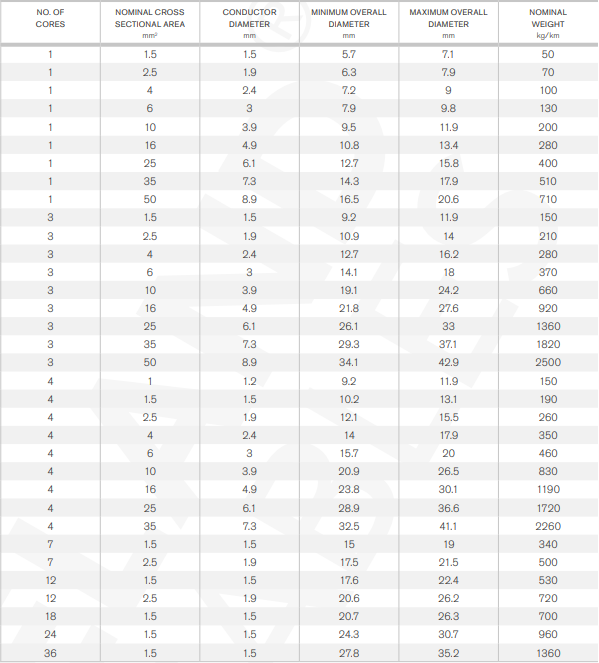
Dimensions and Construction Range
The datasheet provides a complete range of sizes to match different power and space requirements:
Conductor type: Class 5 flexible copper
Nominal cross-section: From 1.5 mm² up to 50 mm² in single-core versions, and from 1 mm² up to 35 mm² in multi-core configurations
Core configurations: 1, 2, 3, 4, 7, 12, 18, 24 and 36 cores available
Color coding for easy identification:
1-core: Black
2-core: Blue, Brown
3-core: Brown, Green/Yellow, Blue
4-core: Green/Yellow, Blue, Brown, Grey
5-core: Green/Yellow, Blue, Brown, Black
6 cores and above: Black insulation marked with white numerical numbers
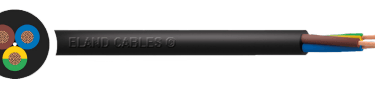
Outer sheath: Uniform black rubber
Detailed parameters include conductor diameter, minimum and maximum outer diameter, and nominal weight per kilometer for each part number, allowing precise selection for design and installation.
Structural Design & Engineering Principles
The performance of H07RN-8-F begins with its internal structure. Each layer is designed to work in harmony with the others, balancing electrical function, mechanical strength and environmental protection. Moving from the inside out, the construction consists of conductor, insulation, filler elements and outer sheath, each chosen and arranged according to clear engineering principles.
Layer-by-Layer Construction
Conductor: Made of Class 5 fine-stranded copper as defined by EN 60228. Instead of a single solid wire, it uses thousands of thin copper strands twisted together in layers. This structure improves flexibility significantly and distributes mechanical stress evenly across the entire cross-section. When the cable is bent, no single point carries all the tension, reducing the risk of breakage even after thousands of cycles. It also lowers the skin effect in alternating current systems, allowing more efficient use of the conductor’s capacity.
Insulation: Formed from high-grade EI4 ethylene-propylene rubber (EPR). This material creates a uniform barrier that prevents electric current from leaking between cores or to earth. Unlike thermoplastics, cross-linked rubber maintains its elasticity over a wide temperature range, so it expands and contracts together with the copper conductor without creating gaps. This prevents moisture from entering the cable and ensures long-term electrical stability.
Filler elements: Non-hygroscopic rubber compounds placed between insulated cores. They do not conduct electricity but help maintain a perfectly round cross-section. A round shape ensures that bending forces are distributed evenly around the whole cable, avoiding concentrated stress that could cause kinking or deformation. It also reduces friction between cores during movement, protecting the insulation from wear.
Outer sheath: Manufactured from EM2 grade rubber such as chlorinated polyethylene or polychloroprene. It serves as the first line of defense against water, oils, ozone, ultraviolet radiation and physical abrasion. The thickness is calculated to provide sufficient protection while keeping the cable flexible enough to follow movement and installation curves.
Core Engineering Logic
Flex-fatigue design: The combination of fine-stranded conductors and elastic rubber layers allows the cable to withstand repeated bending, vibration and dragging without permanent damage. This is essential in applications like portable tools, generators and pumps where position changes frequently.
Thermal compatibility: Copper and rubber materials are selected to have similar coefficients of thermal expansion. As temperatures rise or fall, both materials expand or contract at nearly the same rate, preventing separation or delamination that would create paths for water ingress.
Insulation coordination: The design provides a safety margin far above normal operating voltage. With a dielectric strength of more than 20 kV per millimeter, even the thinnest insulation layer offers a breakdown threshold many times higher than the 750 V rating, ensuring reliability even in humid or slightly contaminated environments.
Material Science Behind Long-Term Performance
To fully understand the advantages of H07RN-8-F, it is necessary to look beyond just construction and examine the materials used and their underlying science. The selection of each component is based on properties that directly influence how the cable behaves over its lifetime, especially under the combined effects of water, heat and mechanical load.
Conductor Material
High-purity electrolytic copper with a minimum purity of 99.99% is used. Copper offers the highest electrical conductivity among commonly available engineering metals, allowing efficient power transfer with minimal energy loss and heat generation. When formed into Class 5 stranding, it also provides excellent fatigue resistance. Each fine strand acts as an independent element, so that even if minor damage occurs to one or two strands, the overall current-carrying capacity remains largely unaffected. This property is particularly valuable on construction sites, farms and industrial floors where cables may be dragged across rough surfaces or bent repeatedly.
Insulation – EI4 Ethylene-Propylene Rubber
EI4 EPR is a cross-linked polymer, meaning its molecular chains are connected into a three-dimensional network rather than remaining as separate linear strands. This structure results in key improvements:
Electrical stability: Low dielectric constant between 2.5 and 3.0 reduces capacitance and reactive current, while a breakdown strength above 20 kV/mm ensures safe operation.
Hydrolysis resistance: The non-polar molecular backbone does not easily react with water molecules. In laboratory tests, EPR maintains insulation resistance above 100 MΩ·km even after being submerged in water at 70°C for 1,000 hours, confirming its stability in wet conditions.
Temperature tolerance: Remains flexible from -40°C to above 80°C, far exceeding the range of standard thermoplastics.
Outer Sheath – EM2 Rubber Compound
EM2 rubber builds on these characteristics with enhanced environmental resistance:
Waterproof mechanism: Its polar functional groups repel water molecules, resulting in a water absorption rate of less than 0.5% by weight after 28 days of continuous immersion. This enables the cable to achieve an AD8 water resistance rating, suitable for long-term freshwater exposure up to 10 meters depth.
Weather resistance: The cross-linked network resists ozone formed in industrial environments and ultraviolet radiation from sunlight, which would quickly degrade PVC. It remains elastic at -40°C and does not soften excessively at high temperatures.
Mechanical and chemical properties: Tensile strength reaches at least 12 MPa, elongation at break is over 300%, and tear resistance is above 10 N per millimeter. It also meets EN 60811-404 for oil resistance, making it suitable near machinery and lubricants.
Comparison with Other Cable Types
Versus PVC cables: PVC absorbs moisture rapidly in humid conditions, becomes brittle below 0°C and softens above 60°C. Its service life in tropical regions is usually only 2 to 4 years.
Versus standard H07RN-F: These use lower-grade rubber compounds with higher water absorption and poorer low-temperature performance. They are intended only for occasional wet exposure, not continuous immersion.
Versus H07RN-8-F: Maintains electrical and mechanical properties for 8 to 12 years under the same conditions, reducing replacement frequency and lowering the total cost of ownership.
Core Performance Advantages
The combination of careful design and advanced materials translates into distinct advantages in practical use. These benefits directly address the difficulties faced by operators in industries such as agriculture, construction and manufacturing, especially in tropical climates.
High flexibility and durability: Class 5 conductors and elastic rubber layers allow easy handling, installation and repeated movement without damage. It does not develop permanent kinks or internal failure when bent around the recommended radius.
Certified waterproof and submersible: Rated for continuous immersion in freshwater up to 10 meters, making it ideal for direct connection to submersible pumps, aerators and irrigation systems. No expensive external conduit or protection is required in most cases.
Wide environmental tolerance: Performs reliably in cool highland areas and hot lowland zones. It resists dust, humidity, mild chemicals and common oils found on farms and factories.
Flame retardant and safe: Complies with IEC/EN 60332-1-2, meaning it will self-extinguish if the external heat source is removed. This reduces fire risk in confined spaces or areas with flammable materials.
Compatible with potentially explosive atmospheres: Low leakage current and high dielectric integrity make it suitable for indirect power supply in Zone 2 hazardous areas, as specified in EN 60079-14. This reduces ignition risk in workshops where gas or dust concentrations may occasionally reach dangerous levels.
Taken together, these advantages mean that H07RN-8-F solves problems that ordinary cables cannot. It bridges the gap between indoor wiring and fully specialized subsea cabling, offering a cost-effective solution for all the intermediate conditions where moisture, heat and movement combine.
Suitable Applications & Operational Limits
The technical specifications and material properties define where the cable can be used effectively, as well as the boundaries beyond which its performance cannot be guaranteed. Understanding these limits is essential to ensuring safe and reliable operation.
Recommended Applications
General environments: Dry, damp and wet locations including workshops, factories, warehouses and temporary construction sites.
Industrial and agricultural equipment: Used as connection cables for boilers, heating plates, electric drills, circular saws, compressors and other portable or semi-fixed machinery.
Water applications: Can be immersed in freshwater up to 10 meters deep, making it ideal for submersible pumps, irrigation systems, pond aerators and water supply systems. Maximum water temperature for continuous use is 40°C.
Construction and lifting: Suitable for power supply to portable motors, generators and lighting on building sites, as well as connecting structural elements and motors in cranes and hoists.
Fixed installations: Approved for use up to 1,000 V when installed inside conduits, pipes, equipment housings or other protected locations. Also used for rotor connections to lifting equipment motors.
Hazardous areas: Acceptable for indirect power supply in workshops classified as Zone 2 with potential explosive gas or dust mixtures.
Conditions to Avoid
Long-distance underwater transmission: Requires additional mechanical protection and higher insulation levels not provided in this design.
Flowing waterways: Should not be installed in open channels where debris or strong currents can impact the cable.
Heavy mechanical exposure: Not armored, so it is not suitable for locations where crushing, heavy impact or constant abrasion is expected.
Salt or brackish water: Dissolved salts and minerals accelerate degradation and increase leakage risk.
Strong chemicals: Not recommended in environments with concentrated acids, alkalis or aromatic solvents.
Field Performance in Indonesia – Case Studies
The real value of any engineering product is confirmed by its performance in actual operating conditions. In Indonesia, where climate and industry create a demanding environment, H07RN-8-F has demonstrated clear advantages over conventional cables, as shown in two representative applications.
Case 1: Agricultural Irrigation – Central Java
Working conditions: Tropical climate with temperatures between 25°C and 35°C, relative humidity above 85% year-round. Used to supply pumps drawing water from ponds 4 to 7 meters deep. Cables are often laid on wet soil and may be submerged or exposed to rain.
Previous challenges: Operators originally used standard PVC or low-grade rubber cables. Insulation became brittle after one dry season, allowing water to enter and corrode conductors. The average service life was only about 1.5 years, and the annual failure rate reached 32%, causing frequent pump shutdowns and extra labor costs.
Solution and outcome: After switching to H07RN-8-F, the situation improved significantly. Its AD8 water resistance allowed continuous submersion without degradation, while its flexibility simplified installation even in cooler morning conditions. After five years of operation, the failure rate dropped to just 4%, and service life extended to approximately 5 years. Total cost of ownership became lower compared to using cheaper but less durable alternatives.
Case 2: Industrial Plant – Paper Mill in East Java
Working conditions: Environment with high steam levels, maintaining relative humidity between 90% and 95% throughout the year. The atmosphere also contains trace amounts of organic vapors and lubricant mist. Equipment cycles on and off between 10 and 15 times per day, causing repeated heating and cooling as well as vibration.
Previous challenges: Older cables swelled, cracked or developed higher leakage current after 12 to 18 months, requiring frequent replacement and inspections.
Solution and outcome: H07RN-8-F was selected for its flame-retardant properties, oil resistance and low capacitance, which reduces spark risk. After three years of continuous service, periodic testing showed insulation resistance remained stable between 200 and 500 MΩ, well above the minimum acceptable levels. No sheath cracking, swelling or leakage alarms were recorded, confirming the design and material choices matched the operating environment.
Equivalent Solution: Feichun H07RN-8-F
While the specification originates from European standards, it is possible to find fully equivalent products that meet the same technical requirements while offering commercial advantages for regional markets. Feichun H07RN-8-F is one such alternative, manufactured to align fully with EN 50525-2-21 and supporting standards.
Technical equivalence: It uses the same construction — Class 5 flexible copper conductor, EI4 grade rubber insulation and EM2 grade rubber sheath. Electrical ratings, temperature range, bending radii and immersion capability are identical. Independent testing confirms dielectric strength, insulation resistance, water absorption and flame retardancy all meet or exceed the required values. This means it can be used interchangeably with cables from European brands without modifying designs or installation specifications.
Commercial advantages: Feichun offers competitive pricing compared to imported European cables, reducing initial investment. Manufacturing processes are optimized for shorter lead times, making delivery more predictable across Indonesia. Complete documentation including test reports, certificates and datasheets is available, ensuring compliance with local regulations and project specifications. For procurement teams, it provides a reliable balance between quality, availability and cost.
Selection & Installation Best Practices
Choosing and installing H07RN-8-F correctly ensures that its full design potential is realized. A few simple guidelines help avoid common mistakes and extend service life.
Selection Guidance
Determine the required number of cores based on the circuit design — single-phase, three-phase, with or without protective earth.
Select conductor cross-section according to operating current, length of run and allowable voltage drop.
For submerged applications, confirm that the maximum depth does not exceed 10 meters and water temperature remains below 40°C.
Check minimum bending radius: 4 × diameter for fixed installation, 6 × diameter for moving or frequently adjusted positions.
Installation Tips
Avoid pulling the cable over sharp edges, concrete corners or rough surfaces that could scratch the outer sheath.
Use rubber or plastic rollers when pulling longer lengths to reduce friction.
For submerged connections, use fully waterproof cable glands and junction boxes. Seal the entry points properly to prevent water from traveling inside along the conductor.
Never use the cable itself to lift or support equipment weight; this places tension on the conductor and insulation, leading to premature failure.
Maintenance and Inspection
Periodically inspect the outer sheath for signs of hardening, cracking, swelling or discoloration.
Measure insulation resistance every two to three years. Readings above 10 MΩ·km indicate the cable is still in good condition.
Replace sections showing damage or significant reduction in insulation performance to avoid risk of short circuits or electric shock.
Frequently Asked Questions
Can H07RN-8-F be used in seawater?
No. The rubber compounds are formulated for freshwater only. Saltwater contains dissolved ions and minerals that accelerate degradation and increase leakage current over time.
What is the maximum continuous submersion depth?
The approved depth is up to 10 meters. Beyond this, hydrostatic pressure increases, and the manufacturer’s performance guarantees no longer apply.
Is it suitable for Zone 1 hazardous areas?
It is approved for indirect power supply in Zone 2 areas only. Direct connection in Zone 1 or Zone 0 requires cables specifically certified for intrinsic safety or increased safety.
How does it differ from standard H07RN-F?
H07RN-8-F uses higher-grade insulation and sheath compounds, offering better water resistance, longer immersion capability and improved low-temperature flexibility. Standard H07RN-F is intended only for occasional wet exposure, not continuous submersion.
What is the expected service life in Indonesian conditions?
With correct installation and within its operating limits, it typically lasts between 5 and 8 years, compared to 1.5 to 2 years for standard PVC cables.
Conclusion
H07RN-8-F EN 50525-2-21 represents more than just another type of rubber cable. It is a purpose-engineered solution developed to meet the challenges of environments where moisture, temperature and mechanical activity combine. By using Class 5 copper conductors, EI4 insulation and EM2 sheath materials, it achieves a balance of properties that ordinary cables cannot match. It is not simply a waterproof cable, but a system designed to resist water ingress, maintain electrical stability, withstand repeated bending and remain chemically stable over many years.
For markets like Indonesia, where tropical conditions and diverse industrial activity place high demands on electrical infrastructure, this cable offers clear advantages. It reduces the frequency of failures, lowers maintenance costs and improves overall system reliability. Whether used for agricultural pumps, construction tools or industrial machinery, it delivers consistent performance when and where it is needed most.
Understanding its design principles, material science and application limits allows engineers and procurement managers to make informed choices that benefit both operational efficiency and long-term project economics.
If you require H07RN-8-F EN 50525-2-21 flexible rubber cable or its certified equivalent, contact the Feichun team for detailed specifications, technical support and competitive quotations.
Email: Li.wang@feichuncables.com
Note: Always refer to the latest manufacturer datasheet and comply with local electrical regulations and installation standards before use.

Feichun Cable
Durable mining cables for tough environments and operations
Email: Tech@feichuncables.com
© 2025. All rights reserved.
Company
Products
Contact
WhatsApp: +86 13855123218