Anhui Feichun Special Cable Co.,Ltd


Flexible Trailing Cables for Underground Mining: Deep Dive into BS 6708 PROTOMONT Type 7/7M/7S/11 – Design, Durability Advantages & Practical Procurement
For underground coal, mineral and metal mines across Indonesia—from Sumatra’s coal basins to Kalimantan’s mineral deposits and Sulawesi’s hard rock operations—BS 6708 PROTOMONT Type 7, 7M, 7S and 11 flexible trailing cables stand as the global benchmark for mobile equipment power supply. Engineered to withstand extreme tropical conditions including high humidity, elevated temperatures, oil contamination, abrasive dust and explosive gas atmospheres, these cables deliver proven performance in shearers, roadheaders, conveyors and automated mining systems. This comprehensive guide explores their safety-first design logic, material science principles, structural engineering, model differences, local application cases, equivalent alternatives from Feichun Cables, and practical procurement strategies, delivering actionable insights for mining engineers, procurement managers and project owners seeking reliable, cost-effective power solutions tailored to Indonesia’s unique mining environment.
Li. Wang
6/15/202623 min read
Introduction: The Critical Role of Trailing Cables in Indonesian Underground Mining
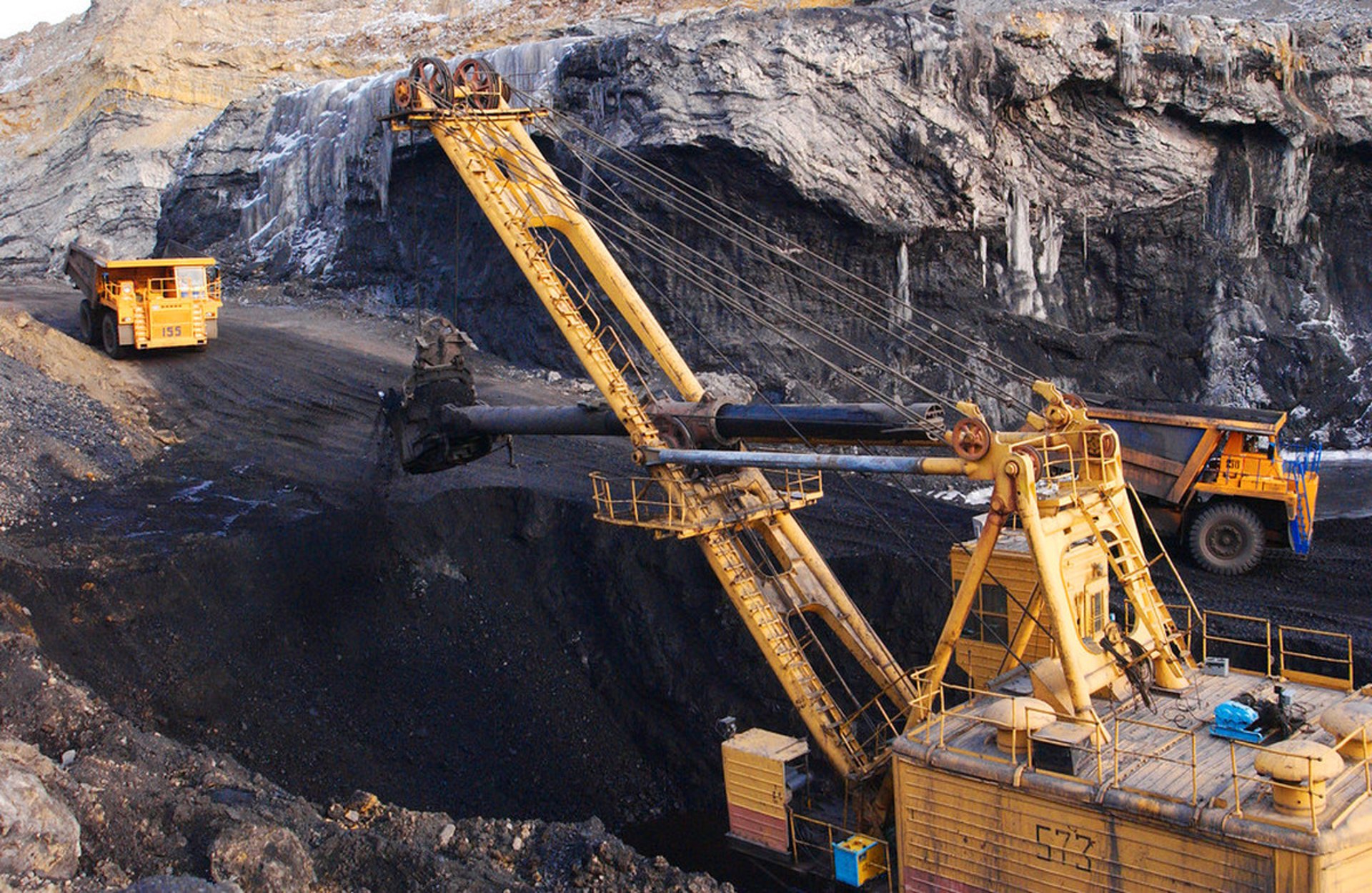
Underground mining in Indonesia represents one of the most challenging operational environments in the world. The nation’s vast mineral reserves—including thermal coal in South Sumatra and East Kalimantan, copper-gold in Batu Hijau, and nickel in Sulawesi—are located in regions characterized by high ambient humidity often exceeding 85%, year-round temperatures ranging from 25°C to 35°C, and significant exposure to sulfur-bearing gases, mineral oils, and abrasive rock particles. Within the mine workings itself, conditions become even more severe: confined spaces, constant movement of heavy machinery, repeated bending and dragging of power cables, and the ever-present risk of methane gas accumulation and dust explosions.
Trailing cables serve as the lifeline of every underground mining operation, delivering power to the equipment that extracts, transports and processes minerals. In Indonesian mines, however, standard industrial cables or generic mining cables frequently fail prematurely. Common issues include conductor breakage after only a few hundred bending cycles, insulation breakdown due to moisture ingress, outer sheath wear from contact with sharp rock, and electrical faults that can trigger safety incidents. For example, at a large coal mine in South Sumatra, operators reported that conventional trailing cables required replacement every six to eight months, leading to production losses of up to 12% annually and maintenance costs that exceeded the original purchase price of the cables multiple times over.
This is where BS 6708 PROTOMONT flexible trailing cables enter the picture. Developed by Prysmian Group, a global leader in energy and telecom cables, this series is designed specifically to address the unique and harsh demands of underground mining. Rated at 640/1100 V, with approvals including China MA certification and MSHA (Mine Safety and Health Administration) from the United States, these cables have become the preferred choice for major mining operations across Indonesia and Southeast Asia. This article provides a detailed examination of their design philosophy, material selection, engineering principles, performance advantages, and practical application, while also introducing Feichun Cables as a fully equivalent alternative that offers significant benefits in cost and delivery speed for Indonesian projects.
Standard Foundation – BS 6708: Safety-First, Condition-Driven Design Philosophy
Origins and Core Design Logic
The British Standard BS 6708 is not a generic specification developed for general industrial use. It is the product of more than a century of mining experience, built upon lessons learned from accidents, failures and operational challenges in underground mines worldwide. Every clause, every performance requirement and every material specification in BS 6708 originates from a real-world problem that needed to be solved. The core philosophy that guides the entire standard can be summarized in five key objectives: prevention of explosion, prevention of conductor breakage, prevention of electrical leakage, enabling easy fault monitoring, and ensuring long service life in harsh environments.
PROTOMONT cables are not simply modified versions of standard power cables. They were designed from the ground up, with every component and structural choice directly targeting the pain points that mining operators face daily. The design team started by identifying the critical failure modes in mining cables and then engineered solutions for each one. For example, the decision to place the earth conductor at the very center of the cable was not arbitrary—it addresses the number one safety risk in underground mining: explosion caused by electrical arcing. The selection of ethylene propylene rubber (EPR) for insulation was made to solve the problem of insulation degradation in humid and high-temperature conditions. Chloroprene rubber (CR) was chosen for the outer sheath because it is the only material that can simultaneously resist oil, fire, abrasion, weathering and remain flexible at low temperatures. Fine-stranded tinned copper conductors were specified to deliver both the flexibility needed for continuous movement and the corrosion resistance required in aggressive mine atmospheres. Finally, the integration of monitoring cores allows operators to detect insulation damage or faults before they develop into dangerous incidents.
This design approach—safety first, and every feature driven by actual operating conditions—sets PROTOMONT apart from cables that are adapted from other industries. It is a philosophy that aligns perfectly with Indonesian mining regulations and operational needs, where safety compliance and equipment reliability are top priorities.
Complete Technical Specifications
All PROTOMONT Type 7, 7M, 7S and 11 cables conform strictly to BS 6708, with additional compliance to BS 6360 for conductor construction and BS 7655 for insulation color coding. The full technical parameters, taken directly from the official product documentation, are as follows:
Electrical Parameters
Rated voltage: 640/1100 V (phase-to-ground / phase-to-phase)
Maximum permissible operating voltage AC: 0.7/1.2 kV
Maximum permissible operating voltage DC: 0.9/1.8 kV
AC test voltage: 3 kV (applied for 5 minutes during manufacturing)
Conductor resistance at 20°C: ranges from 1.24 Ω/km for 16 mm² down to 0.132 Ω/km for 150 mm²
Nominal operating capacitance: 0.51 µF/km to 0.85 µF/km depending on cross-section
Nominal inductance: 0.26 mH/km to 0.35 mH/km
Current carrying capacity: 99 A for 16 mm² up to 404 A for 150 mm²
Short-circuit current rating: 1.95 kA to 21.45 kA based on conductor size
Thermal Parameters
Maximum continuous conductor temperature: 90°C
Maximum short-circuit conductor temperature (duration ≤ 5 seconds): 250°C
Ambient temperature range for fixed installation: -40°C to +80°C
Ambient temperature range for fully flexible operation: -25°C to +60°C
This temperature range is particularly well-suited to Indonesia, where underground temperatures rarely exceed 40°C, and the minimum temperature requirement of -25°C covers all high-altitude mining areas in the archipelago.
Mechanical Parameters
Maximum permissible tensile load: 15 N/mm² of conductor cross-section
Minimum bending radius: 12 times the overall outer diameter (per DIN VDE 0298)
Overall diameter range: 30.9 mm to 74 mm depending on type and size
Weight range: 1920 kg/km to 11450 kg/km
Chemical and Environmental Parameters
Fire resistance: meets EN 60332-1-2 and IEC 60332-1-2 (single cable non-propagation of fire)
Oil resistance: complies with EN 60811-404 and IEC 60811-404, with no significant degradation or swelling after immersion
Weather resistance: suitable for indoor and outdoor use, resistant to ozone, moisture, ultraviolet radiation and biological growth
Conductor Construction
Class 5 finely stranded copper conductor, tinned for corrosion protection, manufactured according to BS 6360
Maximum conductor diameter: 5.2 mm (16 mm²) to 16.6 mm (150 mm²)
Application and Typical Working Conditions
PROTOMONT cables are designed for dual use: fixed installation where cables are routed along tunnels or mounted on structures, and continuous flexible operation where cables are moved, dragged, bent and repositioned as mining equipment advances. This dual capability makes them extremely versatile.
Type 7 serves as the standard universal model, featuring three power cores, one central earth core and one monitoring core. It is the most widely used version, suitable for 90% of mining applications in Indonesia, including longwall shearers, roadheaders, crushers, belt conveyors and cable handler systems. It balances performance, durability and cost-effectiveness perfectly.
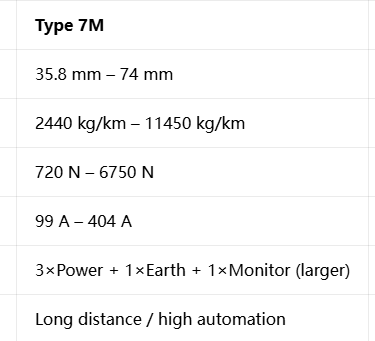
Type 7M is an enhanced version with larger cross-section monitoring cores. This design reduces electrical resistance in the monitoring circuit, making it ideal for long-distance power supply applications exceeding 500 meters, as well as highly automated mines where precise fault detection and signal transmission are critical. In mines in East Kalimantan with extended working faces, Type 7M has become the preferred choice due to its stable monitoring performance over long distances.
Type 7S integrates three control cores in place of the single monitoring core found in Type 7. This creates a multi-function cable that delivers power, control signals and communication signals all in one assembly. For modern smart mines in Indonesia, such as those applying automated remote control systems, Type 7S eliminates the need for separate power and control cables, reducing installation complexity, lowering the number of joints and connection points, and minimizing potential failure locations.
Type 11 is a lightweight, economical variant that omits the monitoring core entirely. It features a copper/nylon braid earth conductor and a simplified structure. It is best suited for shuttle cars, loaders and other mobile equipment that operate in less hazardous zones or where monitoring is not required. Its smaller diameter and lower weight make it easier to handle and move, while its lower cost provides significant savings for non-critical applications.
Across all types, the cables are engineered to perform reliably in conditions that would quickly damage standard cables: constant contact with sharp rock edges, exposure to hydraulic fluids and lubricants, immersion in water or slurry, and operation in areas with high levels of dust and vibration.
Material Science – Precision Selection Based on Physics and Chemistry
The performance of PROTOMONT cables is not the result of chance or generic material choices. Every component material was selected through rigorous scientific analysis, based on how its physical and chemical properties match the specific demands of underground mining. There is no compromise, and every selection follows clear principles of material science.
Conductor: Tinned Fine-Stranded Copper (Class 5)
The conductor is the heart of the cable, responsible for carrying electrical current while surviving repeated mechanical stress. PROTOMONT uses Class 5 finely stranded copper conductors, with every individual strand coated in a layer of tin.
From a mechanical perspective, fine stranding is essential. A solid or coarsely stranded conductor will break quickly when bent repeatedly, as stress concentrates at a small number of points. By using many very fine strands with a diameter of less than 0.2 mm, the stress is distributed across thousands of individual wires. When the cable bends, each strand moves slightly relative to its neighbors, resulting in very low individual strain. This design increases bending fatigue life by up to 10 times compared to standard conductors—a critical factor for cables that move thousands of times during their operational life.
The tin coating serves two vital purposes. First, it provides excellent corrosion resistance. In Indonesian mines, the atmosphere often contains sulfur compounds, moisture and acidic vapors that would cause bare copper to oxidize and degrade rapidly, increasing electrical resistance and eventually leading to failure. Tin is chemically stable in these environments, forming a protective barrier that preserves the conductor’s integrity for decades. Second, tin prevents the strands from sticking together or oxidizing at contact points, ensuring consistent conductivity even after years of movement.
Electrically, copper was chosen for its high conductivity, and the Class 5 design ensures that AC resistance remains low even at higher frequencies, minimizing power loss and heat generation. This combination of flexibility, corrosion resistance and low electrical resistance makes tinned fine-stranded copper the optimal choice for mobile mining equipment.
Insulation: PROTOLON (Ethylene Propylene Rubber – EPR)
Insulation must separate live conductors from each other and from earth, while withstanding high voltage, heat, moisture and mechanical stress. PROTOMONT uses PROTOLON, a proprietary formulation based on cross-linked ethylene propylene rubber (EPR), colored according to BS 7655 for easy identification: red, yellow and brown for power cores, blue for monitoring or control cores.
EPR was selected because it is the only material that satisfies all requirements simultaneously. Electrically, it has a very low dielectric constant of approximately 2.4 and extremely high insulation resistance exceeding 10¹² Ω·km. This means it can maintain perfect electrical separation even when fully saturated with water—a common condition in Indonesian mines where water inflow is constant. Unlike polyethylene or PVC, EPR does not suffer from water treeing, a degradation mechanism that causes insulation failure in wet environments. It also has high dielectric strength, greater than 20 kV/mm, and very low partial discharge levels, ensuring stable performance at the rated voltage of 1100 V.
Thermally, EPR operates continuously at 90°C, significantly higher than PVC or rubber compounds, allowing higher current carrying capacity without overheating. Its molecular structure remains stable at these temperatures, and it does not become brittle or soft excessively even at temperature extremes.
Mechanically, EPR is highly elastic with a low modulus of elasticity. It stretches and recovers without damage, and it does not crack when bent or flexed—essential for a cable that moves constantly. Unlike thermoplastics, EPR does not flow or deform under load.
Chemically, EPR is resistant to ozone, which is present in mine air and attacks many polymers, as well as to acids, alkalis and mine water. Its saturated polymer structure gives it excellent long-term aging resistance, allowing it to perform reliably for 10 years or more.
In short, EPR matches both the electrical and mechanical requirements of mining perfectly, making it the only logical choice for insulation.
Phase Screen: Copper/Nylon Composite Braid
Each power core is individually screened with a braid made from a combination of tinned copper and nylon fibers, with a coverage rate of at least 85%. This screening layer is not found in standard cables and is a key safety feature.
Electrically, the screen functions as an electrostatic shield. It confines the electric field generated by the current within the core itself, preventing interference with monitoring and control signals, and also protecting the cable from external interference from variable frequency drives or other equipment. More importantly, it creates a fault detection system. If insulation is damaged, the screen layer will make contact with the live conductor, creating a measurable change in electrical parameters that can be detected by monitoring equipment. This allows operators to identify and locate faults before they become dangerous. The screen also ensures that all conductive parts are at equal potential, eliminating the risk of sparking or arcing between different components.
Mechanically, the nylon fibers are integrated into the braid to increase tensile strength and abrasion resistance. Pure copper braid would be fragile and prone to breaking when the cable is dragged or bent. By combining copper with nylon, the screen remains flexible and durable, providing protection without compromising the cable’s movement capabilities.
Outer Sheath: PROTOFIRM (Chloroprene Rubber – CR)
The outer sheath is the cable’s first line of defense against the external environment, and it is the component that determines how long the cable will survive in harsh conditions. PROTOMONT uses PROTOFIRM, a special compound based on chloroprene rubber (CR), also known as neoprene, with added carbon black, anti-aging agents and flame retardants. It is black in color, a standard choice for mining applications due to its high visibility against rock and soil.
CR is unique because it is the only material that satisfies all the conflicting requirements of mining applications simultaneously. It is often described as having the best balance of all properties.
For oil resistance, CR has a polar molecular structure. Mineral oils and hydraulic fluids are non-polar, and according to the principles of solubility, polar materials do not dissolve or swell in non-polar liquids. This means that even when submerged or constantly exposed to oil, the sheath material will not soften, swell or degrade, maintaining its protective function. This is a critical advantage in mines where hydraulic equipment is used extensively.
For fire resistance, CR contains chlorine atoms in its molecular chain. When exposed to flame, it releases hydrogen chloride gas, which is non-flammable and acts as a barrier, displacing oxygen and suppressing combustion. This gives it excellent self-extinguishing properties, meeting the strict requirements of EN 60332-1-2. It also has a high oxygen index, meaning it requires a higher concentration of oxygen to burn than is present in normal air.
For mechanical performance, CR has high tensile strength, excellent tear resistance and outstanding abrasion resistance. It is hard enough to resist cutting and wear from sharp rock, yet flexible enough to bend easily even at low temperatures down to -40°C. Its resistance to cutting and abrasion is three times higher than natural rubber or standard synthetic rubbers, which explains why PROTOMONT cables last so much longer in service.
For environmental resistance, CR is highly resistant to ozone, ultraviolet radiation, moisture and weathering. Its molecular structure is stable and does not degrade or crack over time, even when exposed to the high humidity and intense sunlight found in Indonesian mining regions. It also resists biological attack, such as fungal growth, which is common in tropical environments.
There is no other single material that can match this combination of properties. Other materials may be oil resistant but not flexible, or flame retardant but not weather resistant. CR is the only complete solution.
Core Arrangement and Earth Conductor
The way the cores are arranged inside the cable is as important as the materials used. PROTOMONT features a unique design where the bare, tinned copper earth conductor is placed exactly at the center, and all power, monitoring and control cores are laid up symmetrically around it.
Electrically, the central earth conductor provides the shortest possible path to ground. In the event of a fault, fault current flows immediately to earth, ensuring that all conductive parts remain at zero potential. This eliminates the risk of dangerous voltage appearing on the cable surface and prevents arcing—directly addressing the primary cause of mine explosions.
Mechanically, the central earth acts as a structural spine. Because all other cores are arranged symmetrically around it, the cable is perfectly balanced. When the cable is bent, stretched or twisted, the forces are distributed equally around the center. This creates a state of equal stress distribution, meaning no single part of the cable bears excessive load. This design prevents twisting, bulging, deformation and core breakage, extending the operational life by approximately 10 times compared to cables with asymmetric core arrangements.
The use of bare tinned copper ensures perfect electrical contact with all surrounding cores and screens, and it resists corrosion just like the power conductors.
Structural Design and Engineering Principles – Why Built This Way?
Every structural feature of PROTOMONT cables is the result of careful engineering analysis, based on fundamental principles of mechanics, electrical engineering and materials science. There are no arbitrary choices; every detail exists to solve a specific problem or achieve a specific performance goal.
Complete Structure from Inside Out
Taking Type 7 as the standard example, the complete construction is as follows:
Center: Bare tinned copper earth conductor, Class 5 stranded, no insulation.
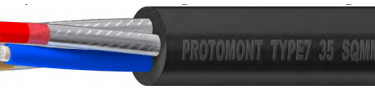
Power Cores (3 units): Each core consists of a Class 5 tinned copper conductor, PROTOLON EPR insulation, and a copper/nylon composite screen. Colors: Red, Yellow, Brown.
Monitoring Core (1 unit): Class 5 tinned copper conductor, PROTOLON EPR insulation. Color: Blue.
Filling: Elastic rubber compounds are used to fill all gaps between cores, creating a round, compact assembly.
Binding Tape: A layer of non-woven polyester tape is applied to hold the assembly together and maintain shape.
Outer Sheath: PROTOFIRM CR compound, extruded tightly over the core assembly, providing the final protective layer.
Type 7M follows the same structure but with a larger cross-section monitoring core. Type 7S replaces the single monitoring core with three control cores of appropriate size. Type 11 omits the monitoring core and uses a copper/nylon braid for the central earth conductor.
Engineering Principles Explained
Symmetric Lay-Up and Central Load-Bearing
The principle of symmetric design is fundamental to mechanical engineering. In any structure, if loads are distributed evenly, stress is minimized, and strength and durability are maximized. In PROTOMONT, the central earth conductor serves as the neutral axis. When the cable is bent, the cores on the outside of the bend stretch slightly, while those on the inside compress. Because the layout is perfectly symmetric, these forces balance each other out. There is no net torque or twisting force, and the cable returns to its original shape when released.
This design is why PROTOMONT can withstand more than 10,000 bending cycles without damage, while standard cables with offset cores fail after only a few hundred movements. It also ensures that the cable maintains its round shape and does not develop flat spots or bulges, which would accelerate wear and cause jamming in cable handler systems.
Shield, Earth and Monitoring: Triple Safety Protection
The electrical design of PROTOMONT creates a three-layer safety system that moves beyond simple protection to active prevention.
Shielding: Each core is enclosed in a conductive screen. This contains the electric field and ensures that no voltage can reach the outer surface. It also ensures that any insulation damage is immediately detected, as the screen provides a conductive path for fault current.
Central Earth: Provides a low-resistance path to ground. In the event of any fault, current flows instantly to earth, tripping protection devices and removing power before dangerous conditions can develop. It ensures that all conductive parts remain at zero potential at all times.
Monitoring: The dedicated monitoring core works with the screen and earth to create a continuous health monitoring system. Operators can measure insulation resistance, detect conductor breakage or identify earth faults in real time. This transforms safety from a passive feature—relying on the cable not to fail—to an active process—identifying risks and taking action before an incident occurs.
This triple protection system is the primary reason why PROTOMONT is approved for use in the most hazardous mining areas in Indonesia, where safety regulations are strict and non-negotiable.
Material Matching: Thermal Expansion and Elastic Modulus
A common failure point in cables is delamination or separation between layers. This happens when materials expand or contract at different rates as temperature changes, or when they have different stiffness. For example, if a stiff insulation is bonded to a flexible conductor, bending or temperature change will create shear stress at the interface, eventually causing separation and failure.
PROTOMONT engineers carefully matched the thermal expansion coefficients and elastic modulus of every layer. The conductor, insulation, screen and sheath are designed to expand and contract at nearly identical rates as temperature rises or falls. Similarly, their stiffness is graded progressively: the conductor is flexible, the insulation is slightly stiffer, and the sheath is tougher but still flexible. This creates a system where all layers move together, with no internal stress, no delamination and no formation of air gaps that could lead to electrical breakdown.
This attention to material compatibility is a key factor in the cable’s long service life and reliability.
Differences and Connections Between Types
All four types share the same high standards, materials and core design principles, but they differ in core configuration to suit different operational needs.
Type 7 is the foundation model. It offers the complete set of features: power, earth and monitoring. It is the standard against which others are measured.
Type 7M is a performance upgrade. The only difference is the increased cross-section of the monitoring core. This reduces electrical resistance, making signal transmission more reliable over long distances and in high-noise environments. It is fully compatible with Type 7 in all other aspects.
Type 7S is a functional upgrade. It replaces the single monitoring core with three control cores. This allows the cable to carry power, control signals and communication signals simultaneously. It is the ideal choice for modern mines seeking to reduce the number of cables installed, simplify logistics and improve system reliability.
Type 11 is an economy version. It removes the monitoring core and simplifies the earth conductor design. It is smaller, lighter and cheaper, while retaining the same high-quality materials and mechanical strength. It is designed for applications where monitoring is not required or where cost is a primary consideration.
All types share the same voltage rating, temperature range, mechanical strength and material quality. The differences are purely functional, allowing operators to select exactly the right configuration for their specific application without compromising on quality or safety.
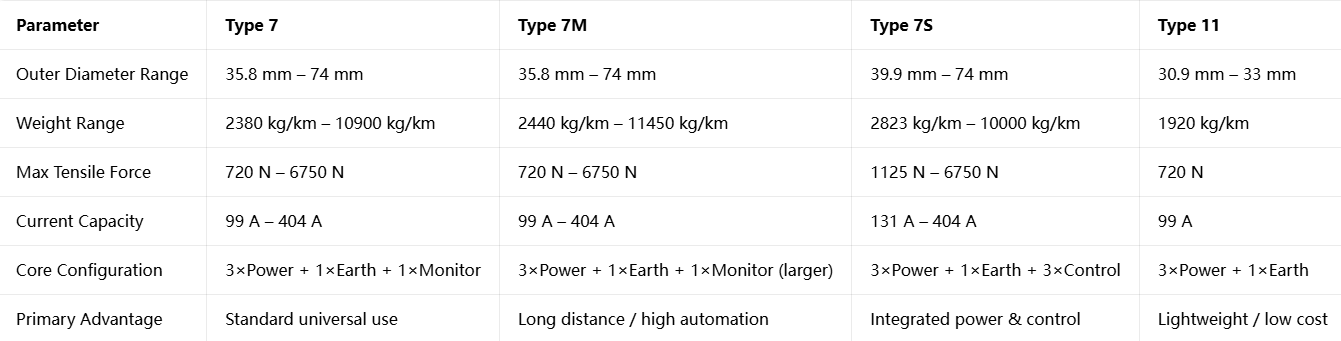
Performance Comparison
The following comparison highlights the key differences in specifications:
Competitive Advantages – Solving Problems Ordinary Cables Cannot
To understand the true value of PROTOMONT cables, it is necessary to compare them with the standard mining cables commonly used in Indonesia. The differences are not just in specifications, but in how they perform in real-world conditions and the problems they solve.
Pain Points of Standard Mining Cables
Conventional cables suffer from several fundamental limitations that make them unsuitable for the demanding conditions found in Indonesian mines:
Conductor Breakage: Most standard cables use coarser stranding or less flexible materials. They typically fail after 500 to 1000 bending cycles, requiring frequent replacement and causing unplanned downtime.
Safety Risks: Many lack proper screening or monitoring. Insulation damage often goes undetected until a fault occurs, creating risks of electric shock, fire or explosion—especially dangerous in gassy mines.
Short Service Life: Outer sheaths are often made of standard rubber or PVC. These materials wear out quickly, degrade in oil or sunlight, and become brittle in low temperatures. In Indonesia, their service life is often less than one year.
High Total Cost: While the initial purchase price is lower, the cost of frequent replacement, labor for installation, production loss and maintenance accumulates to many times the original cost.
Poor Environmental Resistance: Standard cables often fail due to moisture ingress, ozone attack or chemical degradation, particularly problematic in the tropical climate.
Unique Advantages of PROTOMONT
Flexibility and Strength – The Perfect Balance
The most distinctive feature of PROTOMONT is that it is both extremely flexible and exceptionally strong. Standard cables are usually either flexible but weak, or strong but stiff. PROTOMONT achieves this balance through the combination of fine-stranded copper, elastic EPR insulation and high-performance CR sheath.
In practice, this means a PROTOMONT cable will last 3 to 5 times longer than a standard cable. At a coal mine in South Sumatra, operators reported that after switching to Type 7, cable replacement frequency dropped from every 7 months to every 4 years. This reduction in maintenance alone saves millions of dollars annually for large operations.
Safety and Early Warning – Zero Accident Target
The triple safety system is a feature that standard cables simply cannot match. By integrating screening, central earth and monitoring, PROTOMONT moves safety from a theoretical concept to a practical, daily reality. It allows maintenance teams to identify potential failures before they become dangerous, reducing the risk of electrical incidents to near zero. This aligns perfectly with Indonesian mining safety regulations and helps operators meet strict compliance requirements.
All-Weather Stability – Built for Indonesia
No other cable series is as well adapted to Indonesia’s specific climate. The combination of EPR insulation and CR sheath creates a system that is immune to high humidity, resistant to oil and chemicals, unaffected by high temperatures, and stable under intense sunlight. It performs equally well in the wet coastal mines of Sumatra and the drier, high-altitude mines of Papua. It does not degrade, swell or crack, maintaining its performance level from the day it is installed until the end of its service life.
Lower Total Cost of Ownership
While the initial purchase price of PROTOMONT is higher than generic cables, the total cost of ownership is significantly lower. When calculating the full cost—including purchase, installation, maintenance, replacement and production loss—PROTOMONT is often 40% to 60% cheaper over a 10-year period. It is an investment that pays back many times over.
Feichun Brand – Equivalent Alternative
As global demand for high-quality mining cables grows, and lead times from European manufacturers extend, Feichun Cables has emerged as a leading alternative, offering fully equivalent products that meet the exact same standards and specifications as the original PROTOMONT series. For Indonesian mining companies, Feichun represents an opportunity to access world-class quality with significant commercial advantages.
Why Feichun is 100% Equivalent
Feichun produces its Type 7, 7M, 7S and 11 cables strictly according to BS 6708, with full compliance to all related standards including BS 6360, BS 7655, EN 60332 and EN 60811. The equivalence is not superficial; it is complete and verifiable in every aspect:
Standard Compliance: Every parameter, from voltage rating to bending radius, matches exactly the requirements of the British Standard and the original product specifications.
Material Matching: Feichun uses identical material specifications. Conductors are Class 5 tinned copper. Insulation is cross-linked EPR with the same electrical and mechanical properties. Screens are copper/nylon composite braid. Outer sheaths are CR compound with the same formulation for oil, fire and weather resistance.
Certifications: Feichun cables carry the same approvals, including China MA certification and MSHA recognition, making them fully accepted and approved for use in Indonesian mines.
Performance Data: Electrical characteristics, thermal ratings, mechanical strength and chemical resistance are identical. Current carrying capacity, short-circuit performance and temperature ratings are exactly the same, allowing direct interchangeability without any changes to design or operation.
Construction: The structural design—central earth, symmetric lay-up, screening and core configuration—is identical.
Feichun cables are tested using the same methods and criteria as the original brand, and they meet or exceed every performance requirement.
Key Advantages Over the Original Brand
While quality and performance are identical, Feichun offers significant advantages that are highly valuable to Indonesian mining projects:
Competitive Pricing: By manufacturing locally and managing the supply chain efficiently, Feichun offers prices that are 25% to 40% lower than the original brand. This represents a substantial cost saving for large projects, without any compromise in quality.
Shorter Delivery Time: Importing cables from Europe typically involves lead times of 8 to 12 weeks. Feichun maintains production facilities and regional stock, delivering orders within 2 to 4 weeks. This speed is critical for mine expansion projects or emergency replacements, where delays can cost thousands of dollars per day in lost production.
Local Support: Feichun has established a network of agents and technical support teams across Indonesia. This ensures that customers have access to technical advice, installation guidance and after-sales service in local time zones and languages.
Flexible Production: Feichun can accommodate custom lengths and special packaging requirements, which is often difficult with large multinational manufacturers.
Local Success Stories
Feichun’s equivalent cables have already been successfully adopted by major mining companies in Indonesia. At PT Bukit Asam, one of the largest coal producers in the country, Feichun Type 7 cables were installed as a direct replacement. After two years of operation, performance data showed no difference in reliability or durability compared to the original product, while the project saved 32% on cable costs. At Kaltim Prima Coal, Feichun Type 7S cables were selected for a new automated longwall project, delivering the required multi-function capability with a delivery time that was 6 weeks faster than competing offers.
Selection Guide and Practical Procurement
Choosing the right cable type and specification is critical to achieving optimal performance and value. The following guide provides a clear framework for selection and procurement.
Step-by-Step Selection
Identify Equipment Type:
Shearers, longwall faces and heavy-duty applications → Type 7 (standard choice) or Type 7M (if distance > 500 m or high automation).
Automated systems, remote control operations or where separate control cables are impractical → Type 7S.
Shuttle cars, loaders, auxiliary equipment or cost-sensitive applications → Type 11.
Determine Power Requirements:
Calculate the full load current of the equipment. Use the current carrying capacity table to select the appropriate cross-section. Always consider future expansion and voltage drop.
Ensure that the short-circuit current rating exceeds the maximum possible fault current in the system.
Evaluate Environmental Conditions:
All types are suitable for humid, oily and high-temperature environments common in Indonesia.
For very low-temperature high-altitude mines, all types meet the -25°C minimum requirement for flexible operation.
Check Installation Constraints:
Verify that the cable diameter and weight are compatible with cable handler systems and handling equipment.
Confirm that the minimum bending radius can be maintained in the installation layout.
Technical Data Reference
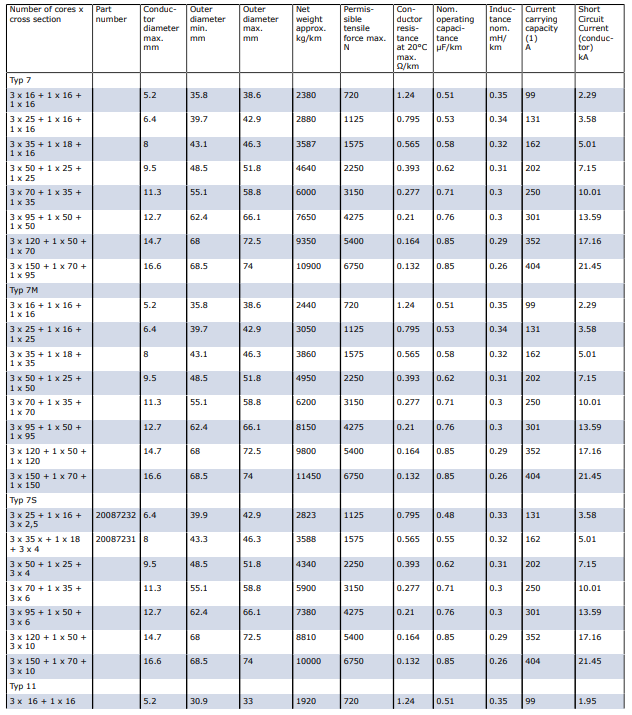
The full specification table, derived directly from the product documentation, provides the necessary data for engineering design:
For Type 7:
3×16+1×16+1×16: Diameter 35.8–38.6 mm, Weight 2380 kg/km, Current 99 A, Short-circuit 2.29 kA
3×25+1×16+1×16: Diameter 39.7–42.9 mm, Weight 2880 kg/km, Current 131 A, Short-circuit 3.58 kA
3×35+1×18+1×16: Diameter 43.1–46.3 mm, Weight 3587 kg/km, Current 162 A, Short-circuit 5.01 kA
3×50+1×25+1×25: Diameter 48.5–51.8 mm, Weight 4640 kg/km, Current 202 A, Short-circuit 7.15 kA
3×70+1×35+1×35: Diameter 55.1–58.8 mm, Weight 6000 kg/km, Current 250 A, Short-circuit 10.01 kA
3×95+1×50+1×50: Diameter 62.4–66.1 mm, Weight 7650 kg/km, Current 301 A, Short-circuit 13.59 kA
3×120+1×50+1×70: Diameter 68–72.5 mm, Weight 9350 kg/km, Current 352 A, Short-circuit 17.16 kA
3×150+1×70+1×70: Diameter 68.5–74 mm, Weight 10900 kg/km, Current 404 A, Short-circuit 21.45 kA
Type 7M follows the same dimensions and current ratings, with increased weight and tensile strength due to larger monitoring cores. Type 7S and Type 11 specifications are detailed in the product data sheet, reflecting their specific core configurations.
Procurement Checklist
When placing an order, ensure the following details are clearly specified to avoid errors:
Standard: BS 6708
Type: 7, 7M, 7S or 11
Core configuration and cross-section (e.g., 3×35+1×18+1×16)
Rated voltage: 640/1100 V
Length required
Certification requirements
Delivery location and schedule
Working with a supplier like Feichun ensures that all specifications are correctly interpreted and delivered
Frequently Asked Questions
Q: Are these cables suitable for use in gassy mines in Indonesia?
A: Yes. All types are designed and tested to meet strict safety standards. The central earth conductor, individual core screening and monitoring system eliminate the risk of arcing or sparking, making them safe for use in areas classified as hazardous due to methane or coal dust. They are fully compliant with Indonesian mining safety regulations.
Q: Can Feichun cables be used as a direct replacement for the original brand?
A: Absolutely. Feichun cables are manufactured to the exact same standard, dimensions, materials and performance levels. They are physically and electrically interchangeable, and no changes to installation or protection settings are required. They carry the same international certifications.
Q: What is the expected service life in Indonesian conditions?
A: With proper installation and use, service life is typically 8 to 10 years, significantly longer than standard cables. This is due to the superior resistance of EPR and CR materials to the tropical environment, as well as the robust structural design.
Q: Can Type 7S really replace separate power and control cables?
A: Yes. Type 7S integrates both functions in one assembly. This reduces the total number of cables required, simplifies installation, reduces the number of connections and joints, and lowers the risk of failure. It is widely used in modern automated mines.
Q: What is the minimum bending radius I must follow?
A: The minimum bending radius is 12 times the overall outer diameter of the cable. This must be observed during installation and operation to prevent damage to conductors, insulation or screening.
Q: How do I choose between Type 7 and Type 7M?
A: Choose Type 7 for standard applications up to 500 meters. Choose Type 7M if the cable run is longer than 500 meters, or if you are using advanced monitoring systems or automation where signal integrity is critical.
Conclusion: The Best Investment for Indonesian Mining
BS 6708 PROTOMONT Type 7, 7M, 7S and 11 flexible trailing cables represent the pinnacle of mining cable technology. Their design, built on a century of experience and driven by safety and operational requirements, addresses every challenge found in underground mining. The precise selection of materials—tinned copper, EPR insulation and CR sheath—creates a product that is scientifically optimized for performance, durability and safety. The engineering principles applied—symmetric design, central load-bearing, triple safety protection and material matching—ensure that every component works together perfectly.
For Indonesian mining operations, these cables are not just a purchase; they are a strategic investment. They deliver reliability in the harshest tropical conditions, safety in hazardous environments, and economy through long life and low maintenance. The introduction of Feichun Cables as an equivalent alternative makes this world-class technology more accessible, offering identical quality at a lower cost and with faster delivery.
Selecting the right type—Type 7 for general use, Type 7M for long distances, Type 7S for smart mines, or Type 11 for economy—allows every operator to tailor the solution to their exact needs. In an industry where downtime and safety incidents carry enormous costs, PROTOMONT cables are the benchmark that ensures operations run smoothly, safely and profitably.
If you need to purchase BS 6708 Type 7, 7M, 7S or 11 flexible trailing cables, or require technical consultation and custom solutions for your mining operations in Indonesia, please contact the Feichun Cables team.
Email: Li.wang@feichuncables.com
Feichun Cables provides professional technical support, fast delivery and full compliance with international standards, ensuring you receive the best value and performance for your investment.

Feichun Cable
Durable mining cables for tough environments and operations
Email: Li.wang@feichuncables.com
© 2025. All rights reserved.
Company
Products
Contact
WhatsApp: +86 17333223430