Anhui Feichun Special Cable Co.,Ltd


Why Type 441 Class 1 Cable Is Extremely Important for the Epiroc Boomer E3 at Mines in Indonesia
Learn why Type 441 Class 1 Cable is highly suitable for the Epiroc Boomer E3 in Indonesian mines — flexible, wear‑resistant, and safe for underground operation. The best choice for engineers and procurement professionals in the mining industry.
Li Wang
3/30/20266 min read
Introduction
The Indonesian mining industry continues to grow despite global challenges in 2025. Coal production reached a record 836 million tonnes in 2024, but contracted by around 0.66% throughout 2025 due to weakening export demand from China and India. On the other hand, the underground mining sector is becoming increasingly strategic.
The transition from open‑pit mining to underground mining, as undertaken by companies like PT Freeport Indonesia with potential resources of 3 billion tonnes of copper and gold ore, is a key trend to maintain sustainable production.
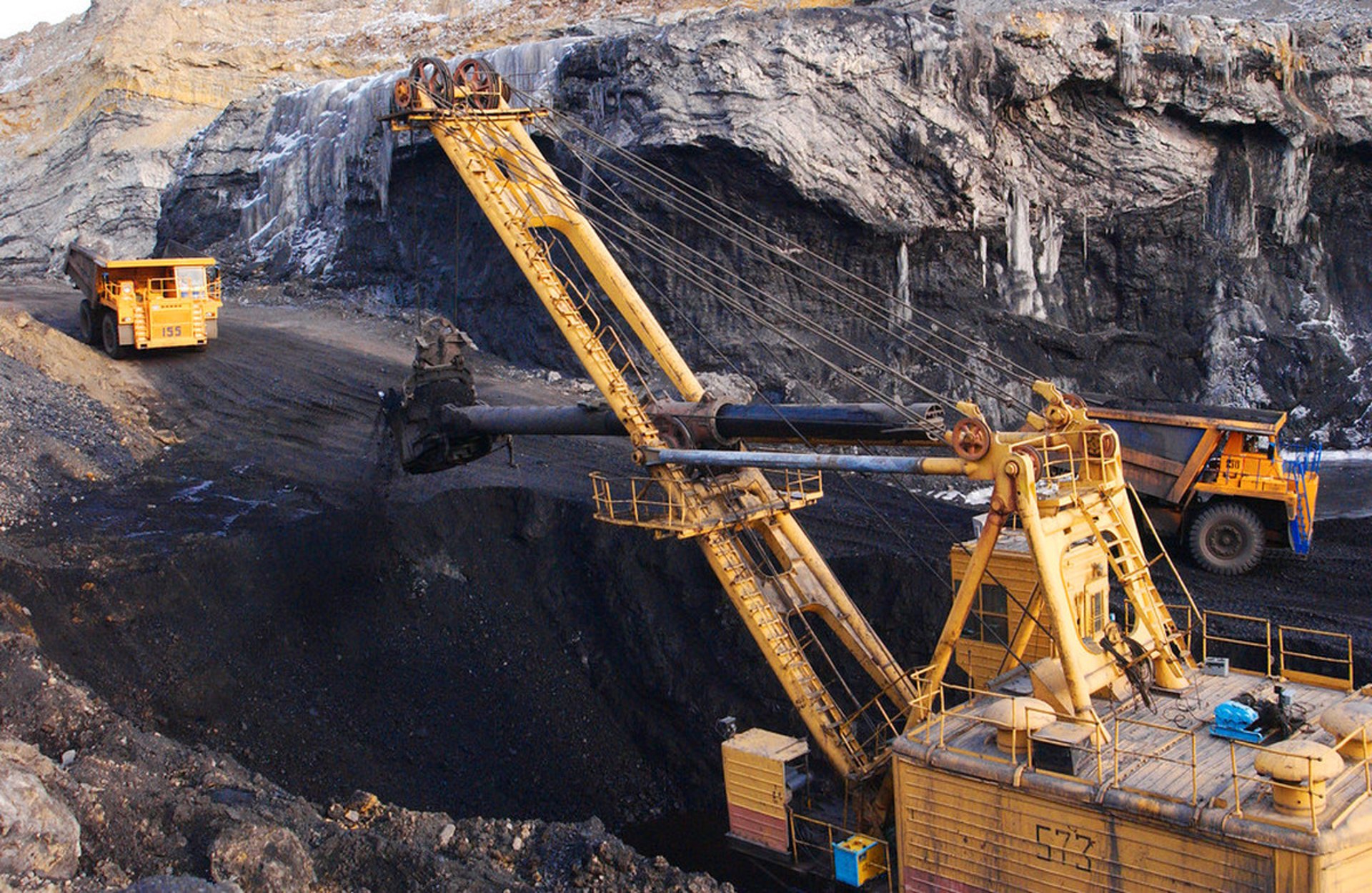
Underground operations in Indonesia face extreme working environments: high vibration from blasting and drilling, fine dust accumulation, relative humidity reaching 80–90% due to the tropical climate, and hard rock formations such as porphyry copper and nickel laterite in Sulawesi and Papua. These conditions not only test the durability of mechanical equipment but also electrical systems — in particular power supply cables that must move dynamically with the rig.
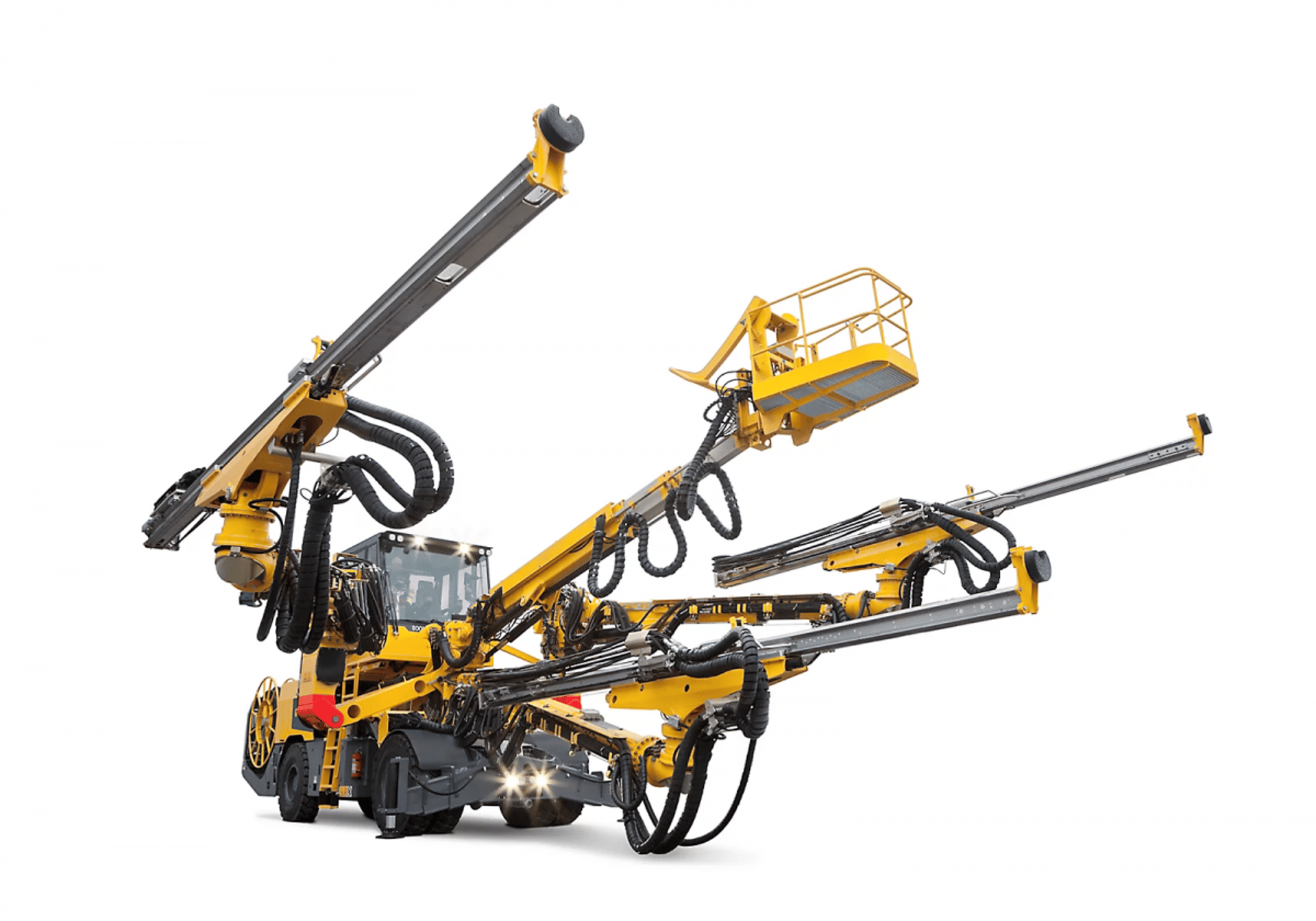
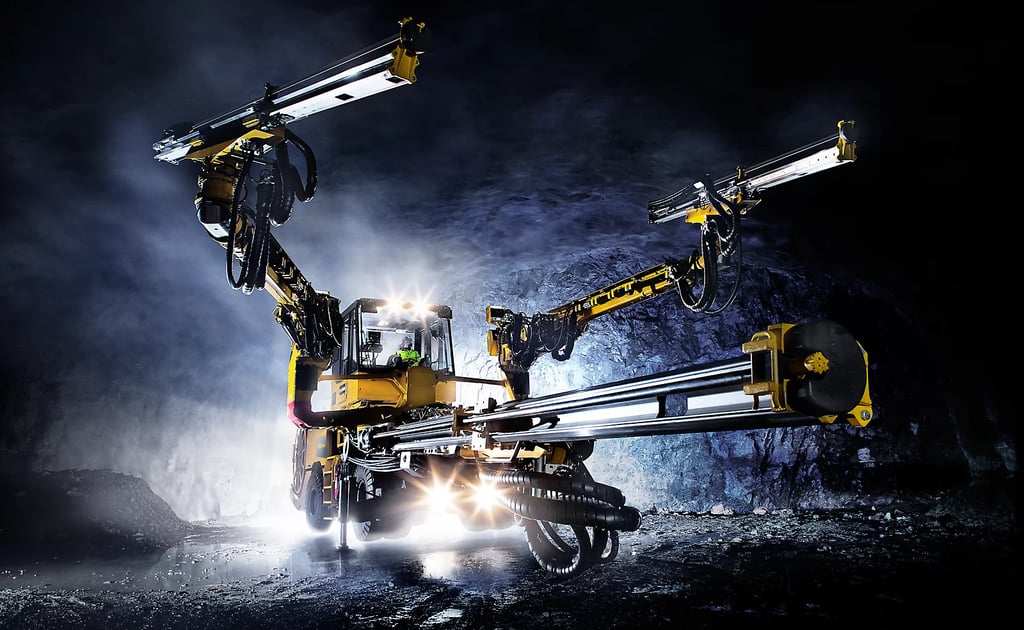
This is where the Epiroc Boomer E3 (including XE3 and WE3 variants) excels. This face drill hydraulic rig is designed for tunnels and drifts with coverage up to 198 m². Equipped with a heavy‑duty BUT 45 boom, intelligent RCS 5 control system, and hydraulic rock drills with 16–40 kW power, the Boomer E3 can achieve high drilling accuracy, reduce overbreak, and support high productivity in hard rock.
The crucial question for engineers, technical managers, and procurement decision‑makers in Indonesian mines is: Why is choosing the correct mining cable such as Type 441 Class 1 critical to the performance and safety of the Epiroc Boomer E3? This cable is not just a conductor of electricity — it is a critical component that determines rig uptime, long‑term operational cost, and electrical safety in hazardous underground environments.
This article will deeply review the technology of Type 441 Class 1 cables, their suitability for the Boomer E3, and their practical value in Indonesian mines — serving as a reference guide for cable dealers, suppliers, and rig operators.
Overview of Type 441 Class 1 Cable:
Type 441 Class 1 is a flexible mining cable built to Australian/New Zealand standards (AS/NZS), specifically designed for trailing (pulling) and reeling applications on mobile equipment like drill rigs, shovels, and draglines. These cables are available for voltage ratings from 3.3/3.3 kV up to 22/22 kV, making them ideal for high‑power electric rigs like the Boomer E3 that require stable 380–1000 V supply.
Standards met include:
AS/NZS 2802:2000 (reeling & trailing cable construction)
AS/NZS 1125 (conductor)
AS/NZS 3808 (insulation & sheathing)
AS/NZS 5000.1 (electrical cable requirements)
The main advantage of Class 1 over Class 2 is thinner insulation and sheath that are still “extra heavy‑duty.” The result: cables are lighter, more flexible, and easier to wind on the 1,600 mm diameter reels used by the Boomer E3 — without sacrificing mechanical durability.
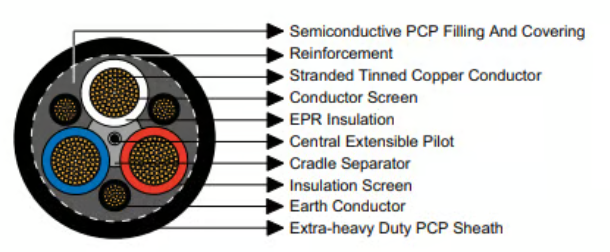
Cable Structure in Detail
Conductor:
Flexible stranded tinned annealed copper (high flexibility Class 5). Tinning prevents oxidation in humid underground mining environments.Conductor Screen:
Semiconductive compound (for ≥3.3 kV) — equalizes electric field and prevents partial discharge.Insulation:
EPR (Ethylene Propylene Rubber) with a semiconductive elastomer screen. EPR resists temperatures from −25°C to +90°C, oil, water, and ozone — ideal for the high humidity in tunnel environments.Cradle Separator & Overall Core Screen:
Semiconductive PCP (Polychloroprene) — the “heart” of Type 441 design: the cradle supports and protects the three power cores so the cable resists crushing and squashing during winding or under heavy equipment.Earth Conductor:
Three flexible interstitial earth conductors with semiconductive PCP covering — providing low‑resistance grounding pathways, crucial for the earth fault detection system on the Boomer E3’s RCS 5.Pilot Conductor:
One central extensible EPR‑covered core — used for monitoring and control signals, supporting intelligent rig protection systems.Textile Reinforcement:
Open‑weave braid (often polyamide yarn) — enhances tensile and abrasion resistance.Sheath:
Extra‑heavy‑duty PCP (or optional CPE/CSP) — wear, fire, UV, and chemical resistant. Standard black for low visibility in dark tunnels.
This structure makes Type 441 Class 1 significantly superior to ordinary cables. The semiconductive PCP cradle design reduces mechanical damage risk by up to 50% compared to designs without a cradle, while the pilot core enables real‑time grounding monitoring — aligning with the Boomer E3’s earth fault indicator technology.
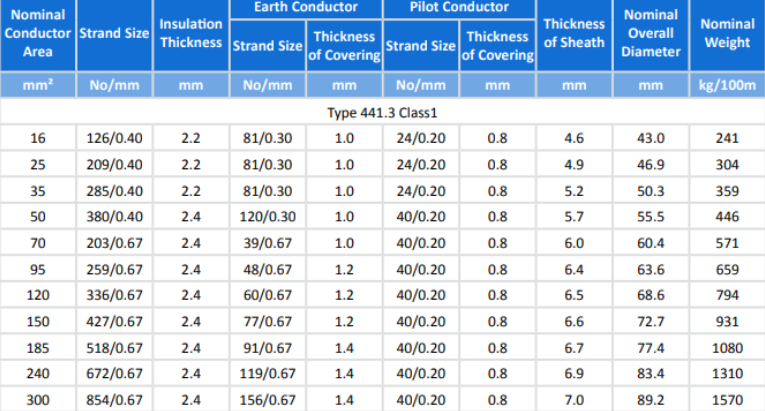
Dimensions and Weight: Practical Advantages
The following is an example of nominal dimensions (Type 441.3 Class 1 for 3.3 kV):
Epiroc Boomer E3: Features and Operational Demands
The Boomer E3 is a medium‑large hydraulic face drilling rig for drifts and tunnels with coverage up to 198 m². Its modular BUT 45 boom allows precise tunnel shaping, while the Rig Control System (RCS 5) provides self‑diagnostics, automatic rod handling, and real‑time power optimization.
Operational Environment in Indonesian Mines
In narrow drifts (4–6 m wide), hard rock (UCS >150 MPa), high silica dust, and extreme humidity, the rig must move dynamically: forward, backward, rotate, and adjust boom angles. Vibration from the hydraulic rock drill (up to 40 kW) and blasting can reach high levels, while groundwater and mud frequently wet the cable.
Key Technologies Relying on Cables
BUT 45 Boom: Heavy-duty and modular, offering flexibility for optimal tunnel shaping.
RCS 5 Smart Control: Monitors power consumption, drilling accuracy, and overload protection.
Hydraulic Rock Drill: COP series (16–40 kW), requiring a stable power supply for the main hydraulic pump.
The Boomer E3’s electrical requirements include total installed power of 237 kW (standard 3×75 kW) up to 342 kW (with higher‑power rock drills), operating voltages of 380–1000 V, 50/60 Hz, and a 1,600 mm reel with dual control and guidance system — demanding a cable that is flexible, rugged against repeated reeling and capable of carrying high currents without significant voltage drop.
Without the right cable, the risk of high downtime is substantial: cables failing due to crushing, overheating, or earth faults can halt operations for days in narrow tunnels.
Suitability of Type 441 Class 1 Cable for Boomer E3
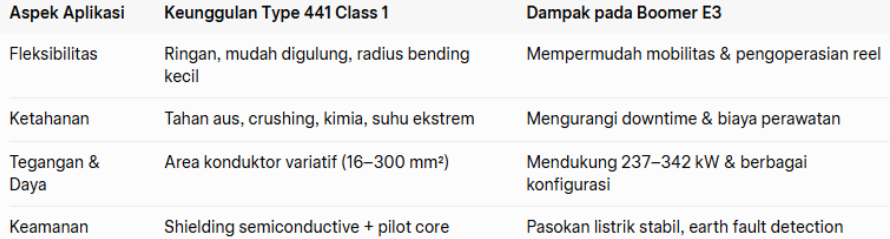
Flexibility & Mobility
High flexibility combined with the semiconductive PCP cradle allows bending radii compatible with the 1,600 mm reels. When the rig moves or swings its boom, the cable winds and unwinds without kinking — resulting in easier operation, increased mobility, and reduced setup time.
Mechanical & Environmental Durability
The extra‑heavy duty PCP sheath with textile reinforcement resists wear, oil, water, and crushing forces. In Indonesian mines with dust and mud, these cables last much longer than standard cables. EPR insulation resists tropical temperatures and humidity, while semiconductive screens prevent corona discharge at higher voltages.
Voltage Compatibility & Electrical Performance
Available conductor sizes from 16–300 mm² can match recommended configurations (e.g., 3×240 mm² for 380–500 V). The low‑resistance earth path and pilot core complement the RCS 5 system, ensuring optimal protection. Minimal voltage drop preserves rock drill performance up to 40 kW.
Practical Suitability Table
Case in Indonesia
At PT Freeport Indonesia (Grasberg Block Cave and Deep Mill Level Zone), rigs similar to the Boomer E3 are used for developing drifts at depths over 1,000 m. Trailing and reeling cables must withstand daily blasting vibration and high humidity. Using AS/NZS‑grade cables like Type 441 Class 1 (or equivalent) has been shown to reduce cable damage by up to 40% compared with non‑mining grade cables.
In underground nickel mines in Sulawesi (e.g., nickel downstreaming projects), operators reported that 240 mm² Type 441 Class 1 cables on 1,600 mm reels supported 24/7 operation for over 18 months without replacement. Practical economic benefits included:
Reduced downtime by 15–25%
Cable life 2–3× longer
Lower maintenance costs — limited to routine visual inspection and sheath cleaning.
In narrow drifts with sharp turning radii, Class 1 flexibility prevented cables from being pinched or crushed under rig wheels. The pilot core enabled integration with the RCS 5 monitoring system so earth faults were detected before causing trips.
Type 441 Class 1 is the best mining cable for the Epiroc Boomer E3 in Indonesia. Its combination of flexibility for reeling, extra mechanical durability, voltage compatibility (380–1000 V), and safety features (pilot + earth shielding) ensures optimal performance, high uptime, and long‑term investment value.
Practical Recommendations for Procurement and Engineers:
Select conductor size based on power need:
• 240 mm² for 380–500 V (237 kW)
• 180–240 mm² for 690–1,000 VMatch reel length to typical drift length (100–250 m)
Conduct routine inspections: check sheath wear, pilot core continuity, and ground resistance <1 Ω
Use certified AS/NZS suppliers with local splicing and repair services
Integrate with predictive maintenance programs for early fault detection
Choosing high‑quality cables is not a cost — it is an investment in safety and productivity. In the era of intensifying underground mining in Indonesia, Type 441 Class 1 becomes a trusted partner for the Epiroc Boomer E3 — ensuring smooth, safe, and efficient operations even in the harshest environments.
Feichun Cable
Durable mining cables for tough environments and operations
Email: Li.wang@feichuncables.com
© 2025. All rights reserved.
Company
Products
Contact
WhatsApp: +86 17333223430