Anhui Feichun Special Cable Co.,Ltd


Submarine Cables for Offshore Oil & Gas in Indonesia: South Natuna Block Case Study and Technical Selection Guide
Explore this comprehensive guide to submarine cables for the offshore oil and gas industry in Indonesia, featuring a case study on the Natuna Block. It covers technical specifications for XLPE, EPR, and hybrid umbilical cables; adherence to API 17E and IEC standards; the unique corrosion challenges of the Natuna region; and selection guidelines for dealers, engineers, and procurement decision-makers. An essential practical reference for the Marlin Natuna, Forel, and Terubuk FPSO projects.
Li Wang
3/27/20266 min read

Introduction
Indonesia is one of the largest offshore oil and gas producers in Southeast Asia, with more than 630 offshore platforms distributed across the waters of Natuna, Mahakam, and Papua. Upstream offshore oil and gas production contributes significantly toward the national target of 1 million barrels of oil per day (BOPD) and 12 billion standard cubic feet per day (BSCFD) of gas by 2030.
Amid energy transition and decarbonization pressures, submarine cables have become critical infrastructure for supporting platform electrification, subsea production systems, and FPSO (Floating Production Storage and Offloading) connectivity.
Why are submarine cables so important? Because offshore platforms are often tens of kilometers away from onshore facilities or between platforms, while onboard gas‑turbine generators are expensive, inefficient, and high in emissions. Submarine cables enable shore‑to‑platform or platform‑to‑FPSO power delivery, reducing CO₂ emissions by 30–50% and long‑term O&M costs.
The South Natuna Sea Block (especially South Natuna Sea Block B) case represents an ideal example: it includes mature fields such as Anoa and Belanak, as well as newer developments Forel and Terubuk operated by Medco E&P Natuna since acquisition from ConocoPhillips in 2016.
The key question for engineers and procurement professionals: “Why can’t standard land cables be used on deepwater offshore platforms?” The answer is simple but crucial — land cables lack anti‑pull armour, radial water blocking, hydrostatic pressure resistance, and dynamic fatigue resistance. Using ordinary cables would cause insulation failure within months due to seawater ingress, corrosion, and FPSO movement.
This article provides a complete technical guide based on international standards (API SPEC 17E, IEC 60502, ISO 13628‑5) and Indonesian project experience, so cable dealers, technicians, and decision‑makers can choose the right, safe, and economical solution.
What Is a Submarine Cable?
A submarine cable is a specialized cable designed for operation beneath the sea surface, capable of transmitting electrical power, control signals, fiber optics, and even hydraulic fluids in one assembly. Its primary purpose is to connect offshore facilities without relying on local generators, while supporting real‑time monitoring and subsea control.
Fundamental differences from standard land cable:
Land cables have only PVC/XLPE insulation without strong armour and water blocking.
Submarine cables must resist hydrostatic pressure (up to 100 bar+), salt corrosion, installation pull tension (tensile strength > 100 kN), and wave‑induced dynamic fatigue.
Minimum design life is 25 years, with safety factors 2–3× higher.
Main types of submarine cables in the oil & gas sector:
Power cable: AC/DC power transmission (6.6–36 kV for platforms).
Hybrid cable: Combined power + fibre optic for monitoring.
Umbilical cable: Integrated electrical + control + hydraulic + FO assembly.
In the Natuna Block, umbilical and power cables dominate because water depths are 70–100 m (shallow‑medium), suitable for tie‑back from FPSO to wellhead platform (WHP).
Submarine Cable Applications in Indonesian Offshore Projects
In Indonesia, submarine cable applications fall into four main categories, with the Natuna Block as a real example:
Inter‑Platform Power Transmission
Central Processing Platform (CPP) or FPSO sends power to satellite platforms. Example: Premier Oil project (2016) in Anoa Field, Block A Natuna — an umbilical power cable connected the Madura BD FPSO to the WHP with MW‑level capacity, replacing diesel generators.
Subsea Production Systems
Provide power and control to the subsea Christmas tree, ESP (Electric Submersible Pump), and manifold. In Forel‑Bronang (Medco, 2025), an umbilical was installed to the WHP, including spool installation and pre‑commissioning.
FPSO Dynamic Connections
Dynamic cables connect the FPSO Marlin Natuna (the first local tanker conversion in Batam) to subsea infrastructure. These require bend stiffeners and fatigue analysis due to heave/roll motion.
Umbilical Systems
Integrated electrical + fibre optic + hydraulic lines. In South Natuna Sea Block B, umbilicals support chemical injection, valve control, and data transmission to the onshore receiving facility (ORF) in Singapore via the WNTS pipeline.
Practical advantages include reduced personnel on platforms (NUI — Normally Unattended Installation), > 99% uptime, and compliance with SKK Migas and local content regulations (TKDN).
Environmental and Technical Challenges in the Natuna Block
The Natuna Block (South China Sea) presents extreme environments requiring super‑premium cable specifications:
High corrosion risk: High salinity seawater + CO₂/H₂S in some reservoirs necessitate tinned copper conductors, lead sheaths, and cathodic protection.
Hydrostatic pressure: Even at 70–100 m, pressure reaches ~10 bar; radial water blocking is required to prevent water treeing.
Mechanical stress: Irregular seabed, pull‑in tension during installation (up to 200 kN), anchor drag hazard, and strong currents (up to 2 knots).
Dynamic fatigue: FPSO Marlin Natuna moves continuously; umbilicals must pass dynamic fatigue tests (reeling fatigue simulation).
Thermal performance: Seawater ~28–30 °C and seabed 20–25 °C; seabed thermal resistivity (~1.0 K·m/W) affects current‑carrying capability.
Water blocking & insulation: Water ingress results in insulation failure; longitudinal + radial barriers (swelling tape + compound) are mandatory.
Engineers must conduct seabed surveys, one‑year current measurements, and VIV (Vortex Induced Vibration) analysis before cable selection.
Technical Specifications of Submarine Cables
Submarine cable specifications are strictly governed by API SPEC 17E (umbilicals), IEC 60502/60840 (power cables), and relevant local standards.
Conductor
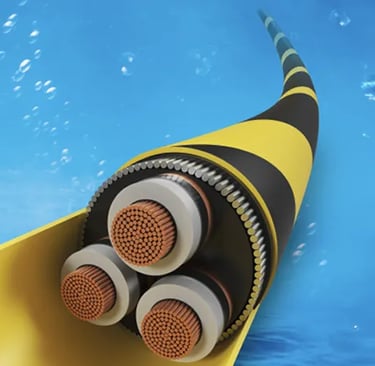
Copper (preferred) or aluminium with cross‑sections 70–1000 mm², tinned for corrosion resistance. Longitudinal water blocking uses swelling tape.
Insulation
XLPE (Cross‑Linked Polyethylene): Low dielectric loss, 90 °C rating, suitable for static power cables.
EPR/HEPR (Ethylene Propylene Rubber): More flexible with better mechanical & fire resistance, ideal for dynamic umbilicals.
Comparison: XLPE has better efficiency (lower loss), while EPR excels in fatigue and chemical resistance.
Armour
Single/double galvanized steel wire armour (5–8 mm diameter). Non‑magnetic for single‑core HV to minimize induced current loss. Tensile strength exceeds minimum breaking load as per API.
Sheath
HDPE/MDPE outer sheath for corrosion protection.
Lead or aluminium sheath for radial water sealing.
Water Blocking Techniques
Longitudinal (tape) + radial (compound/metal sheath) prevents water migration along the cable.
Technical Ratings
Voltage: ≤ 36 kV AC (medium voltage for platforms)
Operating temperature: -15 °C to +40 °C
Tensile strength & minimum bend radius: 8–12× cable diameter
Example current ratings (IEC 60287):
240 mm²: ~480 A
630 mm²: ~715 A
All cables must pass Factory Acceptance Tests (FAT): high‑voltage test, water tightness, crush test, and reel‑lay simulation.
Common Submarine Cable Types for the Natuna Block
Based on actual projects:
XLPE Insulated Power Cable (< 36 kV) for platform power transmission. Example: 3‑core SWA + HDPE sheath for static connections in Anoa Field.
Hybrid Cable (Power + Fibre Optic): Integrated power + 8–32 core FO for temperature/fault monitoring at subsea control modules (SCM).
Dynamic Cable for FPSO Marlin Natuna: Added Kevlar or bend stiffeners, EPR insulation to absorb vessel movement.
Umbilical Cable (API 17E Compliant): Integrated electrical + hydraulic + FO (e.g., 5‑inch power umbilical from past FSO Gas Concord projects). Types include production control umbilicals (PCU) or IWOCS for intervention.
Leading suppliers include Nexans, Prysmian, ZTT, and Fibron — all with records in Indonesian waters and meeting local content requirements.
Cable Selection Guide
Step 1 — Match Cable Type to Scenario
Shallow static water: XLPE 3‑core power cable.
Dynamic FPSO environment: EPR umbilical with fibre reinforcement.
Step 2 — Key Considerations
Voltage & power demand (calculate current using IEC 60287)
Corrosion resistance (tinned conductors + lead sheath)
Mechanical load capacity (tensile strength, crush resistance, bend radius)
Water sealing performance (radial barrier testing)
Installation method (plough burial or rock berm protection)
Step 3 — Lifecycle & Maintenance
Design life: 25–30 years
Plan IRM (Inspection, Repair & Maintenance) with ROV support
Choose suppliers with local service centers (e.g., Batam/Jakarta)
Procurement Checklist
Request design verification reports, FAT protocols, and third‑party certifications (e.g., ABS/DNV). Ensure compliance with SNI and grid connection standards if tied to PLN.
Frequently Asked Questions (FAQ)
Q: What is the best cable for deepwater platforms?
A: Hybrid EPR umbilical with double armour + fibre optics meeting API 17E.
Q: Can standard land cables be used offshore?
A: No. Without armour and water blocking they will fail within 6–12 months.
Q: What is an umbilical cable and how does it work?
A: It is an integrated assembly of power, control, and hydraulic lines that serves as the subsea tree’s “lifeline”: supplying power, sending signals, and enabling chemical injection.
Q: What is the typical submarine cable lifespan?
A: 25–40 years with routine maintenance depending on dynamic loading conditions.
Conclusion
Submarine cables are the backbone of reliable and safe offshore oil & gas operations in Indonesia. The Natuna Block, with challenges such as corrosion, strong currents, and dynamic FPSO Marlin movement, shows that selecting the correct cable specs (XLPE/EPR, steel armour, water blocking) determines project success.
For cable dealers, engineers, and procurement professionals, understanding API 17E, IEC standards, and local experience is a competitive advantage in SKK Migas tenders.
Don’t hesitate to consult certified suppliers or EPC contractors for customized Natuna‑specific solutions. Contact us for detailed specifications, current rating simulations, or recommendations for upcoming Forel‑Terubuk project tenders. With quality submarine cables, Indonesia will not only produce oil & gas — but also lead offshore electrification in Southeast Asia.

Feichun Cable
Durable mining cables for tough environments and operations
Email: Li.wang@feichuncables.com
© 2025. All rights reserved.
Company
Products
Contact
WhatsApp: +86 17333223430