Anhui Feichun Special Cable Co.,Ltd


Guide to Selecting Crane Cables for Coastal Environments with High Humidity in Indonesia (Port & Marine Guide)
Learn a complete guide on selecting crane cables for coastal environments with high humidity in Indonesia. Discover key criteria, the best cable types, and model recommendations for safe and durable port and marine operations.
Li Wang
3/26/20265 min read
Introduction: The Importance of Crane Cables in Coastal Environments
Indonesia, as a tropical archipelagic country near the equator, has a dense network of ports and a growing crane industry. Crane cables play a critical role in ensuring that port operations and marine activities run smoothly. Cable failures can lead to operational disruptions, safety risks, and high maintenance costs.
The Indonesian coastal environment poses unique challenges for crane cables, including a combination of high humidity, salt spray, intense UV radiation, and dynamic mechanical stress due to reeling and festoon operations. This guide is intended for cable distributors, purchasing decision‑makers, engineers, and technicians who need an in‑depth understanding of selecting crane cables resistant to such extreme conditions.
Why Indonesia Is Considered a “Tropical Coastal Environment” with High Humidity, Salt Spray, and High UV
High Humidity (Humidity > 80%)
In Jakarta, Surabaya, and most of Indonesia’s coastline, relative humidity consistently reaches 80–95%.
High humidity promotes the formation of a thin electrolyte layer on the surface of metals, accelerating conductor oxidation and increasing water absorption in insulation.
Technical Mechanisms:
Water + oxygen → persistent electrochemical corrosion environment.
Moisture ingress through micro‑cracks in the sheath or at joints → insulation resistance degradation → risk of partial discharge.
Impacts:
Reduced insulation resistance
Copper conductor corrosion
Increased risk of leakage current and short circuits
Salt Spray (Salt Mist / Chloride)
Sea breezes carry Cl⁻ ions that adhere to the surface of cables and equipment.
Salt has two main effects:
Breaks down the passive protective layer on metal
Forms conductive paths → accelerates electrochemical corrosion
Technical Mechanisms:
Salt + water = electrolyte → corrosion of copper conductors and shield layers
Impacts:
Increased resistance → excessive heat
Decreased mechanical strength
Reduced effectiveness of cable shielding
High UV Radiation
Proximity to the equator leads to intense UV exposure year‑round.
UV radiation damages polymer chains in PVC, PE, or rubber cable sheaths, causing materials to become brittle, crack, and chalk.
Technical Mechanisms:
Polymer chain scission → brittleness → loss of flexibility
Surface chalking → degraded appearance
Impacts:
Sheath cracking → moisture ingress
Dramatic reduction in cable service life
Combined Effects
Humidity + salt spray + UV → cable aging accelerates 2–4× faster than in typical industrial environments.
Understanding this synergy is critical when determining the correct sheath and insulation materials.
Extreme Conditions in Ports: Environmental and Mechanical Stress
Marine Corrosion
Constant exposure to salt spray and high humidity
Formation of salt electrolyte on conductors and shields → copper corrosion and sheath mechanical degradation
UV Exposure and Heat
Port crane cables are often unprotected
Ambient temperatures can reach 30–40°C → accelerated material aging
Dynamic Mechanical Stress
Crane operations involve:
Reeling (drum‑based)
Festoon (track‑based)
High‑frequency bending, torsion and tension → micro‑cracks → moisture and salt ingress
Conclusion:
Ports = Marine corrosion + Tropical climate + Dynamic mechanical stress → extreme conditions testing the entire cable system.
Failure Mechanisms of Conventional Cables
Sheath Cracking (Material Stage)
Cause: UV degradation, heat, humidity cycling
Symptoms: Chalking, cracking, loss of flexibility
Significance: Sheath cracks = protective system failure
Copper Conductor Corrosion (Electrochemical Stage)
Moisture and salt penetrate → electrolyte pathways form
Oxidation → creation of Cu₂O / CuO → contact resistance rises
Most risk at points of corrosion initiation
Insulation Degradation (System Stage)
Water + salt → decreased insulation resistance
Partial discharge → short circuits → equipment downtime
Technical Analysis: Coastal Environmental Challenges in Indonesia
High Humidity
Moisture ingress through micro‑cracks or poorly sealed joints
Effects: decreased insulation resistance, short circuits, conductor corrosion
Salt Spray Corrosion
Chloride attack → electrochemical corrosion of copper and shields
Effects: increased resistance, heat buildup, reduced cable longevity
UV Radiation
Polymer degradation → brittleness, chalking, cracking
Sheath cracking → moisture ingress → accelerated corrosion
Mechanical Stress
Dynamic bending, torsion, tension, vibration
Effects: micro conductor breaks, shield deformation, sheath abrasion
Result: mechanical failure → electrical malfunction
Types of Crane Cables for Coastal Environments
Festoon Cables (Track‑Based)
Recommended models: NSHTÖU, (N)SHTÖU
Characteristics: High flexibility, abrasion resistance, UV resistance
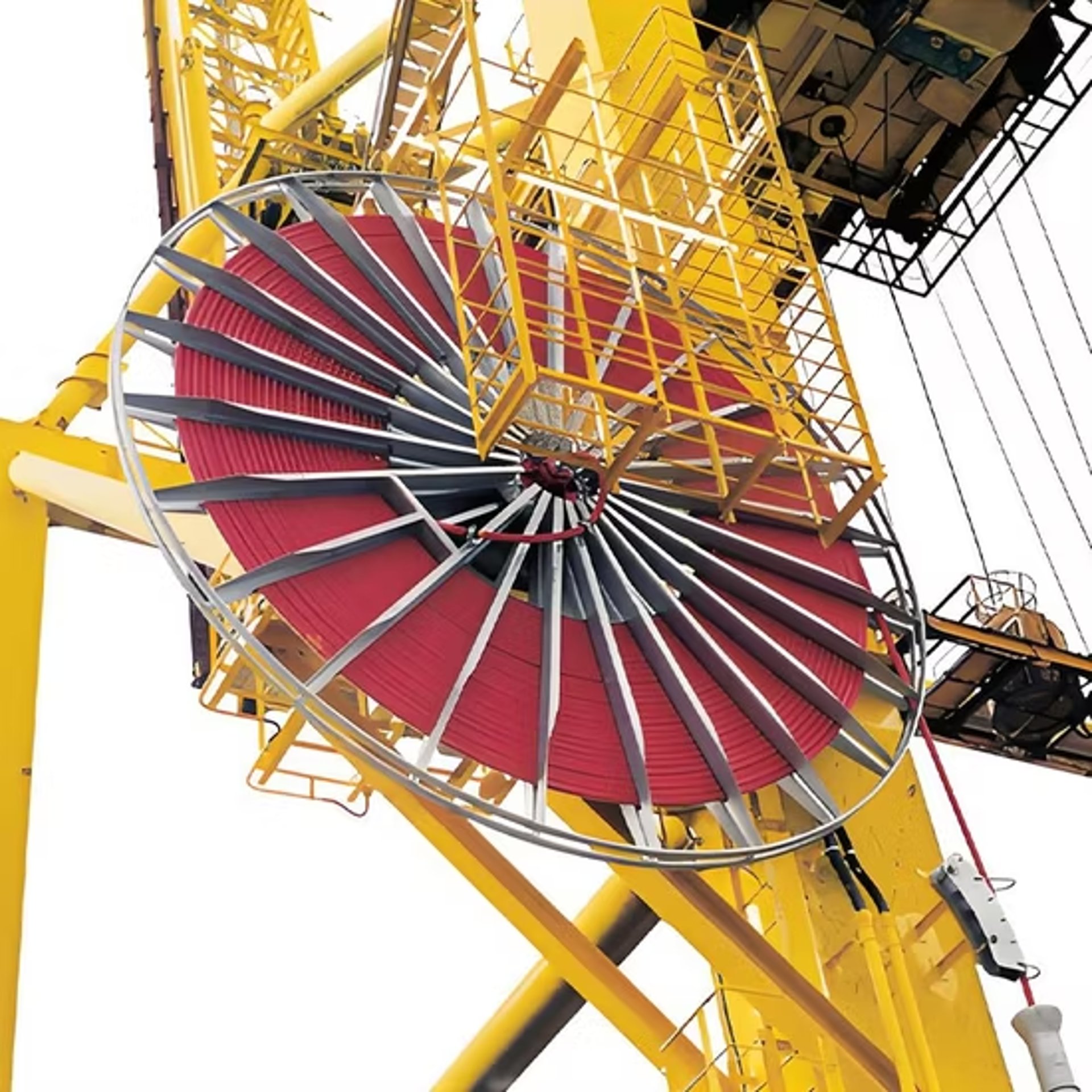
Reeling Cables (Drum‑Based / Coil)
Recommended models: NTSKCGOEU, (N)SHTÖU‑J
Characteristics: Designed to withstand repeated bending, torsion, and tensile stress
Heavy‑Duty Rubber Cables
Recommended models: (N)SSHCÖU
Characteristics: Extra flexibility, extreme mechanical resistance, suitable for heavy‑duty conditions
Cable Selection Criteria for Crane Applications
Sheath Material
PVC: ❌ Not suitable for UV and coastal environments
Rubber: ✔ Suitable
TPU: ✔✔ Best option — UV & abrasion resistant
Water Resistance
EPR or Rubber insulation → prevents moisture ingress
Corrosion Resistance
Tinned copper conductors → reduced oxidation
Flexibility
Must withstand many bending cycles (reeling/festoon)
Temperature Range
Must withstand Indonesia’s tropical temperatures + direct sunlight exposure
Common Mistakes in Cable Selection
Using standard PVC in coastal environments
Ignoring UV protection
Not accounting for high mechanical cycling (reeling/festoon)
Neglecting conductor and shield corrosion protection
Practical Recommendations
Select cables based on environment, mechanical demands, and electrical requirements
Recommended models:
Festoon: NSHTÖU / (N)SHTÖU → track‑based cranes
Reeling: NTSKCGOEU / (N)SHTÖU‑J → drum‑based cranes
Heavy‑Duty Rubber: (N)SSHCÖU → extreme mechanical conditions
Consult cable length, bending radius, and electrical ratings with your supplier
FAQ
Q: Which crane cable is best for Indonesian ports?
A: For aggressive port environments (high flex, frequent movement, salt & UV exposure), purpose‑built crane/festoon and reeling cables with high‑performance weather‑resistant sheaths such as PUR or rubber are most suitable. These cables provide high flexibility, resistance to abrasion/bending, and components engineered for heavy mechanical loading like STS, RTG, RMG, and ship unloader applications.
Q: Can ordinary PVC be used in coastal environments?
A: Not ideal. Standard PVC insulation and sheathing may work for light flex in protected indoor applications, but it lacks necessary protection and is prone to rapid degradation from salt and UV.
Standard PVC:
Not designed for high flex cycles
Less resistant to salt/UV than specialized compounds (PUR, TPU, rubber)
Conclusion: Standard PVC is suitable only for indoor or sheltered environments, not open coastal conditions.
Q: What is the difference between festoon and reeling cables?
Festoon cables: Designed to move horizontally on trolley/track systems — ideal for cranes with linear back‑and‑forth motion.
Reeling cables: Designed to reel on a drum — suitable for cranes requiring large cable extension and retraction, such as E‑RTG and automated shiploaders.
Q: How can crane cable service life be extended in high‑humidity conditions?
Key approaches:
✔ Use high‑performance sheathing like PUR, TPU, or rubber that is water‑ and corrosion‑resistant
✔ Select cables with high IP rating / waterproof & ozone resistance
✔ Use proper support/trolley systems to reduce unnecessary abrasion or twisting
✔ Inspect cables regularly (cracks, wear, delamination) and replace before total failure
✔ Choose products with appropriate environmental ratings (IP, UV, abrasion, chemicals)
Q: Is TPU superior to rubber in tropical ports?
Generally, cables with TPU (Thermoplastic Polyurethane) sheaths outperform standard rubber in tropical port settings because:
✔ Better abrasion resistance
✔ Higher resistance to UV and ozone than standard rubber
However, for very heavy‑duty loads, high‑grade rubber compounds may still offer superior elasticity and flexibility. The best choice depends on the sheath material’s ratings and operating conditions.
Q: What maintenance practices help prevent premature cable failure?
Best practices include:
Routine inspections — check for cracks, wear, and deformation
Clean salt and contaminants off cables regularly
Use protective covers if cables are directly exposed to sunlight/coastal conditions
Ensure trolley/track systems are well maintained to prevent pinching or sheath damage
Replace cables before technical life cycle limits are exceeded
Choose suitable products with correct environmental ratings (IP, UV, abrasion, chemical resistance)
Conclusion
Selecting crane cables for the coastal environment in Indonesia requires comprehensive consideration of both environmental factors (humidity, salt, UV) and mechanical demands (reeling/festoon). Using the correct cable types — such as TPU, heavy‑duty rubber, and appropriate reeling/festoon cables — ensures safe, reliable, and long service life.
For reliable crane cable solutions suited to port and marine conditions in Indonesia, contact our technical team for expert recommendations and custom specifications.
Feichun Cable
Durable mining cables for tough environments and operations
Email: Li.wang@feichuncables.com
© 2025. All rights reserved.
Company
Products
Contact
WhatsApp: +86 17333223430