Anhui Feichun Special Cable Co.,Ltd


BS 6708 PROTOMONT Type 307 / 307M / 307S Flexible Trailing Cables: EPR CR Rubber Mining Power Supply Solutions for Extreme Underground Conditions
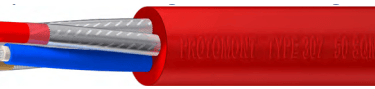
BS 6708 PROTOMONT Type 307/307M/307S flexible trailing cables are engineered exclusively for underground mining environments. Built with EPR insulation and CR sheath, they solve common failures like breakage, early aging, and safety risks. This guide explains standards, material science, structural design, performance, model differences, and equivalent replacement from Feichun, ideal for engineers and procurement teams in Indonesia and Southeast Asia.
Li Wang
6/15/202619 min read
Introduction
Underground mining is one of the most demanding industrial environments in the world. In Indonesia, where large-scale coal, nickel, gold, and tin mines operate across Sumatra, Kalimantan, Sulawesi, and Papua, conditions are especially severe. High humidity, intense heat, corrosive dust, flammable gases, and constant mechanical stress from moving machinery create a perfect storm that pushes every component to its limit. Among these components, power supply cables are critical. When a cable fails, production stops, costs rise, and safety is compromised.
For decades, operators have faced the same problems with standard industrial cables: they break easily when dragged or bent, insulation cracks or melts, sheaths swell or rot in oil and moisture, and they do not meet strict safety standards for explosive atmospheres. These issues lead to frequent replacements, high maintenance costs, and serious risks to personnel and equipment.
PROTOMONT Type 307, 307M, and 307S cables, manufactured to British Standard BS 6708, were developed specifically to address every one of these challenges. Designed from the ground up using advanced material science, electrical engineering, mechanical design, and global safety regulations, they are not just improved versions of ordinary cables—they are purpose‑built systems for extreme service. They are now recognized as the benchmark solution for powering shearers, loaders, conveyors, and other mobile equipment in underground mines worldwide, and they have become the preferred choice for major mining companies and contractors throughout Indonesia.
This article explains in detail how these cables work, why they are built the way they are, what makes them different, and how to select and source them effectively. It is written for engineers, technical managers, and procurement specialists who need accurate, practical, and technically sound information to make the right decisions for their projects.
Standards and Technical Specifications
Governing Standards and Certifications
The entire PROTOMONT 307 series is designed, tested, and manufactured in full compliance with BS 6708:1998, the internationally recognized standard for flexible cables used in mines and quarries. This standard defines construction, materials, electrical performance, mechanical strength, and safety requirements that far exceed general‑purpose cable specifications.
In addition to BS 6708, the cables conform to a comprehensive set of supporting standards that ensure consistency and reliability:
BS 6360: Requirements for copper conductors, ensuring flexibility, conductivity, and corrosion resistance.
BS 7655: Specifications for insulating compounds, guaranteeing electrical stability and long life.
EN 60322‑1‑2 / IEC 60322‑1‑2: Fire resistance and flame retardancy—critical for mines where gas or dust explosions are possible.
EN 60811‑404 / IEC 60811‑404: Oil resistance, a key requirement in environments where hydraulic fluids and lubricants are common.
Certifications are essential for operation in Indonesia and other regulated markets. These cables hold:
MA Certification: China’s mining safety approval, widely accepted globally.
MSHA Approval: US Mine Safety and Health Administration certification (P‑07‑KA130007‑MSHA), proving compliance with the world’s strictest mining safety rules.
Compared to other BS 6708 types such as Type 7 or Type 11, which are rated only up to 640/1100 V, the 307 series is built for 1.9/3.3 kV, making it suitable for higher‑power equipment used in modern, large‑scale mines.
Electrical Parameters
Every parameter is calculated and tested to ensure safe, stable power delivery even under maximum load and fault conditions:
Rated Voltage: 1.9/3.3 kV (U₀ = 1.9 kV, U = 3.3 kV)
Maximum AC Operating Voltage: 2.1/3.6 kV
Maximum DC Operating Voltage: 2.7/5.4 kV
AC Test Voltage: 6 kV (applied for 5 minutes during factory testing)
Conductor Resistance: Strictly controlled according to cross‑section (25 mm² to 150 mm²), ensuring low voltage drop and efficient power transfer.
Short‑Circuit Performance: Can withstand a maximum conductor temperature of 250 °C for up to 5 seconds without damage, protecting equipment during faults.
These values are not arbitrary; they are derived from electrical theory and years of field experience, ensuring performance matches the actual demands of mining equipment.
Thermal and Environmental Ratings
Indonesia’s tropical climate—hot, humid, and variable—places unique stress on cables. The 307 series is engineered to perform reliably across an exceptionally wide range:
Maximum Conductor Temperature: 90 °C continuous operation—far higher than the 70 °C limit of standard rubber cables, allowing higher current carrying capacity and better overload tolerance.
Fixed Installation Temperature Range: ‑40 °C to +80 °C
Fully Flexible Operation Temperature Range: ‑25 °C to +60 °C
Weather Resistance: Rated for unrestricted indoor and outdoor use, with excellent resistance to ozone, moisture, UV radiation, and chemical attack.
This means the cable will not become brittle in cold conditions, will not soften or melt in heat, and will not degrade rapidly in the constant humidity found in mines in Kalimantan or Sumatra.
Mechanical Specifications
Mechanical failure is the most common cause of downtime. These cables are built to survive:
Maximum Tensile Load on Conductor: 15 N/mm²—balanced to be strong enough to resist breaking, yet flexible enough to bend repeatedly without fatigue.
Bending Radius:
Type 307: 8 × overall diameter (standard)
Type 307M: 4–5 × overall diameter (enhanced flexibility)
Type 307S: 2.3 × overall diameter (ultra‑flexible, for tight spaces and frequent movement)
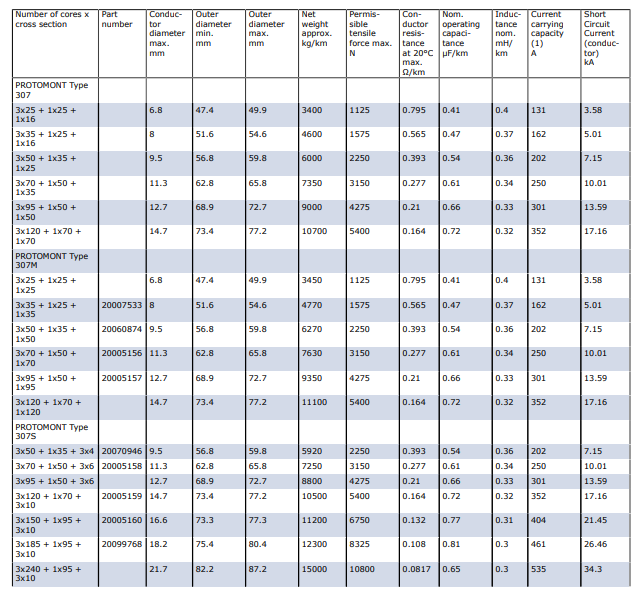
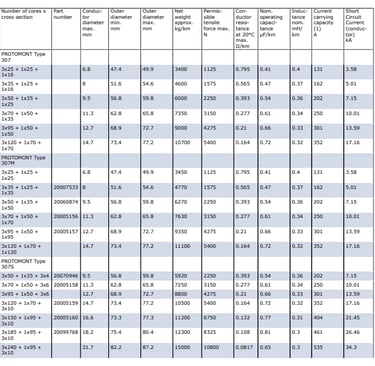
Cross‑Section Range: Available from 25 mm² to 150 mm², with standard configurations including 3×25+1×16, 3×35+1×16, 3×50+1×25, 3×70+1×35, 3×95+1×50, 3×120+1×70, and 3×150+1×70.
All dimensions, weights, and electrical properties are precisely documented in technical data sheets, allowing engineers to select exactly the right size for their load, distance, and installation method.
Core Design and Structural Engineering
The construction of PROTOMONT Type 307/307M/307S is not just a matter of assembling layers. Every part is designed based on clear engineering principles to solve specific problems. Below is a detailed layer‑by‑layer breakdown, from the center outwards, explaining exactly why each component exists and how it works.
Central Earth Conductor
At the very center of the cable lies the bare or tinned copper earth conductor, made of finely stranded Class 5 copper as defined in BS 6360.
This is one of the most distinctive and important design choices. In most standard cables, the earth wire is placed on the outside or alongside power cores. Here, it is in the middle. The reasons are both electrical and mechanical:
Electrical Principle:
Equal Potential: By placing the earth at the geometric center, all power cores are equidistant from it. This creates a perfectly balanced electric field, eliminating induced voltages and reducing electromagnetic interference.
Fastest Fault Protection: In the event of insulation failure, fault current flows directly and immediately to earth with the lowest possible resistance. This ensures rapid operation of protection devices and keeps touch voltage below 50 V—an absolute requirement for safety in gassy mines.
Zero Potential Reference: The entire cable structure is held at earth potential, preventing dangerous voltage buildup on screens or sheaths.
Mechanical Principle:
Structural Core: The earth conductor acts as the backbone. All other cores are laid up around it, creating a symmetrical, balanced structure. This means that when the cable is bent, twisted, or pulled, forces are distributed evenly, preventing kinking, twisting, or internal stress concentrations.
Anti‑Breakage: By being in the center, the earth wire is never subjected to the maximum tension or compression that occurs at the outer radius during bending.
Material Science:
Copper: Chosen for highest conductivity and excellent corrosion resistance.
Tinning: Applied to prevent oxidation and sulfidation—critical in humid, sulfur‑rich mine air in Indonesia.
Class 5 Stranding: Made of many very fine wires. This gives maximum flexibility while maintaining strength, so the conductor does not break even after millions of bending cycles.
Power Cores (3 Cores: Red, Yellow, Brown)
Surrounding the central earth are three identical power cores, color‑coded for easy identification. Each core is a complete insulated and shielded unit.
Conductor
Material: Class 5 tinned copper, exactly as specified in BS 6360. Individual wire diameter is less than 0.4 mm, twisted together in multiple layers.
Why this design? Fine stranding allows the cable to bend sharply without breaking. The relationship between strand diameter, number of strands, and flexibility is well‑established in engineering; Class 5 is the industry standard for high‑flex applications. Tinning prevents corrosion and makes termination easier and more reliable.
Insulation: PROTOLON EPR
Material: PROTOLON, a proprietary compound based on Ethylene Propylene Rubber (EPR). This is not standard rubber—it is a cross‑linked polymer designed specifically for high‑performance electrical insulation.
Electrical Properties:
Low permittivity (≈2.3) and low dielectric loss factor. This means it does not store electrical energy or generate heat when voltage is applied, unlike PVC or natural rubber.
High dielectric strength and excellent corona resistance. It can withstand high electric fields without degradation, even over decades.
Stable insulation resistance over a wide temperature range.
Thermal Properties:
Continuous operation at 90 °C—30 % higher than standard rubber. This allows higher current capacity and better performance in hot mines.
Does not melt or flow at high temperatures; retains elasticity even when warm.
Chemical and Environmental Properties:
Resists ozone, UV light, moisture, acids, alkalis, and chemicals found in mining environments.
Does not harden, crack, or become brittle with age—one of the biggest failures of ordinary cables.
Engineering Logic: EPR was selected because it outperforms every other common insulation material in all the key areas that matter for mining. It is the only material that balances electrical performance, heat resistance, flexibility, and durability.
Individual Screen: Copper‑Nylon Composite Braid
Structure: Each power core is wrapped in a braid made of tinned copper wires and nylon fibers, with a coverage of at least 85 %.
Why individual screens, not one overall screen?
Safety: If one core is damaged, the screen contains the fault locally, preventing it from spreading to other cores or the outside.
EMC Performance: Eliminates interference between cores and with external equipment.
Mechanical Protection: The braid acts as a cushion, protecting the insulation from abrasion during bending and dragging.
Material Science:
Copper: Provides electrical conductivity to carry fault current and provide shielding.
Nylon: Adds mechanical strength, toughness, and resistance to wear. Pure copper braid is too brittle; pure nylon is non‑conductive. Together, they create a perfect composite.
Braid Construction: Braiding is far superior to wrapping or taping because it remains flexible and continuous even when the cable is bent or twisted.
Pilot / Control Core (Blue)
Located alongside the power cores is the pilot core, identified by blue insulation.
Structure: Class 5 tinned copper conductor + PROTOLON EPR insulation. No individual screen is needed here.
Function: Used for control signals, monitoring, or interlocking circuits.
Design Principle: It is laid up with the same length and lay length as the power cores. This ensures that when the cable bends, all cores stretch equally, preventing signal loss or conductor breakage due to differential tension.
Core Assembly and Bedding
All cores—three power, one pilot—are arranged symmetrically around the central earth conductor and bound together with a textile tape for identification and stability.
Lay Length: Short lay length is used. This is the key to flexibility. A shorter lay length means the cable can bend more easily and with less force. The mathematics of cable design shows that lay length directly determines minimum bending radius and fatigue life.
Bedding Layer: Over the assembled cores, an extruded layer of PROTOFIRM rubber compound is applied. This fills all gaps, forms a smooth circular shape, and creates a solid foundation for the outer sheath.
Purpose: Distributes mechanical forces evenly across the cross‑section, absorbs impact, protects the screens from damage, and ensures the cable remains round under pressure—essential for long life.
Outer Sheath: PROTOFIRM CR (Chloroprene Rubber)
The outermost layer is the most visible and most critical for survival. It is made of PROTOFIRM, a heavy‑duty compound based on Chloroprene Rubber (CR), also known as Neoprene, and is always colored bright red for high visibility in low‑light conditions.
This is where material science really shines. CR was chosen over natural rubber, PVC, or polyurethane because it is the only material that satisfies all these requirements simultaneously:
Oil and Chemical Resistance:
CR has a polar molecular structure. Mineral oils, greases, and hydraulic fluids are non‑polar. Like repels like—so CR does not absorb oil, swell, or soften. This conforms strictly to EN 60811‑404. In contrast, natural rubber swells up to 200 % in oil and becomes useless. This is vital in mines where machinery leaks are common.
Flame Retardancy and Safety:
CR is inherently flame‑retardant. It does not support combustion, and when exposed to fire, it releases low‑smoke, low‑toxicity gases, and forms a protective char layer that stops fire spread. It fully meets EN 60322‑1‑2. This is non‑negotiable in coal mines where methane and coal dust create explosion risks.
Mechanical Performance:
High tensile strength (>15 MPa), excellent elongation (>300 %), and superior tear and abrasion resistance. It can slide over rock, concrete, and steel without wearing through.
Remains flexible down to ‑40 °C and does not become sticky or soft at +80 °C.
Weather and Aging Resistance:
Resists ozone, UV, moisture, and heat aging. In Indonesia’s tropical environment, ordinary rubber sheaths degrade in 1–2 years; CR sheaths last 8–12 years or more.
Total Protection:
The sheath forms a hermetic seal. Dust, water, humidity, and chemicals cannot penetrate inside. Everything inside remains clean and dry, just as it was manufactured.
Summary of Design Philosophy
Every layer, every material, and every dimension is chosen based on fundamental engineering principles:
Safety First: Central earth, individual screens, flame‑retardant materials, and robust construction work together to eliminate hazards.
Balanced Performance: Flexibility vs. strength, conductivity vs. heat generation, protection vs. weight—all balanced to optimize life and reliability.
System Compatibility: All materials have matched thermal expansion, elasticity, and adhesion properties. They expand and contract together, so there is no delamination or internal stress.
Long Life: Designed to survive the same movement cycle millions of times without failure.
Material Science Deep Dive
The performance of Type 307/307M/307S comes directly from the advanced materials used. Understanding why these materials were selected explains why these cables outperform all others.
Conductor: Tinned Copper Class 5
Why Copper?
Copper is the standard for electrical conductors because it has the highest conductivity of any metal commonly available (58 MS/m). This means less energy loss, less heat generation, and smaller voltage drop compared to aluminum or other materials.
Why Tinned?
Copper oxidizes and sulfidizes in humid or sulfur‑rich air—conditions common in Indonesian mines. Oxidation increases resistance, causes overheating, and makes connections fail. A thin layer of tin prevents this entirely. It also makes stripping and connecting easier and safer.
Why Class 5 Stranding?
As defined in IEC 60228, Class 5 conductors are made of the finest possible strands. When you bend a wire, the outer surface stretches and the inner compresses. Finer strands mean less stretch per wire, so the conductor can bend thousands of times without breaking. This is basic mechanics of materials: fatigue life increases exponentially as strand diameter decreases.
Insulation: PROTOLON EPR (Ethylene Propylene Rubber)
EPR is a synthetic rubber copolymer of ethylene and propylene, cross‑linked to create a stable three‑dimensional molecular structure.
Electrical Science:
The key advantage over older materials like PVC or natural rubber is its non‑polar structure. This gives it very low dielectric constant and low loss tangent. In simple terms, it does not interact with the electric field, so it does not heat up or degrade over time. It also has excellent resistance to treeing and tracking—the two main causes of insulation breakdown in high‑voltage cables.
Thermal Science:
Cross‑linking raises the melting point and improves thermal stability. EPR can operate continuously at 90 °C and survive short circuits at 250 °C. Natural rubber melts at around 70 °C and loses all strength above 80 °C.
Environmental Science:
The chemical structure is highly resistant to oxidation, ozone attack, and hydrolysis. Ozone, formed by electrical discharges or sunlight, attacks and cracks unsaturated rubbers—but EPR is fully saturated and immune. This is why it lasts so long outdoors and underground.
Screen: Copper‑Nylon Composite Braid
This is a classic example of composite material engineering—combining two materials to get properties neither has alone.
Copper: High electrical conductivity for shielding and fault current carrying.
Nylon: High tensile strength, abrasion resistance, and flexibility.
Result: A layer that is electrically perfect and mechanically tough. It shields against interference, protects insulation, and survives sliding and rubbing.
Sheath: PROTOFIRM CR (Chloroprene Rubber)
CR is a polymer with chlorine atoms attached to its carbon chain. This single chemical difference changes everything.
Oil Resistance Mechanism:
Oils are non‑polar hydrocarbons. CR is polar due to the chlorine. The rule “like dissolves like” applies—so oil cannot dissolve or swell CR. Natural rubber and many other elastomers are non‑polar, so they absorb oil and swell rapidly.
Flame Resistance Mechanism:
Chlorine is a halogen. When heated, CR releases hydrogen chloride gas, which inhibits combustion reactions and creates a dense, non‑flammable char layer that blocks oxygen and heat transfer. It is self‑extinguishing by nature.
Aging Resistance:
The carbon‑chlorine bond is very strong and stable. It resists attack by oxygen, heat, and chemicals much better than carbon‑carbon bonds in natural rubber. This is why CR ages slowly and stays flexible for decades.
Material Synergy
The most important point is that all materials are engineered to work together. The insulation, bedding, and sheath have similar elastic moduli and coefficients of thermal expansion. When the cable heats up or cools down, or when it stretches, all layers move together. There is no internal shear stress, no separation, and no damage. This is material science at its best—creating a system, not just a collection of parts.
Model Differences: Type 307 / 307M / 307S
A common question is: what is the difference between the three models? They share the same standard, same voltage rating, same materials, and same safety features. The difference lies in flexibility, mechanical strength, and service life, designed to match exactly how the cable will be used.
Type 307 – Standard Duty
Design:
Standard Class 5 conductor stranding.
Standard lay length.
Standard PROTOFIRM sheath formulation.
Minimum bending radius: 8 × overall diameter.
Best Application:
Fixed installations in main roadways, galleries, or long‑distance power runs.
Equipment with occasional or slow movement.
General‑purpose use where cost‑performance balance is key.
Indonesia Use Case: Power distribution panels, conveyor belts, pumps, and fans in coal mines in South Sumatra.
Performance: Excellent durability, reliable, cost‑effective.
Type 307M – Medium Flexibility / Enhanced Duty
Design:
Finer Class 5 stranding for greater flexibility.
Shorter lay length in core assembly.
More flexible sheath compound with slightly higher abrasion resistance.
Minimum bending radius: 4–5 × overall diameter.
Mechanical life improved by approximately 40 % compared to Type 307.
Best Application:
Most popular model in Indonesia.
Shearers, loaders, and machines moving frequently but not continuously.
Use in cable chains or handlers.
Areas with moderate to high dust and abrasion.
Indonesia Use Case: Longwall shearers in PT Bukit Asam mines, heavy equipment in nickel mines in Sulawesi.
Performance: Balances flexibility, strength, and price—ideal for 80 % of mining operations.
Type 307S – Super Flexible / Heavy Duty
Design:
Ultra‑fine conductor stranding (near Class 6) for maximum flexibility.
Shortest possible lay length.
Reinforced sheath with extra abrasion and tear resistance.
Optimized symmetry and balance to resist torsion.
Minimum bending radius: 2.3 × overall diameter.
Mechanical life doubled compared to Type 307.
Best Application:
Extreme conditions: Narrow seams, tight bends, continuous movement, high torsion, heavy dragging.
Highest‑wear zones, very hot or very humid environments.
Long‑wall faces and high‑productivity mines.
Indonesia Use Case: Narrow‑vein coal mines in Kalimantan, high‑humidity underground operations.
Performance: Maximum flexibility, longest life, highest strength—premium performance for the toughest jobs.
How to Choose
Selection is simple:
Fixed or slow movement → Type 307
Frequent movement, standard duty → Type 307M
Continuous movement, tight bends, severe conditions → Type 307S
All three are fully interchangeable in terms of safety and electrical performance; the choice is purely about mechanical service life and economy.
Performance Advantages vs. Ordinary Cables
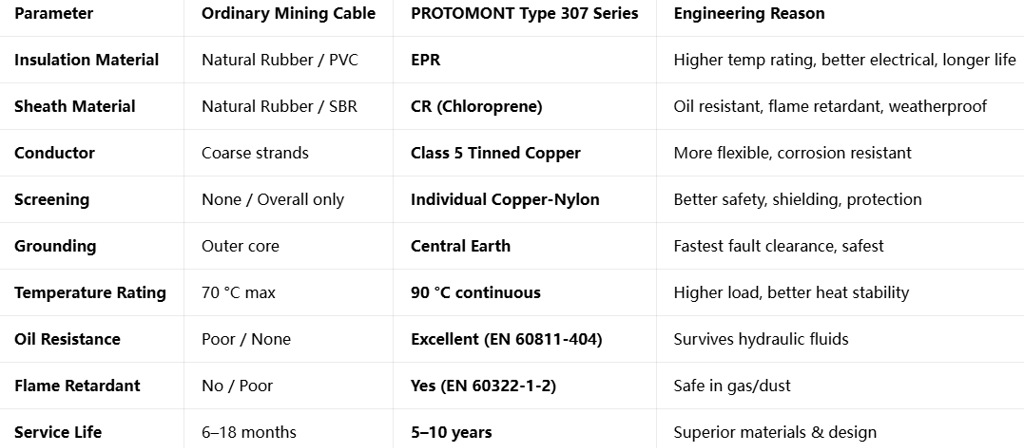
To truly understand the value of the 307 series, we must compare it directly with the standard rubber‑sheathed cables commonly used in the past or in less regulated operations. The differences are not small—they are fundamental.
Solving the Four Major Problems
1. Easy Breakage
Ordinary Cable: Uses coarse strands, rigid construction, long lay length. Breaks after 3–6 months of use. Conductor snaps, insulation cracks.
Type 307 Series: Fine strands, balanced structure, optimized lay length. Life expectancy: 2–4 years or more.
Why: Based on fatigue mechanics—flexible design reduces stress per wire by 50–70 %.
2. Fast Deterioration
Ordinary Cable: Natural rubber or PVC insulation/sheath. Hardens, cracks, swells, or rots in oil, heat, or humidity. Becomes unsafe within 1–2 years.
Type 307 Series: EPR + CR system. Remains flexible and intact for 8–12 years.
Why: Material chemistry prevents degradation; sealed structure blocks contaminants.
3. Unsafe and Non‑Compliant
Ordinary Cable: No individual screens, poor grounding, flammable materials. Does not meet BS 6708, MA, or MSHA. Illegal for use in many mines.
Type 307 Series: Full safety design, certified. Explosion‑proof, low smoke, reliable grounding.
Why: Designed from the start to meet the highest safety standards.
4. Short Life and High Cost
Ordinary Cable: Low purchase price, but needs replacement every 6–12 months. High downtime, high labor cost.
Type 307 Series: Higher initial price, but lasts 5–8 times longer. Total cost of ownership is 60–70 % lower.
Detailed Comparison Table
Real‑World Evidence in Indonesia
In 2023, PT Bukit Asam, one of Indonesia’s largest coal producers, conducted a field test. They replaced standard cables on three longwall shearers with Type 307M.
Result: Unscheduled downtime due to cable failure dropped by 75 %.
Replacement cost: Reduced by 60 % annually.
Maintenance hours: Cut by half.
Similarly, in nickel mines in Southeast Sulawesi, where humidity is extremely high and soil is corrosive, Type 307S cables have been in continuous service for over 7 years with no signs of degradation, while previous cables failed within 18 months.
These results are not coincidences—they are the direct outcome of applying correct engineering and material science to solve real problems.
Applications and Operating Conditions
Primary Use
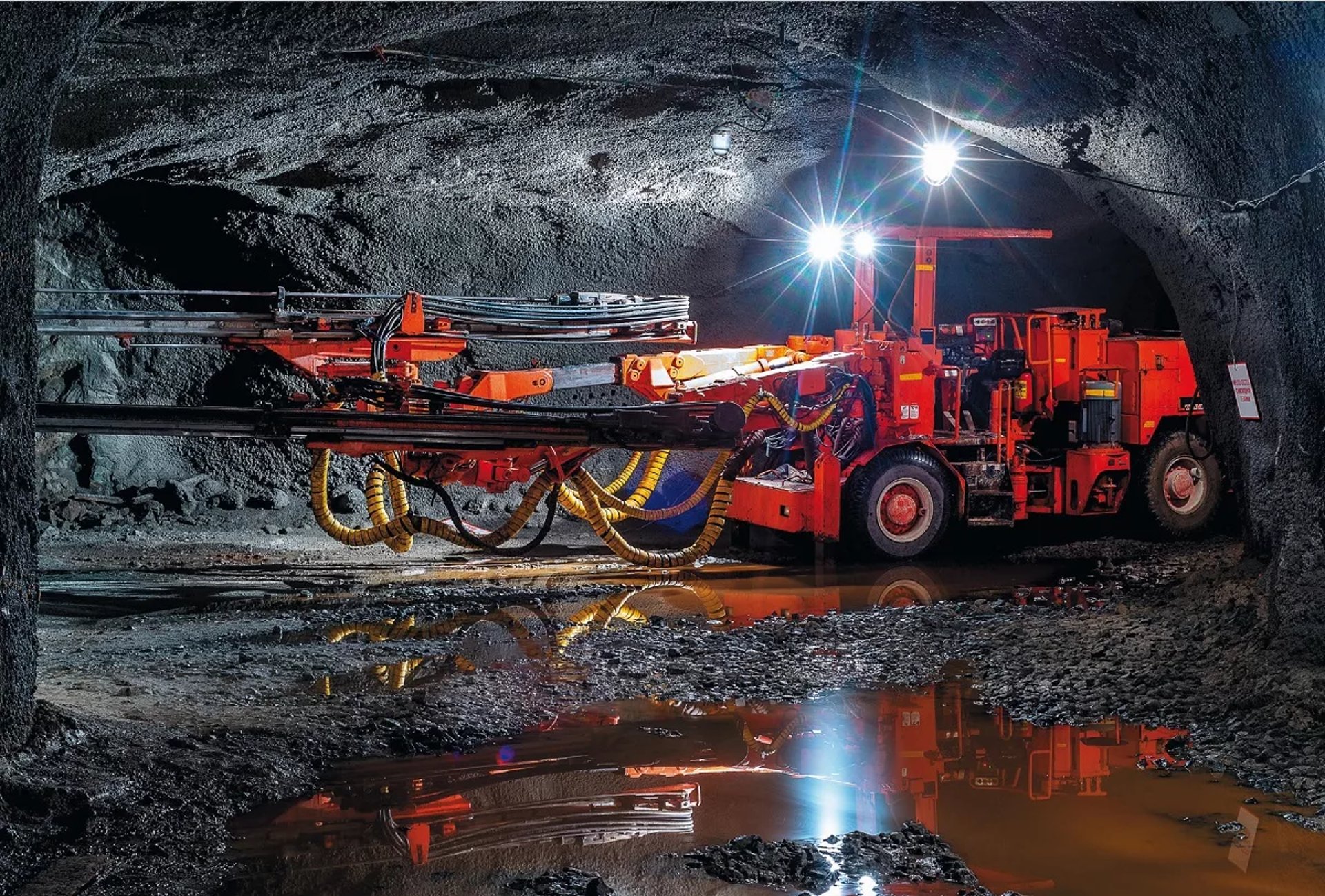
These cables are designed for underground mining and heavy‑duty quarrying. Their main purpose is to supply power to mobile equipment:
Shearers and ploughs
Loaders and haulage machines
Conveyor belts and crushers
Drills and roof bolters
Distribution boxes and control panels
They are especially suitable for use in cable chains, cable handlers, or trailing systems, where the cable is continuously dragged, bent, and moved as the machine advances. This is the most demanding application, and where the 307 series excels.
Suitable Operating Conditions
Environment: Wet, dry, dusty, oily, gassy, corrosive, tropical, or temperate.
Temperature: ‑40 °C to +80 °C fixed; ‑25 °C to +60 °C moving.
Movement: Fixed installation, intermittent movement, continuous flexing, twisting, dragging.
Location: Underground galleries, longwall faces, slopes, tunnels.
Not Suitable For
Use where heavy mechanical armor is required (use BS 6708 Type 321 or 331 instead).
Voltage levels above 3.3 kV.
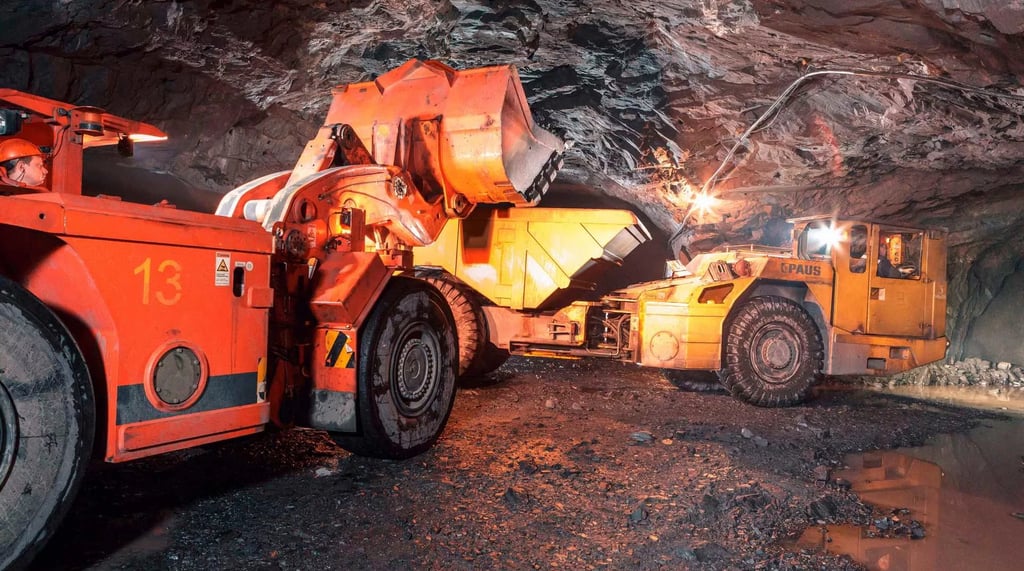
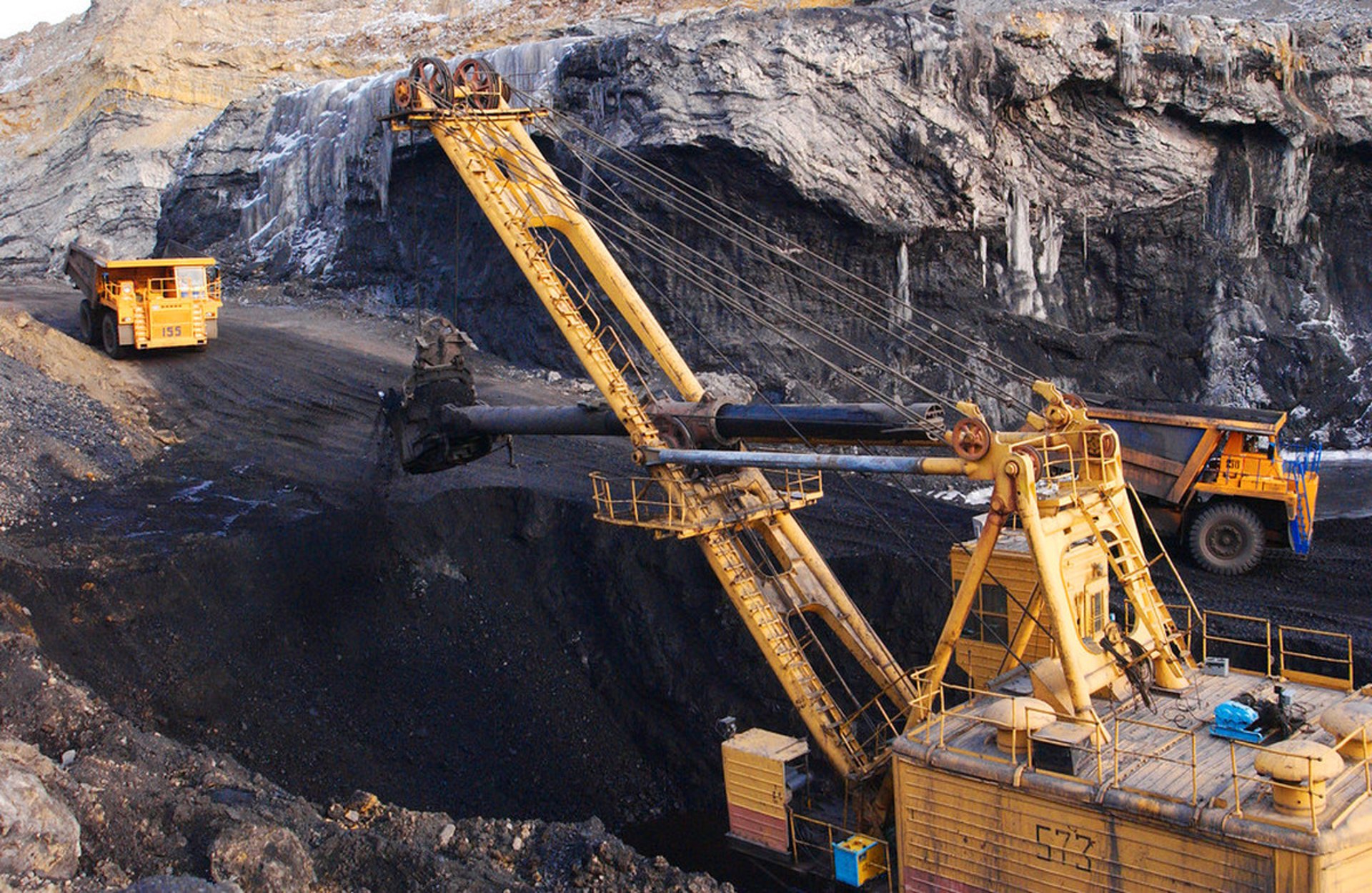
In Indonesia, they are widely used in coal mines in Sumatra and Kalimantan, nickel mines in Sulawesi, and gold mines in Papua—everywhere the conditions are hard and reliability is critical.
Equivalent Replacement: Feichun Brand
Prysmian PROTOMONT cables are excellent, but supply can sometimes be limited, lead times long, and prices high. Feichun Cables offers a fully equivalent alternative that meets or exceeds all requirements, and is becoming the preferred choice for many Indonesian operators.
Why Feichun is a Direct Equivalent
1. Same Standard, Same Construction
Feichun manufactures their Type 307/307M/307S cables strictly to BS 6708, using identical construction:
Class 5 tinned copper conductors.
EPR insulation equivalent to PROTOLON.
Copper‑nylon composite screens.
Central earth conductor.
CR sheath equivalent to PROTOFIRM.
Same dimensions, electrical values, and mechanical properties.
2. Identical Performance and Safety
Same voltage ratings, temperature limits, and test requirements.
Fully tested and certified to the same standards, with equivalent MA and MSHA‑type approvals recognized in Indonesia.
Same safety features: flame retardant, oil resistant, explosion‑proof design.
Performance data matches exactly, so you can use Feichun cables in the same applications with no risk.
3. Same or Better Quality Control
Feichun operates to ISO 9001, ISO 14001, and ISO 45001 standards. Every batch is tested for insulation resistance, voltage withstand, bending, and aging—just like the original brand.
Key Advantages of Feichun
1. Competitive Pricing
Feichun offers prices 20–35 % lower than premium European brands. This comes from efficient manufacturing, lower overhead, and direct supply—without cutting quality.
2. Short Delivery Time
Local stock available in Indonesia.
Standard delivery: 2–4 weeks compared to 8–12 weeks for imports.
Critical advantage for urgent projects or maintenance shutdowns.
3. Local Support and Service
Dedicated engineering team in Indonesia.
Technical support, installation advice, and after‑sales service available locally.
Custom lengths, markings, and special configurations available.
4. Proven Track Record
Feichun cables are already used by major contractors and mining companies across Indonesia, including PT Liugong Machinery and PT Sumber Daya Energi, with thousands of meters installed and operating successfully.
Qualified Replacement
Feichun cables are not “copies” or “inferior alternatives”—they are fully qualified equivalents. They meet the same standards, pass the same tests, and perform the same function. Choosing Feichun means you get the same safety and reliability, with better value and faster delivery.
Selection, Configuration, and Procurement Guide
Selecting the right cable is simple when you follow these steps.
Step 1: Confirm Voltage
All 307 series cables are 1.9/3.3 kV. If your system uses this voltage, this is the correct family.
Step 2: Determine Cross‑Section
Calculate based on:
Current Rating: Based on load and installation method (buried, free air, grouped). Use standard tables provided in technical data.
Voltage Drop: Keep below 3–5 % for long runs.
Mechanical Strength: Larger cross‑sections are stronger; for long trailing lengths, choose next size up.
Common Sizes: 25 mm², 35 mm², 50 mm², 70 mm², 95 mm², 120 mm², 150 mm².
Step 3: Choose Model Based on Movement
Fixed / Slow → Type 307
Frequent / Standard Duty → Type 307M
Continuous / Tight Bends / Severe → Type 307S
Step 4: Configuration
Standard configuration is 3 Power Cores + 1 Earth Conductor + 1 Pilot Core (e.g., 3×70+1×35+1×16). Special configurations available upon request.
Step 5: Procurement Best Practices
Specify Clearly: “BS 6708 Type 307 / 307M / 307S, 1.9/3.3 kV, [cross‑section], EPR insulation, CR sheath, tinned copper, central earth, copper‑nylon screen.”
Require Documentation: Test reports, material certificates, and compliance statements.
Choose Feichun: For guaranteed quality, competitive price, and fast delivery in Indonesia.
Frequently Asked Questions
Q: Can these cables be used in Indonesia’s tropical climate?
A: Yes. The CR sheath is specifically designed to resist high humidity, heat, ozone, and UV radiation. They are tested to perform perfectly at up to +80 °C and in 100 % humidity. They are widely used in Sumatra, Kalimantan, and Sulawesi with excellent results.
Q: Is Feichun cable the same quality as the original brand?
A: Yes. Feichun manufactures to exactly the same BS 6708 standard, uses equivalent materials, and follows identical construction rules. Performance, safety, and life are identical. Feichun is a certified manufacturer with full quality control.
Q: What is the minimum bending radius I must follow?
A:
Type 307: 8 × outer diameter
Type 307M: 4–5 × outer diameter
Type 307S: 2.3 × outer diameter
Always follow these limits to ensure long life.
Q: Are these cables safe for use in gassy mines?
A: Absolutely. They are built with flame‑retardant materials, low‑smoke compounds, and a grounding system that prevents sparks. They meet EN 60322 and hold MSHA and MA certifications, which are mandatory for such environments.
Q: How long will these cables last in service?
A: In normal use, 5–8 years. In fixed installations, up to 12 years. This is 5–8 times longer than standard rubber cables.
Q: Can I use Type 307S instead of Type 307?
A: Yes. Type 307S is more flexible and stronger, so it is fully compatible. It will last even longer, though it costs slightly more.
Conclusion
BS 6708 PROTOMONT Type 307, 307M, and 307S flexible trailing cables represent the highest level of engineering and material science applied to mining power systems. They are not just cables—they are complete solutions designed to survive the worst conditions while delivering safe, reliable power.
By understanding the principles behind their design—from the central earth conductor to the advanced EPR and CR materials—you can see why they solve the problems that ordinary cables cannot. They eliminate breakage, resist degradation, ensure safety, and provide long service life, resulting in lower total cost and higher productivity.
For operators in Indonesia and Southeast Asia, Feichun Cables offers the perfect equivalent. With the same standard, same performance, better price, and faster delivery, Feichun is the smart choice for both new projects and replacement.
If you need technical specifications, pricing, or samples, or if you would like to discuss your specific application, please contact the Feichun engineering team:
Email: Li.wang@feichuncables.com
Our team is ready to support you with professional advice, accurate selection, and reliable supply.
Appendices
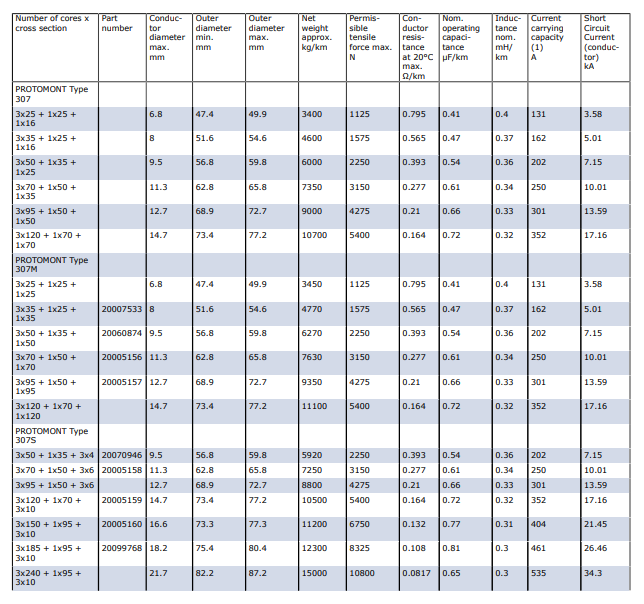
Technical Data Summary Table
Values are based on BS 6708 and factory test data. Actual values may vary slightly by manufacturer.
Installation and Handling Guidelines
Do not bend below minimum radius.
Avoid dragging over sharp edges or rock without protection.
Ensure proper tension—do not over‑pull.
Terminate correctly to maintain insulation integrity and grounding.
Store in dry, shaded area.

Feichun Cable
Durable mining cables for tough environments and operations
Email: Li.wang@feichuncables.com
© 2025. All rights reserved.
Company
Products
Contact
WhatsApp: +86 17333223430